
Download 18 FREE Maritime eBooks
What are Margin Lines in Ships?
Damage stability is a very important topic encompassing any form of discourse related to vessel design.
The subject of damage is quite diverse and studies the possible ways of sinkage and subsequent hull loss in the event of physical damage that leads to the ingress of water into the watertight space of the buoyant main hull volume.
Damage stability can be studied broadly using two methods:
i) Deterministic and
ii) Probabilistic.
Deterministic methods are more commonly used, and they include the traditional assessment and analytical methods in studying the stability characteristics of the vessel under different extents or conditions of flooding due to damage.

The probabilistic methods use advanced techniques of assessing the vessel’s chance of survival using probability indices and factors depending on the vessel type and the capacities and taking into account all plausible damage cases.
As per regulations, all dry cargo ships of 80 m and above, along with all passenger vessels built after 2009, will be designed based on probabilistic approaches.
For all practical purposes, the most critical concern for a vessel’s seaworthiness and safety under risk is the aspect of main deck sinkage.
The main deck, as we know, is the uppermost limit of the main hull that is usually exposed to the weather. It is also known as the strength or the bulkhead deck.
Since the main hull of any floating surface vessel is responsible for buoyancy and flotation, so when the water level reaches the main deck, this is the ‘limiting case of sinkage’.
In other words, when the main deck starts going below this level, or the main hull is completely submerged underwater, the buoyancy is said to be lost, and the vessel sinks completely.
Submarines and underwater vehicles, which follow a different physics of operation, are outside this realm.
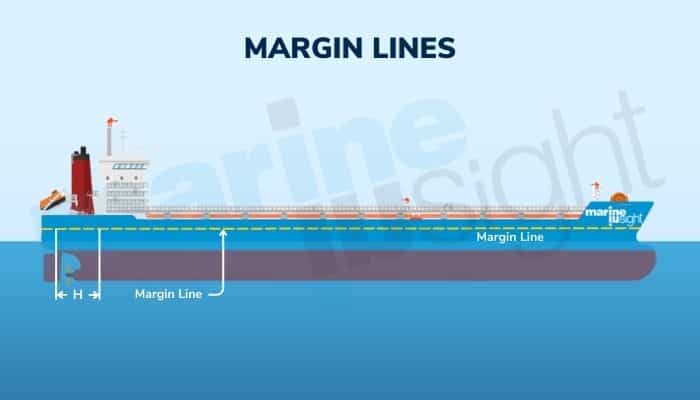
Hence, the main deck level is considered the ‘ultimate limit’ for the safety or intactness of any vessel under any form of conditions.
Now, for any kind of limiting situation, it is always better to keep a margin of safety. For example, for a material, the strength is always first described as the allowable strength and then the ultimate strength, defined as the maximum strength-bearing capacity of the vessel beyond which the material fails.
So, all loads acting on the material or body should always be permissible within the allowable limit instead of the ultimate for safety purposes. The ratio of the ultimate and the allowable or permissible values in real-world cases is known as the factor of safety.
Similarly, per the rules and guidelines of IMO and other authorities, the safety limit value for deck sinkage under intact and damaged conditions should include a factor or margin instead of the extreme limit of the main deck. This is known as the margin line.
In other words, a margin line can also be defined as an imaginary line or level below the actual level of the main deck that can be considered equivalent to a deck immersion case.
That is, when the vessel suffers damage and starts sinking, or due to some other factors, there is a loss in stability, the maximum level that can be taken as the limiting value for deck immersion should be somewhat even lower than the actual deck level value, called the margin line.
For example, suppose a vessel has a depth of 5 metres from the baseline. The margin line can be considered at a height of 4.24 metres above the baseline. So, the margin of 76 mm or 7.6 cm between these two values is the factor or margin of safety considered.
For all practical purposes, 76 mm is the universally accepted value for most ships at which the margin line is considered below the actual main deck level. However, it is not always so.
This depends on the sheer and the construction of the main deck.
What is sheer remember? Sheer is the vertical rise of the main deck level from the average value, usually at the forward and aft ends.
According to detailed guidelines and regulations, the value of this margin can vary as follows:
- When the average value of sheer at the aft and forward perpendiculars is 30.5 cm and above, the value of the margin line is taken as 76 mm or 7.6 cm below the maximum main deck line and parallel to it.
- When the average value of sheer at the aft and forward perpendiculars is 15.2 cm: The value of the margin line is taken as 152 mm or 15.2 cm below the maximum main deck line and parallel to it.
- When the average value of sheer at the aft and forward perpendiculars is 0 (the vessel has no sheer and a flat deck): The value of the margin line is taken as 228 mm or 22.8 cm below the maximum main deck line and parallel to it.
For all other intermediate values of sheer, the margin line is obtained by interpolation. What can you generally observe from these values?
As you can see, the higher the extent of the deck sheer, the lower the margin taken and vice-versa. Why?
Because, for decks having an inherent sheer construction, the geometry of the elevation itself accounts for this safety margin, as expected.
For sheerless decks, the factor of safety needs to be increased as there is no added elevation to cater to this margin.
For every point on the strength deck, the margin line is always considered parallel to the deck line.
You might also like to read-
- The Design Of Modern Ship Masts – A Quick Overview
- What is a Skeg in a Vessel?
- Understanding Working of Hovercrafts
- Types of Sailboats – A Comprehensive Classification
- What Do You Understand By Prow Of A Ship?
Disclaimer :
The information on this website is for general purposes only. While efforts are made to ensure accuracy, we make no warranties of any kind regarding completeness, reliability, or suitability. Any reliance you place on such information is at your own risk. We are not liable for any loss or damage arising from the use of this website.



About Author
Subhodeep is a Graduate of Naval Architecture and Ocean Engineering. He has deep interest in marine structures and goal-based design aspects, and is dedicated to sharing and propagating technical knowledge of the industry.
Disclaimer :
The information on this website is for general purposes only. While efforts are made to ensure accuracy, we make no warranties of any kind regarding completeness, reliability, or suitability. Any reliance you place on such information is at your own risk. We are not liable for any loss or damage arising from the use of this website.
Related Articles
⚓️ Enhance Your Knowledge. Prevent Accidents. Stay Safe at Sea.
1. eBooks for Engine Department
Master machinery operations, troubleshooting, and safety procedures with expertly written guides tailored for marine engineers. Prevent costly breakdowns and onboard accidents through practical knowledge.
👉 Explore Engine Department eBooks
2. eBooks for Deck Department
Sharpen your seamanship, navigation, and cargo-handling skills with real-world case studies and practical insights designed for deck officers and cadets.
👉Discover Deck Department eBooks
3. eBooks on Electrical Fundamentals & Issues
Understand marine electrical systems, identify potential faults, and prevent onboard electrical failures with step-by-step explanations from industry experts.
4. Pocket Guides for Quick Reference
Compact, handy, and loaded with essential checklists—perfect for on-the-go reference during operations and emergencies at sea.
5. Combo Packs to Save Big
Access multiple expert eBooks at discounted prices. Ideal for professionals seeking complete safety and operational knowledge across various ship departments.
6. Digital Maritime Courses – Learn at Your Own Pace
Upgrade your competence with Marine Insight Academy’s online courses. Learn from industry professionals anytime, anywhere, and become a safer, smarter seafarer.
Subscribe To Our Daily Newsletter
By subscribing, you agree to our Privacy Policy and may receive occasional deal communications; you can unsubscribe anytime.

BE THE FIRST TO COMMENT