
10 Things About Merchant Navy You Must Know
The merchant navy is the driving force of the world economy, yet it is often misunderstood by the public, most of whom confuse it with the military. In contrast, others envy seafarers for living a life of adventure and endless travel to new places around the world. However, most of it is not true. The reality is very different, and in this article, I will discuss 10 things about merchant navy you must know.
It is not just a job; it is an all-encompassing lifestyle that demands a specific temperament.

1. It is Commerce, Not Combat
As mentioned above, the majority confuses the merchant navy with a country’s defence navy. While both share similar hierarchical structures, uniforms, and a disciplined environment, the core objectives of both are completely different.
The Merchant Navy enables the world to conduct trade via oceans and seas. Seafarers are civilians manning different types of ships like oil tankers, container ships, bulk carriers, cargo ships, etc, which help transport 90% of the world’s commodities. Seafarers have to fight harsh weather conditions, focus on logistics, battle tight schedules and maintain calm in difficult situations like pirate attacks.
On the other hand, the defence navy protects a country’s territorial borders, preventing the nation’s enemies from entering via seaways. It has warships like destroyers, aircraft carriers, frigates, patrol ships, etc.
2. The “Travel the World” Myth Has Changed
Thirty years ago, a ship might have spent a couple of days at port so crew members could explore the city and buy whatever they wanted. However, that has changed considerably now.
Modern Shipping has become efficient and fast with rapid turnaround times for vessels. For instance, a massive container ship might arrive and berth at a port in Singapore, unload cargo and then reload another cargo in just 17 to 18 hours.
It would be back at sea before crew members can even step out to buy a souvenir. Additionally, most modern ports are industrial centres often located outside the main cities. So a seafarer visits different places and countries without actually enjoying or spending time there.
Seafarers do see new places, but often through a porthole or from a terminal jetty.
3. The Remuneration is High, But It’s actually Compensation
Merchant navy officers indeed earn significantly higher salaries than most of their shore-based peers, often tax-free depending on their country’s regulations. This financial allure is a major draw for young cadets.
However, seasoned seafarers view this not just as a salary but as compensation for what is sacrificed. They are paid for missing birthdays, weddings, and festivals. They are compensated for the isolation, the irregular sleep patterns, and the inability to just “go home” at the end of the day.
Under the Maritime Labour Convention (MLC, 2006) and its critical 2025 amendments, seafarers now have strengthened rights regarding repatriation, social protection, and the right to shore leave without discrimination.
The high salary is legally balanced by the shipowner’s obligation to provide quality food, medical care, and guaranteed passage home, ensuring that financial rewards are backed by human rights.
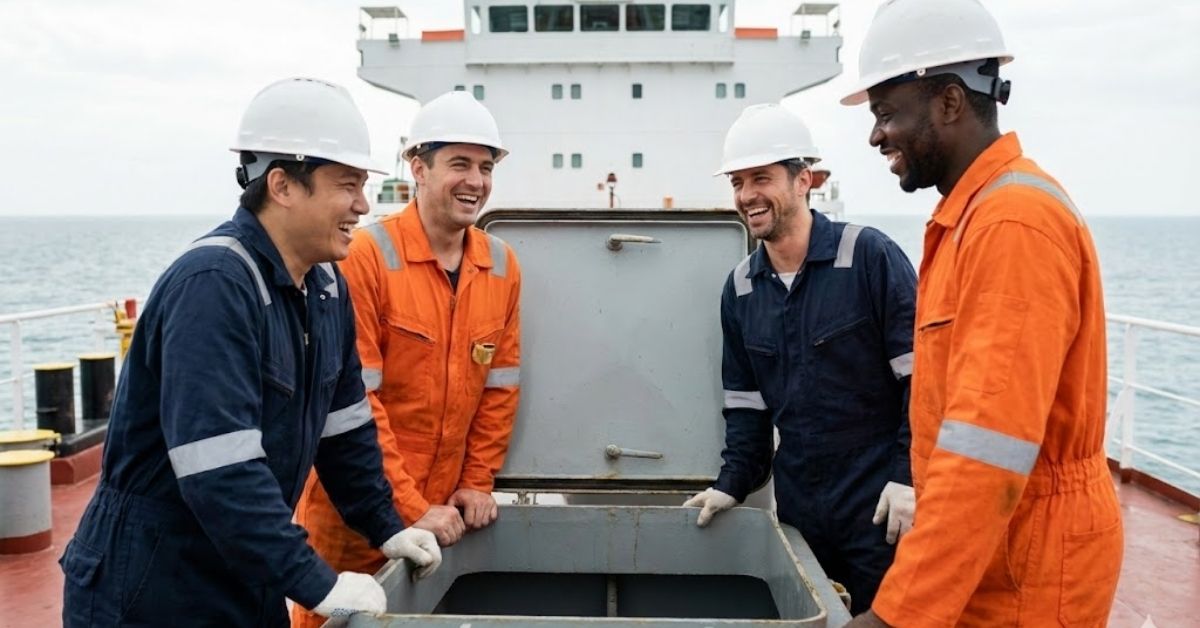
4. Merchant Navy is the Ultimate Multicultural Workplace
Long before “diversity and inclusion” became corporate buzzwords ashore, merchant ships were practising it daily.
A typical crew of 20 can consist of five or six different nationalities, specialising in different departments, all living and working as a team.
Seafarers know that competence knows no nationality. They learn to navigate cultural nuances, dietary differences, and language barriers to ensure the safe operation of the vessel.
This fosters an incredible adaptability and global perspective that few other industries or jobs can offer.
5. Mental Resilience Outweighs Physical Strength
Historically, seafaring was associated with brute physical labour. While it remains physically demanding, especially for crew on deck or in the engine room, modern shipping is increasingly cognitive.
The real challenge today is mental resilience. Months of isolation away from family, coupled with the pressure of managing multimillion-dollar assets in hazardous environments, takes a toll.
The ability to manage stress, combat loneliness, and maintain a stable temperament is now far more critical than how much weight you can lift. The industry is finally waking up to the importance of mental health support for seafarers.
However, new technological breakthroughs like the integration of LEO (Low Earth Orbit) satellites like Starlink have revolutionised connectivity, allowing seafarers to video call home daily.
While this reduces isolation, it creates a new challenge: the “digital cabin” effect. Staying mentally resilient now means finding a balance between staying connected to home and staying engaged with the crew on board to prevent social isolation and “connectivity fatigue.”
6. Seafarers Are the Invisible Backbone of Your Life
Look around the room you are sitting in. The phone in your hand, the coffee in your mug, the chair you are sitting on, and the fuel in your car; almost everything was, at some point, cargo on a merchant vessel.
The world relies on the “just-in-time” delivery model. If merchant shipping stopped for just a week, global supply chains would snap, shelves would empty, and factories would grind to a halt. Working in this industry provides a profound sense of purpose; you know that you are directly keeping the wheels of the modern world turning.
7. The Regulatory Burden is Not Just About Safety
For stakeholders and decision-makers entering this space, the sheer volume of regulation can be shocking. Shipping is one of the most heavily regulated industries on the planet, governed by international bodies like the IMO (International Maritime Organisation).
Today’s ship officers spend almost as much time on paperwork and compliance as they do on actual navigation or engineering. From environmental regulations (like MARPOL) to safety standards (SOLAS) and security protocols (ISPS), the administrative load is intense. A single misplaced document can detain a ship, costing shipping companies tens of thousands of dollars a day.
As of 2025, the IMO’s Net-Zero Framework has introduced mandatory Greenhouse Gas Fuel Intensity (GFI) targets. Ships must now reduce their carbon and methane emissions, transitioning to “green” fuels like ammonia or methanol. For professionals, this means a steep learning curve in managing new propulsion technologies and environmental compliance records that are scrutinised by global authorities.
8. The Rise of “Smart Shipping” and AI
The image of an old sea captain squinting at a sextant is ancient history. The bridge of a modern merchant vessel looks more like the cockpit of a spacecraft, filled with ECDIS (electronic charts), radar, AIS, and satellite communication systems.
We are currently in the era of “Smart Shipping,” where data from the ship is analysed in real-time by shore-based offices. This shift means that modern officers must be as proficient with software and data analytics as they are with traditional seamanship.
The seafarer of tomorrow will need to be part-navigator, part-IT specialist, and part-data analyst.

9. A Life at Sea Often Leads to a Career Ashore
Many aspiring cadets worry that choosing the merchant navy means locking themselves into a life at sea forever. This is false. A sea career is often a foundational stepping stone.
The experience gained at sea from crisis management, leadership under pressure, and technical expertise is highly valued ashore. Ex-seafarers transition into roles like marine superintendents, harbour masters, maritime lawyers, insurance brokers, and logistics directors. You don’t “quit” the sea; you leverage the experience for the next chapter.
10. The Camaraderie is Unmatched
There is a unique bond forged when people face the raw elements of the ocean together. When you are thousands of miles from land, battling a North Atlantic storm, the crew becomes your family. You rely on each other for survival in a way that is rarely replicated in office environments.
The friendships made on board are often deeper and longer-lasting than those made ashore. Despite the hardships, most old salts look back on their time at sea with a profound sense of nostalgia for that shared sense of duty and brotherhood.
Conclusion
The merchant navy is not for everyone. It requires a specific blend of professional discipline, technical aptitude, and emotional durability. It is a life of extreme highs and challenging lows.
Whether you are an aspiring cadet weighing your future or an industry stakeholder looking to understand the human element of shipping, knowing these realities is essential. To understand the merchant navy is to understand the complex, demanding, and vital human effort that keeps the global economy afloat. It is a tough profession, but for those suited to it, it is incredibly rewarding.
You might also like to read-
- All You Need To Know About Merchant Navy Entrance Exams
- 10 Best Companies For Sponsorship In the Merchant Navy
- How Females Can Join Merchant Navy ?
- 4 Ways To Become A Deck Officer in Merchant Navy
Disclaimer :
The information on this website is for general purposes only. While efforts are made to ensure accuracy, we make no warranties of any kind regarding completeness, reliability, or suitability. Any reliance you place on such information is at your own risk. We are not liable for any loss or damage arising from the use of this website.


Disclaimer :
The information on this website is for general purposes only. While efforts are made to ensure accuracy, we make no warranties of any kind regarding completeness, reliability, or suitability. Any reliance you place on such information is at your own risk. We are not liable for any loss or damage arising from the use of this website.

About Author
Raunek Kantharia is a marine engineer turned maritime writer and entrepreneur. After a brief stint at the sea, he founded Marine Insight in 2010. Apart from managing Marine Insight, he also writes for a number of maritime magazines and websites.
Related Articles



Subscribe To Our Daily Newsletter
By subscribing, you agree to our Privacy Policy you can unsubscribe anytime.


