What a Container Actually Costs You: Inside the Terminal’s Cost Puzzle
When a shipping container starts its journey, it passes through various stages, with different parties handling it for different reasons. That is why, in a single journey, the container is invoiced multiple times at different events of the supply chain.
However, when each charge is logged and tracked separately, it becomes difficult and cumbersome to consolidate everything for better decision-making and a smoother cargo transportation process.
Most terminals are struggling to stitch these invoices together as they are governed by separate tariff sheets and customer contracts, leading to manual processing and delays where a proper connected data system can do the trick.
Different charges involved in a single container move:
- Gate charges: These are the charges from the port terminal as the truck entry and exit fees for carrying the container.
- Weighing charges: When a container enters a terminal, it needs to be checked against the declared weight. This process is done in a weighbridge, for which a fee is charged. The fee structure may vary depending on the customer contract or container type.
- Container Storage charges: Every container terminal has a complimentary container storage timeline (usually 3-7 days) beyond which the terminal operator will start charging the storage fee against the container. This fee is different from the demurrage charges.
- Equipment charges: Every port or terminal uses specialised equipment at various stages, such as quay cranes, RTM cranes, forklifts, and stackers, etc. to handle the shipping container, for which the port operator charges a fee which depends on the port tariff structure.
- Demurrage: When a container’s free time inside the terminal expires, it is charged by the shipping line as per the shipping line tariff. This fee is usually implemented on a tiered structure where the fee increases more for a longer container stay in the terminal.
- Detention: These are the charges imposed by the shipping line when the container is idling outside the port or terminal beyond the provided free time limit.
- Damage and repair cost: A container is a heavy transportation unit meant to go through various modes of transport, including rail, road and sea. During the process of handling, shifting or transportation, the container may get damaged, and the shipping line or container operator will ask for a fee against it.
Now for a single container, these are multiple cost triggers, which have their own data source and invoicing rules. Each of these single charges is pretty simple and by the book. However, the terminal handles thousands of containers in a month, and when every single container move carries these scattered charges, this makes the terminal billing cycle complicated and time-consuming.
The terminal operator billing dilemma:
Imagine a container entering the terminal and having a weighing discrepancy. This will incur some time at the weighing station to process. Now the same container is sitting longer than the specified free terminal allotted time, which can vary from 3 to 7 days. The demurrage charges also increase exponentially if the container sits idle for more time.
Now, when this container is shipped to the next port, it is taken out by the truck, incurring gate-out charges. After that, the empty container reaches the shipping line after the allotted free time, which again may vary from 3-5 days.
When we consolidate all these additional charges, we need to factor in the cost incurred after the free time limit, the slab or tiered structure for some activities, fees due to discrepancies in weight or information, customs charges, and on op of that this container will go to different ports which have their own tariff structures.
Many of these processes are logged manually, which requires humans not to make a wrong entry. A small mistake in any number (price, weight, volume, etc.) will change the entire calculation this container incurs during its journey.
As these are separate activities performed by different departments, if they are not connected and not talking to each other digitally, then the process becomes more complicated and heavily human-dependent.
The Compliance Issue:
As per the U.S. Federal Maritime Commission rule 46 CFR Part 541, the demurrage and detention charges are regulated by the correct billing and invoicing activities and dispute resolution.
Every fee should include specific and verified information, including
- Container number
- Bill of lading
- Information about the ports
- Exact dates
- Free time
- Tariff structure
- Amount due
- Dispute methods
The carrier and terminal operator usually have 30 calendar days to issue all the invoices after the applicable fees, and the billed party will also have 30 calendar days to dispute them. When even a single piece of information is missed or entered incorrectly across disconnected logs and spreadsheets, it will lead to a failure in compliance of the due that eventually becomes disputed.
Connected Operations with billing
To comply and make the cumulative billing process efficient, the first step is to tie all the separate processes together automatically from the time a single event is created.
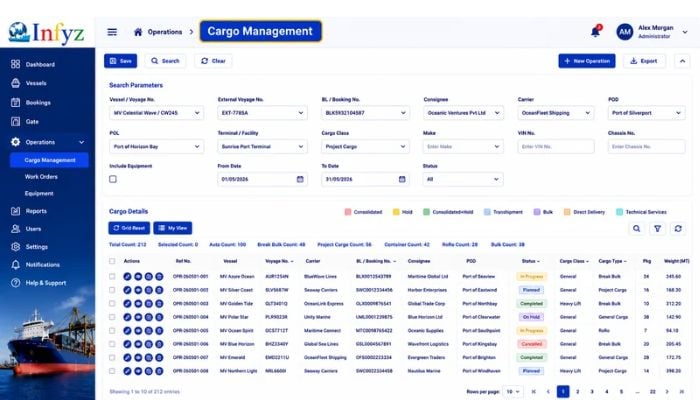
Software like iTOMS not only maps these events against its own predefined tariff, they also provide the exact time in the yard, calculates the charges, and integrates them with the ERP, providing a positive impact on the business with billing accuracy, revenue capture, and customer transparency.
How Infyz Addresses these Challenges
The above challenges can be addressed through Infyz’s proven Terminal Operating System (iTOMS), which offers flexible contract rating, automated calculation logic and integrated billing capabilities designed to align with the diverse workflows of modern terminal operations.
Contract Rating
- Unified Contract Repository: Automatically maps customer-specific rate sheets, Volume-Based Discounts (VBDs), and tier privileges directly to each container record.
- Flexible Free-Time Matrix: Manages custom free-time allowances based on container specs (reefer, hazardous, dry, oversized) and account status.
- Multi-Party Split Rules: Pre-defines rules-based allocation to automatically bill the correct party—shipping lines, cargo owners, or truckers.
Calculation Logic
- Precision Dwell Tracking: Calculates dwell time down to the minute from the exact Gate-In or Vessel Discharge timestamp.
- Automated Tiered Slabs: Executes progressive step-rate math (e.g., Days 1–3 free, Days 4–7 Rate A, Day 8+ Rate B) without manual intervention.
- Discrepancy & Ancillary Surcharges: Automatically applies fees for weight discrepancies, extra yard shifts, reefer monitoring, and damage repairs.
- FMC Compliance Auto-Match: Verifies mandatory fields (Container ID, B/L, timestamps, free time, tariff refs) against event logs to prevent billing disputes under FMC
Billing Capabilities
- Event-Driven Capture: Logs billable events in real time across all physical movements (crane lifts, gate passes, weighbridge scans).
- Consolidated Pro-Forma Invoices: Stitches all cost triggers into a single itemized statement for fast, one-click review.
- Two-Way ERP Sync: Direct integration with platforms like SAP, Oracle, and MS Dynamics for instant revenue posting and gate-out credit checks.
You might also like to read-
- Port Automation: The Reality Nobody Tells You
- The $6.9 Billion Cost of Non-Automated Port Operations: Why Delays Are Becoming More Expensive
- Why Modern Terminals Are Replacing Legacy Software with AI?
- What Can Operators Expect From a Modern Terminal Operating System (TOS) ?
- Small Ports Don’t Need Rotterdam’s Budget To Automate – Here’s What They’re Doing Instead
- Inside the Terminal’s Digital Twin: What Real-Time Yard Visibility Looks Like
Disclaimer :
The information on this website is for general purposes only. While efforts are made to ensure accuracy, we make no warranties of any kind regarding completeness, reliability, or suitability. Any reliance you place on such information is at your own risk. We are not liable for any loss or damage arising from the use of this website.

About Author
Founded in 2007 and headquartered in Hyderabad, India, Infyz Solutions is a premier technology company specialising in cloud-native and AI-enabled software solutions for the ports, shipping, and logistics industries. With nearly two decades of domain excellence, Infyz empowers terminal operators and logistics providers worldwide through its flagship suite of enterprise products, including iTOMS (Terminal Operations Management System), iNauka (Maritime & Shipping Operations), iVBS (Vehicle Booking System), iEPS (Equipment Processing System), iDepot (Container Depot Management System) and iCLMS (Cargo Logistics Management System).


Disclaimer :
The information on this website is for general purposes only. While efforts are made to ensure accuracy, we make no warranties of any kind regarding completeness, reliability, or suitability. Any reliance you place on such information is at your own risk. We are not liable for any loss or damage arising from the use of this website.
Subscribe To Our Daily Newsletter
By subscribing, you agree to our Privacy Policy you can unsubscribe anytime.