
Dwell Time: The Hidden Cost Inside A RoRo Terminal
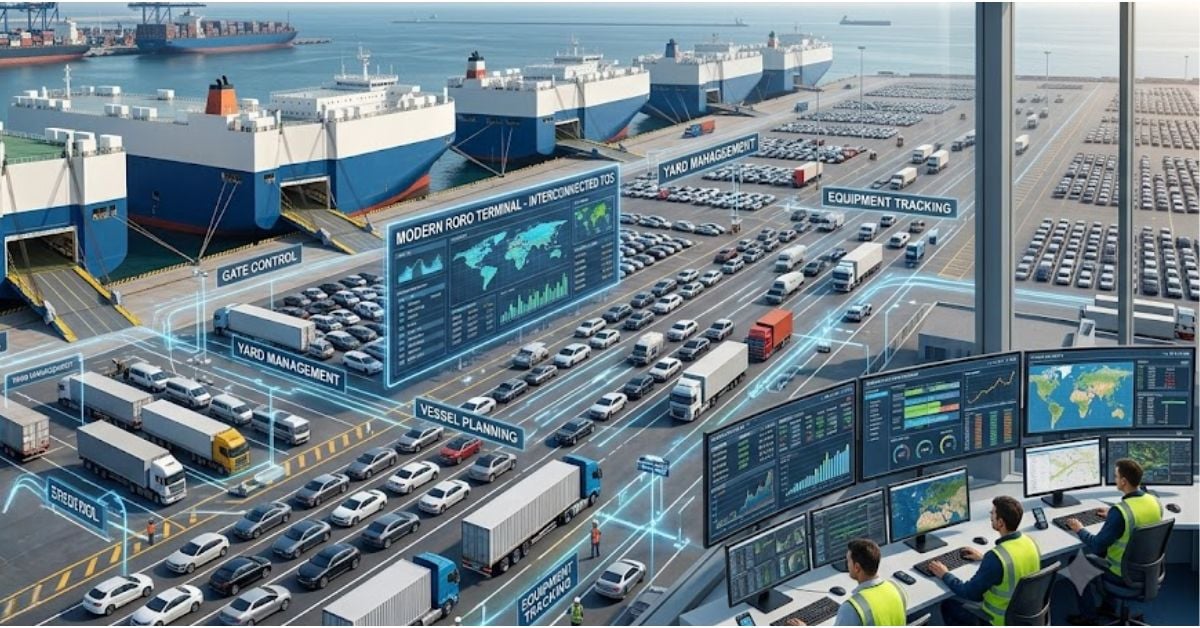
For most cargo terminals, available land and storage capacity play a major role in determining how much cargo a terminal can handle. In a container terminal, containers can be stacked vertically, while bulk cargo can often be stored in piles.
A RoRo terminal is different. Every vehicle requires a dedicated parking position, which means the effective capacity of the terminal is closely linked to how quickly vehicles move through the facility and how long they occupy valuable yard space.
This makes dwell time one of the most important, yet often overlooked, factors affecting RoRo terminal capacity and efficiency.
Recent industry reports have highlighted how European automotive ports experienced increasing pressure from slower vehicle rotation and longer storage periods, even when overall vehicle volumes declined. This demonstrates an important point: throughput alone does not tell the complete story of terminal performance.
A study by Automotive Logistics found that even though the cargo handled by the majority of European car ports in 2025 is less than what was handled in 2024, the congestion issues faced by the terminal were still more. In major ports like Zeebrugge, the newly imported cars were sitting in the port for more than 12 months, significantly taking up the critical space of the terminal.
What is Dwell Time in a RoRo Terminal?
In a RoRo terminal, dwell time refers to the period a vehicle remains within the terminal between entering the facility and leaving for its next destination. For export vehicles, this may begin when the vehicle enters the terminal and end when it is loaded onto a vessel.
For imported vehicles, it generally starts when the vehicle is discharged from the vessel and ends when it leaves the terminal by truck, rail, or another mode of transport. The actual dwell period can range from days to weeks, and in some cases significantly longer, depending on inspection, processing, documentation, customer requirements, and inland transportation availability.
The key challenge is that every additional day a vehicle remains in the terminal consumes a physical parking position. A vessel may complete its loading or discharge operation efficiently, but if the vehicles remain in the yard awaiting inspection, processing, documentation, or onward transportation, the terminal’s available space continues to be occupied.
In other words:
Longer dwell time → occupied parking positions → reduced yard availability → increased congestion → lower effective terminal capacity.
The dwell time for a RoRo terminal is slightly longer than other port types when compared to the unit of the cargo, because it is tied to a single parking space, compared to container or bulk terminals where cargo can be stacked or piled.
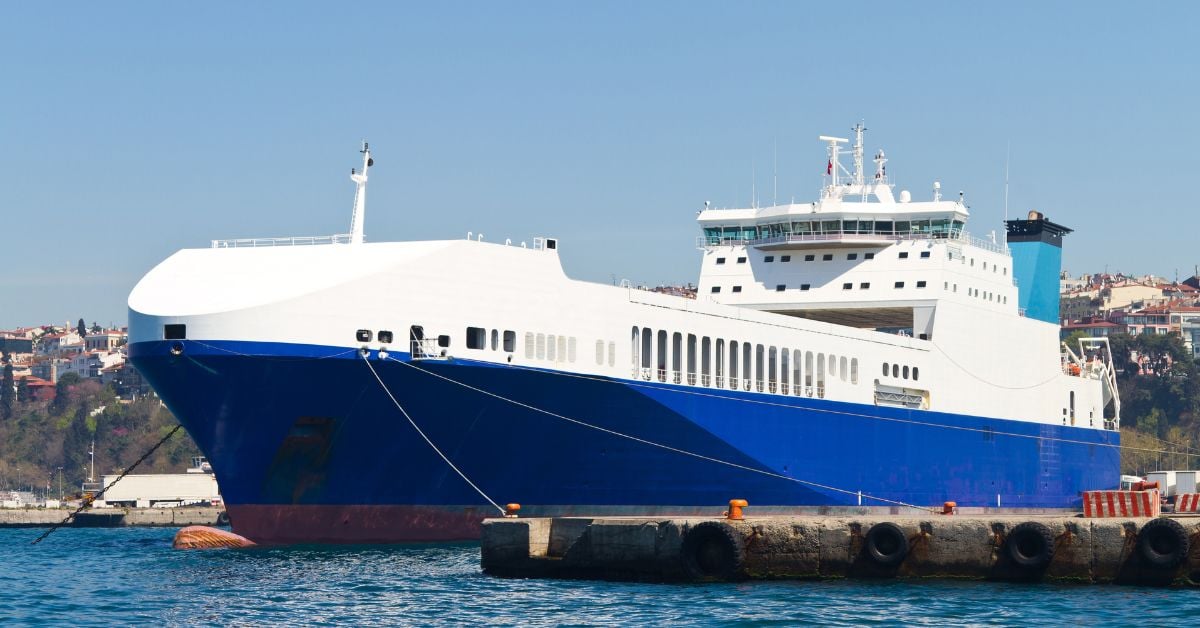
What adds to dwell time in a RORO Terminal
1. Vehicle Visibility and Traceability
RoRo terminals handle large volumes of vehicles moving between vessels, yards, processing areas, and gates.
If the exact location or status of a vehicle is not updated accurately, locating it can take additional time. Missed scans, manual records, or disconnected systems can make vehicle tracing difficult, particularly when the yard is operating at high utilisation.
Improving real-time vehicle visibility can therefore reduce unnecessary searching, additional movements and operational delays.
2. Surveys and Inspections
Vehicles may undergo inspections at multiple stages, including gate-in, processing, vessel loading and discharge.
A complete digital survey trail is important for recording vehicle condition, inspection results, photographs and exceptions. If inspection records are incomplete or difficult to retrieve, resolving discrepancies or claims can take additional time and potentially delay vehicle movement.
3. Processing Requirements
Vehicles arriving from manufacturing facilities may require additional processing before being released to their next destination. This can include pre-delivery inspection, accessory installation, software updates, charging, and other value-added services. When processing capacity or scheduling is not aligned with vehicle arrivals, vehicles remain in the terminal for longer and continue occupying valuable parking positions.
4. Onward Transportation
The movement of vehicles out of a RoRo terminal depends heavily on the availability and readiness of inland transportation.
Truck or rail availability, documentation, dealer schedules, customer requirements, and other supply-chain dependencies can delay vehicle evacuation. Even when the terminal itself is ready to release a vehicle, delays outside the terminal can increase overall dwell time.
5. EV-Specific Handling Requirements
The growing volume of electric vehicles is introducing additional operational considerations for RoRo terminals.
Battery-status monitoring, inspection procedures, charging requirements, designated storage areas, and appropriate safety protocols can require additional processes and controls. As EV volumes increase, terminals need the right processes, trained personnel, and digital visibility to manage these requirements efficiently without creating unnecessary delays.
How Can RoRo Terminals Reduce Dwell Time?
Reducing dwell time starts with understanding where time is being added to the vehicle journey. A terminal needs visibility across the complete operational flow, from gate-in and vessel discharge to yard movement, inspection, processing, and final gate-out.
1. Integrated Yard and Vehicle Planning
Yard planning, vehicle movement, and transportation schedules should work together. When vehicle locations, available parking positions, vessel schedules, processing activities, and outbound transportation are connected, terminal operators can make better decisions about where vehicles should be positioned and when they should be moved. This can reduce unnecessary internal movements and help release parking capacity faster.
2. Measuring Dwell, Not Just Throughput
A terminal may process a high number of vehicles and still experience operational pressure if vehicles remain in the yard for too long. Therefore, operators should monitor metrics such as:
- Average vehicle dwell time
- Yard occupancy
- Vehicle ageing
- Time spent in processing
- Inspection completion time
- Gate turnaround time
- Vehicle evacuation time
- Internal movement frequency
These metrics provide a more complete picture of terminal performance than throughput alone.
How Technology Can Help
A modern RoRo Terminal Operating System should connect the different stages of the vehicle journey rather than treating each operation as a separate process. Infyz iTOMS supports RoRo terminal operations by providing an integrated platform for vehicle processing, gate operations, yard management, inventory visibility, inspections, planning, and vessel-related activities.
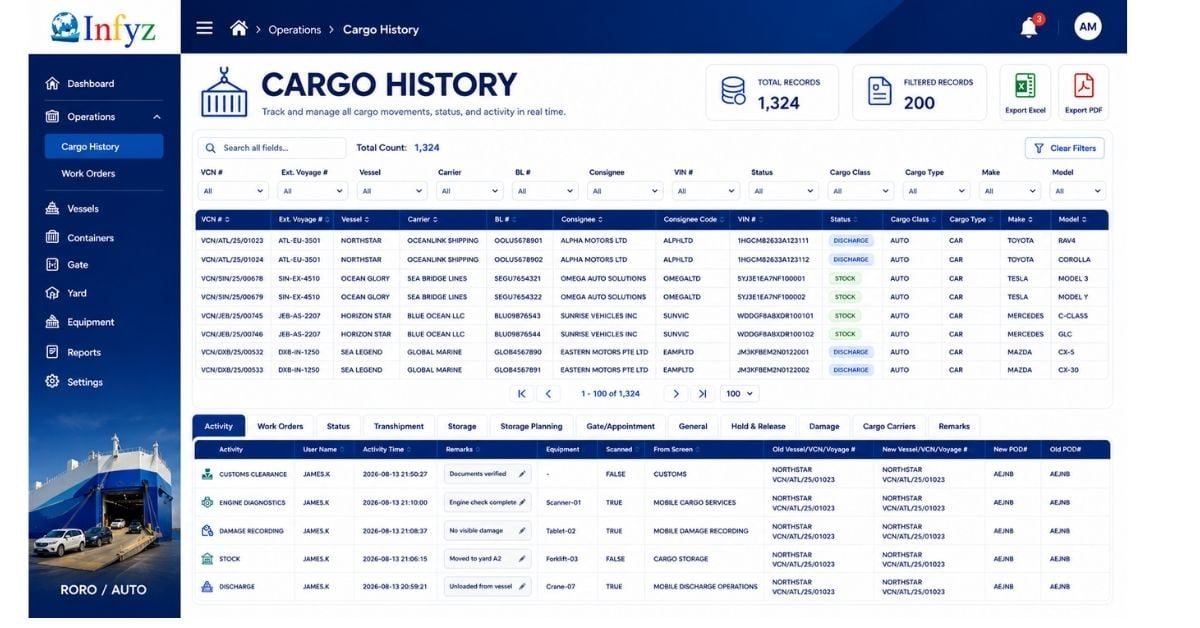
Through integration with vehicle processing solutions such as iEPS, the platform can help create a connected operational flow from vehicle entry and processing through yard tracking and vessel loading. The objective is not simply to digitise individual processes, but to provide end-to-end visibility of where every vehicle is, what stage it is in, what needs to happen next, and where operational delays are occurring.
A smart RoRo terminal should be able to connect its different operational systems while still allowing individual processes to be managed independently when required. This enables terminal operators to address specific operational bottlenecks without disrupting the wider supply chain.
Turning Dwell Time into Operational Visibility
Dwell time is not simply a measure of how long a vehicle stays inside a terminal. It is an indicator of how effectively the terminal is using its available space, resources, and processes. When vehicle movements, yard planning, inspections, processing, and inland transportation are connected, operators can identify where dwell is accumulating and take corrective action before it becomes a capacity constraint.
A RoRo terminal cannot always control every factor that contributes to dwell time. However, with the right operational visibility, connected systems, and data-driven planning, it can better understand where time is being lost and take action to keep vehicles moving. In a RoRo terminal, reducing dwell time does more than move vehicles faster. It helps unlock the capacity that already exists within the terminal.
You might also like to read-
- Port Automation: The Reality Nobody Tells You
- The $6.9 Billion Cost of Non-Automated Port Operations: Why Delays Are Becoming More Expensive
- Why Modern Terminals Are Replacing Legacy Software with AI?
- What Can Operators Expect From a Modern Terminal Operating System (TOS) ?
- Small Ports Don’t Need Rotterdam’s Budget To Automate – Here’s What They’re Doing Instead
- Inside the Terminal’s Digital Twin: What Real-Time Yard Visibility Looks Like
Disclaimer :
The information on this website is for general purposes only. While efforts are made to ensure accuracy, we make no warranties of any kind regarding completeness, reliability, or suitability. Any reliance you place on such information is at your own risk. We are not liable for any loss or damage arising from the use of this website.

About Author
Founded in 2007 and headquartered in Hyderabad, India, Infyz Solutions is a premier technology company specialising in cloud-native and AI-enabled software solutions for the ports, shipping, and logistics industries. With nearly two decades of domain excellence, Infyz empowers terminal operators and logistics providers worldwide through its flagship suite of enterprise products, including iTOMS (Terminal Operations Management System), iNauka (Maritime & Shipping Operations), iVBS (Vehicle Booking System), iEPS (Equipment Processing System), iDepot (Container Depot Management System) and iCLMS (Cargo Logistics Management System).


Disclaimer :
The information on this website is for general purposes only. While efforts are made to ensure accuracy, we make no warranties of any kind regarding completeness, reliability, or suitability. Any reliance you place on such information is at your own risk. We are not liable for any loss or damage arising from the use of this website.
Related Articles


Subscribe To Our Daily Newsletter
By subscribing, you agree to our Privacy Policy you can unsubscribe anytime.


