Who Pays for Carbon? Inside The New Charter Party Battleground
When a ship completes a voyage, the total emissions are calculated, and under the EU ETS, the ship needs to surrender allowances. The allowances have a price tag that needs to be paid, but who pays the cost? The Owner or the Charterer?
Unlike intensity regimes such as FuelEU Maritime, where vessels aim to meet a performance-based target, the ETS is a strict cap-and-trade system: there is no baseline to comply with, only allowances that must be purchased and surrendered for every tonne emitted.
Even when operational data is undisputed and emissions are fully reported, a vessel can swiftly become embroiled in a contractual standoff over who actually pays for those surrendered allowances.
This friction comes directly from practical enforceability and cost-allocation gaps present in charterparty terms. With the UK ETS expanding to maritime transport alongside the EU ETS framework, operators face overlapping surrender timetables and duplicate administrative burdens.
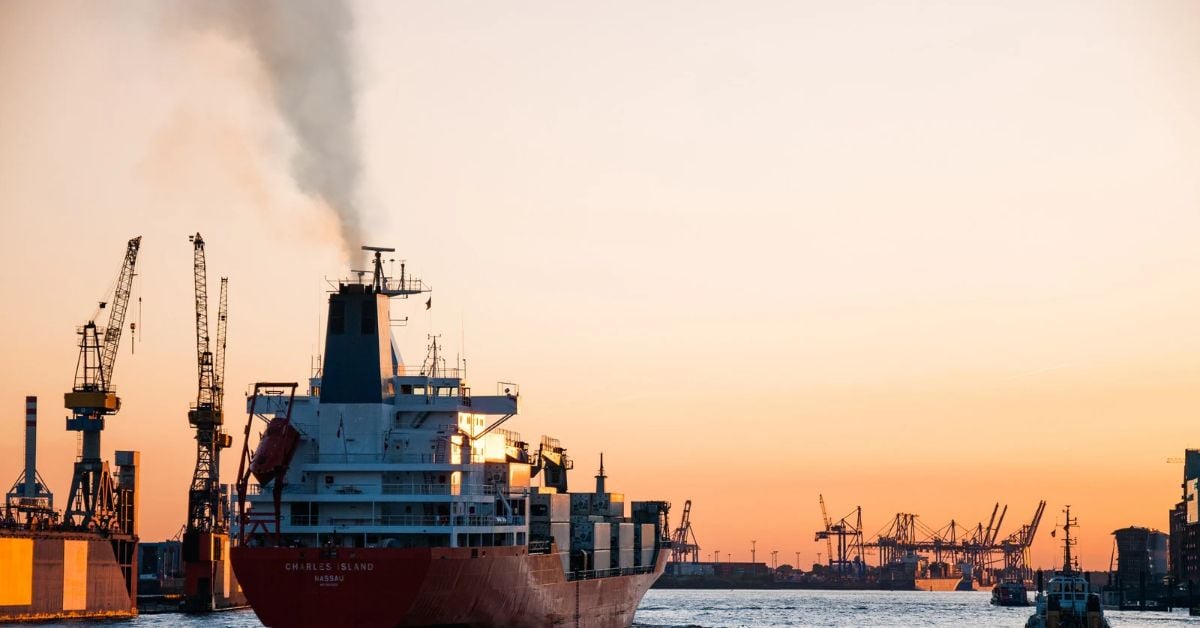
Owners and charterers must ensure their charterparty agreements explicitly allocate carbon liability, reporting obligations, and financial settlement mechanisms across both regimes.
The BIMCO Solution
In 2022, BIMCO introduced the commercial mechanism for the ETS allowance clause for time charter parties by publishing the Emission Trading Scheme Allowances (ETSA) Clause for Time Charter Parties. The clause is based on the “polluter-pays” principle.
Because the time charterer directs the commercial operation of the vessel and determines its fuel consumption, the clause makes the charterer responsible to provide and pay for the emission allowances generated during the charter period.
Hence, the owner calculates the previous month’s emissions based on consumption data and notifies the charterer.
The charterer then has to transfer the required quantity of allowances into the owner’s nominated account by an agreed monthly deadline, enabling the owner or administering entity to surrender them for compliance. Additionally, the clause provides legal remedies if the charterer fails to transfer the allowances on time.
In such a situation, the shipowner can let go of the contractual obligations including refusing voyage orders, while keeping the vessel on hire until the outstanding allowances are transferred. However, maritime law firms and leading P&I clubs, including NorthStandard and Gard, have frequently cautioned that the clause is not a frictionless “set and forget” remedy.
In practice, a single vessel often sits within a long charter chain, involving time charterers, sub-charterers, and voyage fixtures across different jurisdictions. If an intermediary in the chain defaults or delays transferring allowances, the owner cannot absorb the cash shortfall, given the regulatory deadlines.
Furthermore, exercising the right to withhold performance under English-law governed charters can lead to off-hire and cargo-claim counterarguments from third-party bill of lading holders.
UK ETS Add Another Layer To Carbon Cost Allocation
As part of the UK government’s statutory Net Zero strategy, the UK ETS expanded to commercial cargo and passenger ships of 5,000 GT and above on 1 July 2026, with offshore vessels joining on 1 January 2027.
Crucially, while the EU initially regulated only carbon dioxide, the UK agenda captures carbon dioxide, methane and nitrous oxide from day one.
The UK Emissions Trading Scheme (UK ETS) thus introduces another layer of operational and financial complexity regarding payment for emissions caused while the ship was chartered out.
The registered owner remains strictly liable under statutory law for complying with the scheme, unless that statutory duty has been formally delegated to the ISM/DOC manager. Under the charterparty, however, commercial liability is routinely passed to the charterer, and this may mean payments to the owner or allocation of allowances.
It is necessary to indicate in the contract whether the provisions of EU ETS, UK ETS or both are included, how emissions are calculated, whose responsibility is to provide data, and how the cost is to be paid.
There should be an agreement about what to do when the vessel is delivered before the calculation of the emissions cost is done.
The GB–Northern Ireland issue
There is a special provision in the UK ETS about voyages from Great Britain to Northern Ireland, which applies a 50% deduction to the vessel’s allowance surrender obligation.
At first glance, this looks just like the EU ETS rule, which charges 50% on voyages in and out of the bloc. But the reasoning is completely different.
The EU charges 50% on international trips to share coverage with other countries. A voyage between Great Britain and Northern Ireland, however, is a domestic UK trip that would normally be taxed at 100%. The UK cut this to 50% to ensure carbon-pricing PARITY between NI-GB and RoI-GB routes.
This creates an easy trap in charter agreements. Standard contracts often talk broadly about “emissions charges” without defining how this discount applies. If the clause does not state whether the charterer pays for the full carbon emitted or only the discounted 50% actually handed over to regulators, a payment dispute is almost guaranteed.
The BIMCO ETS – Emission Trading Scheme Allowances Clause for Time Charter Parties 2022 provides a general framework for the discussion. Still, it may be necessary to check if the wording applies to the UK ETS rules for their particular vessel or voyages, and how to accommodate the UK specifics.
In practice, owners, managers and charterers can use dedicated solutions such as OceanScore’s Compliance Manager to calculate emissions liabilities, allocate costs between counterparties and manage the associated compliance workflows across EU ETS and UK ETS.
The issue of deadlines
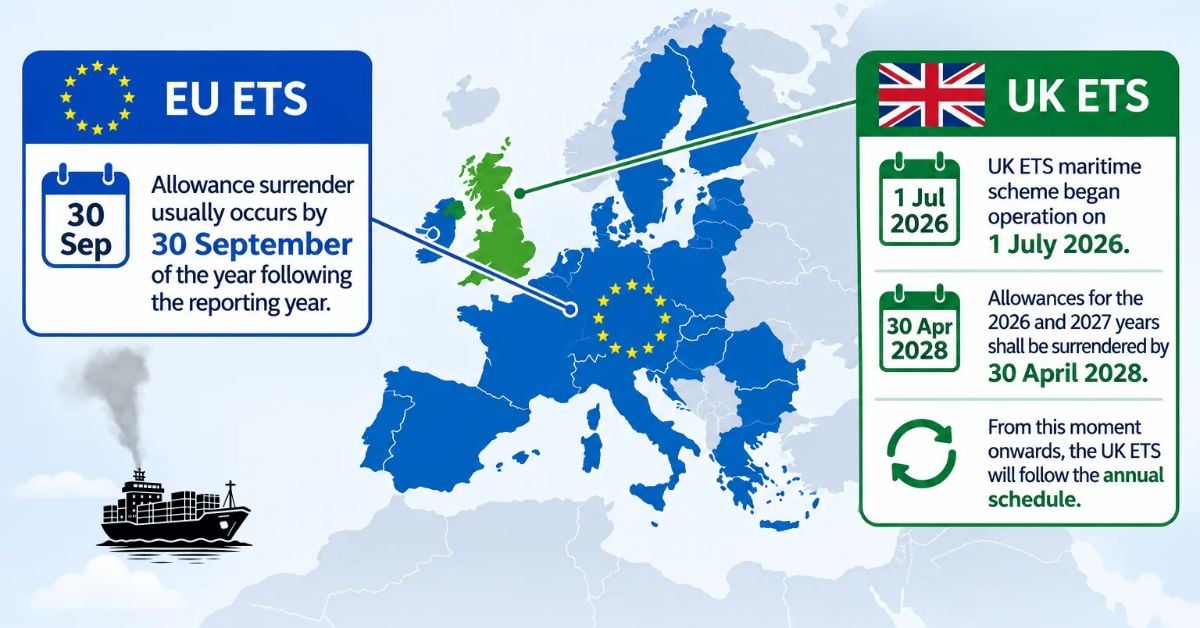
The EU ETS and UK ETS have different deadlines for surrendering allowances. Under the EU ETS, allowance surrender usually occurs by 30 September of the year following the reporting year. As for the UK ETS, its maritime scheme began operation on 1 July 2026. Under it, the allowances for the 2026 and 2027 years shall be surrendered by 30 April 2028. From this moment onwards, the UK ETS will follow the annual schedule.
These deadlines may create problems since the emissions cost may not yet be calculated when the period of a charter expires.
Indeed, a vessel may emit carbon dioxide under a charter and be handed over to the owners. Then, at the time when the owners will have to satisfy the scheme’s requirements, the charter may be terminated, and emissions costs may not be calculated.
5 Issues That Should Be Agreed In Charter Party Regarding Emission Charges
1. What scheme is applied?
The contract should indicate if the voyages of the vessel are subject to the EU ETS, UK ETS, or both. Only a generic wording concerning “emission charges” is not sufficient.
2. How will emissions be calculated?
Parties should agree on the calculation of emissions during the charter period. The contract should specify voyages and port calls, which will be included in the calculation and how adjustments or corrections will be made.
3. How will the cost be paid?
The contract should contain information about whether the cost will be transferred to the owner through allowance transfers or payments.
The timing of the transfer or payment should be indicated as well. In case of payment, parties should also agree upon the carbon price that would be used for such calculations.
4. Who provides the data?
The agreement should include the parties that are responsible for providing information on the fuel consumption and bunkering, the access rights for voyage data, emissions and their calculation. It can prevent possible disputes regarding emissions connected with the chartering agreement.
5. What should be done in case the vessel has been redelivered?
Because standard redelivery relies on precise bunker off-hire surveys, calculating the exact volume of fuel burned and emissions generated is rarely the issue. The real friction lies in final commercial reconciliation.
Even with clear consumption data, the charterparty must define a strict close-out process. It should set deadlines for transferring remaining allowances or settling cash equivalents, specify the benchmark market price if paying cash, and establish how to handle adjustments following annual accredited MRV verification.
If the verified figure exceeds the provisional settlement upon redelivery, the charterer must cover the shortfall. If surplus allowances or cash deposits were provided, the contract must outline how and when the owner credits or refunds the excess once accounts close.
Who Is Going To Pay?
Although the price for carbon emissions could be clear on the market, it should be defined in the agreement who is responsible for the cost.
The owners and the charterer should come to an agreement regarding the applicable scheme, the method of calculation and the payment before the vessel commences trading under the charter.
This is particularly true in instances where the vessel is redelivered before the final cost of emissions has been determined. Proper definitions can enable the two parties to know what costs they will have to meet. Do your charter parties account for UK ETS as well as EU ETS?
See how OceanScore helps shipping companies track, allocate and manage carbon costs under both schemes.
You might also like to read-
- From Cost Centre To Commercial Edge: How Shipping Companies Are Turning Emissions Compliance Into Leverage
- What Are The Main Risks In Charterparties?
- 5 Important Responsibilities Of Charterers In Maritime Trade
Disclaimer :
The information on this website is for general purposes only. While efforts are made to ensure accuracy, we make no warranties of any kind regarding completeness, reliability, or suitability. Any reliance you place on such information is at your own risk. We are not liable for any loss or damage arising from the use of this website.


Disclaimer :
The information on this website is for general purposes only. While efforts are made to ensure accuracy, we make no warranties of any kind regarding completeness, reliability, or suitability. Any reliance you place on such information is at your own risk. We are not liable for any loss or damage arising from the use of this website.
Subscribe To Our Daily Newsletter
By subscribing, you agree to our Privacy Policy you can unsubscribe anytime.
Related Articles



About Author
Founded in 2020 by industry veterans Jörg Molzahn and Albrecht Gundermann, OceanScore equips the shipping industry with digital solutions to handle complex environmental regulations like the EU Emissions Trading System (EU ETS), FuelEU Maritime and UK ETS, which increasingly influence commercial decisions, including fuel strategies, charter party negotiations and emissions cost management.