Why Port Cargo Clearance Gets Delayed By Paperwork, Not Cranes & How to Fix It
Modern ports are equipped with new tech and software that help port operators get the right data to make decisions faster and automate tasks, which increases the efficiency of cargo operations. Different sections of the port, including crane operations, cargo movement within the port, warehousing, yard areas, intermodal transport areas, etc., are automated and connected.
However, tasks such as inspections and checks that take place in yards, warehouses, weighbridges, sampling stations, and specifically customs, are usually left to human approvals and are semi-automated.
Even with EDI, or Electronic Data Interchange, the systems behind these processes take time to get validated. This means that even when the container or bulk cargo is unloaded and ready to leave the port, the paper trail behind it does not keep up and adds to the delay. This happens because this paper trail data is slow, fragmented, and manual.
Understanding the EDI trail in port operations
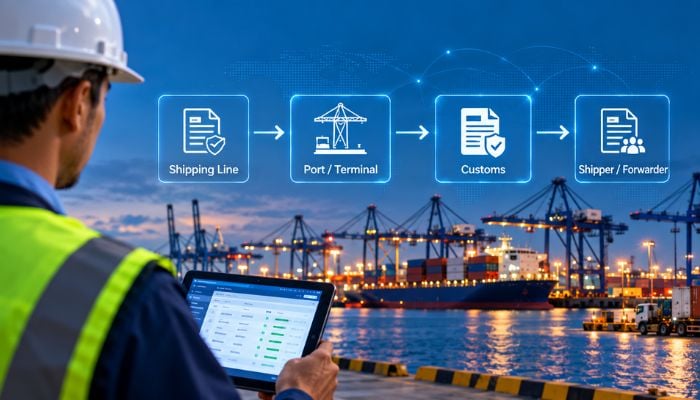
EDI, or Electronic Data Interchange, is the exchange of business information between stakeholders in port operations, including shipping companies, ports, terminal operators, customs, shippers, and freight forwarders.
Before a ship docks at the port, its cargo manifest and pre-arrival notice are sent to the port, which are verified and confirmed by the terminal. Once the cargo is discharged, important paperwork like the bill of lading, customs declaration, etc., is prepared and sent to relevant stakeholders.
Once the cargo is cleared by the port and customs, confirmations such as shipping line release, delivery pickup authorisation, etc., are in place.
An EDI can add to the operational time if there is any discrepancy or inconsistency in the data. This happens because humans carry out checks, and any missing digital data in the legal or audit trail will delay the entire process of physical movement of cargo in or out of the port.
Even a minor document log issue may add up to 24 to 72 hours to cargo clearance time, also exposing monetary charges like demurrage, missed delivery costs, and detention.
This is where Terminal operating software like iTOMS comes in, where they seamlessly connect and integrates gate operations, yard operations, customs, and billing into one visible system, which helps the operator to clear cargo smoothly without any delays.
What does a good EDI trail look like?
A TOS like iTOMS brings automated yet disconnected systems together and provides a single dashboard so operators can pre-fill all requirements, with event-based tracking across different parts of terminal operations. The human in the loop is brought into the trail only when needed for review.
When EDI is integrated with other systems, either using the latest EDI systems or APIs from other software that are used for different operations in the port, the data is visible in one place.
A single data submission also helps in avoiding repetitive tasks by different stakeholders and also removes the issue of wrong entry at any point in the data trail.
For example, if the container details are entered by the ship with a pre-filling validation and then captured in the system, other stakeholders now don’t need to add these details, avoiding delays and errors.
Event-based updates in the system will provide better visibility to the operator on where and at which stage the cargo has reached. The dashboard should be updated whenever an important event occurs in both the physical cargo and digital trail journey.
What Regulations Say?
There are multiple international and national requirements that a port infrastructure needs to comply with when it comes to the import and export of goods by sea. Some of the important regulations are:
FAL Convention: The IMO’s Facilitation of International Maritime Traffic (FAL) mandates an EDI system in place to ensure seamless exchange of information and remove manual and paper-based data submission.
Mandatory Maritime Single Window: MMSW came into force in 2024, which mandates all IMO member states to use a single channel for information exchange on ship arrival, departure, and stay in the port.
WCO Single Window Environment: The World Customs Organisation also promotes the use of a single window and connects all international regulatory organisations in one place, such as customs, the agriculture department, port authority, health, and similar relevant agencies, so that all trade documents are submitted in a standard format.
SOLAS Verified Gross Mass (VGM): This regulation ensures that all packed containers are provided and verified with their gross mass before loading on ship. This information is exchanged between the shipper, ship master, and port authorities well ahead of cargo loading so that the cargo planning can be done accordingly.
Regional Regulations: There are further regional or national requirements which are mandatory for ship and port authorities where data exchange is mandatory. Some of the examples are India’s One Nation One Port Process (ONOP) and the European Maritime Single Window environment (EMSW).
We always talk about automation with respect to machinery and objects where cranes and ships can work independently and more efficiently. However, the data trail is the most critical integration in any automation. Automation is not only about the machinery and process, but it is also about compliance logic between the systems
If a port or terminal is planning to automate its operation, they need to adopt technologies like iTOMS, which helps with EDI integration with shipping lines, customs, and ERP systems, as well as integration with port community systems and other operational technologies.
You might also like to read-
- Dwell Time: The Hidden Cost Inside A RoRo Terminal
- The Hidden Cost Of Gate Congestion At Ports
- What Happens When An Automated Terminal’s System Goes Down?
- Inside the Terminal’s Digital Twin: What Real-Time Yard Visibility Looks Like
Disclaimer :
The information on this website is for general purposes only. While efforts are made to ensure accuracy, we make no warranties of any kind regarding completeness, reliability, or suitability. Any reliance you place on such information is at your own risk. We are not liable for any loss or damage arising from the use of this website.

About Author
Founded in 2007 and headquartered in Hyderabad, India, Infyz Solutions is a premier technology company specialising in cloud-native and AI-enabled software solutions for the ports, shipping, and logistics industries. With nearly two decades of domain excellence, Infyz empowers terminal operators and logistics providers worldwide through its flagship suite of enterprise products, including iTOMS (Terminal Operations Management System), iNauka (Maritime & Shipping Operations), iVBS (Vehicle Booking System), iEPS (Equipment Processing System), iDepot (Container Depot Management System) and iCLMS (Cargo Logistics Management System).


Disclaimer :
The information on this website is for general purposes only. While efforts are made to ensure accuracy, we make no warranties of any kind regarding completeness, reliability, or suitability. Any reliance you place on such information is at your own risk. We are not liable for any loss or damage arising from the use of this website.
Subscribe To Our Daily Newsletter
By subscribing, you agree to our Privacy Policy you can unsubscribe anytime.