
US Navy’s Largest Uncrewed Submarine Can Travel 6,500 Nautical Miles Without a Support Ship
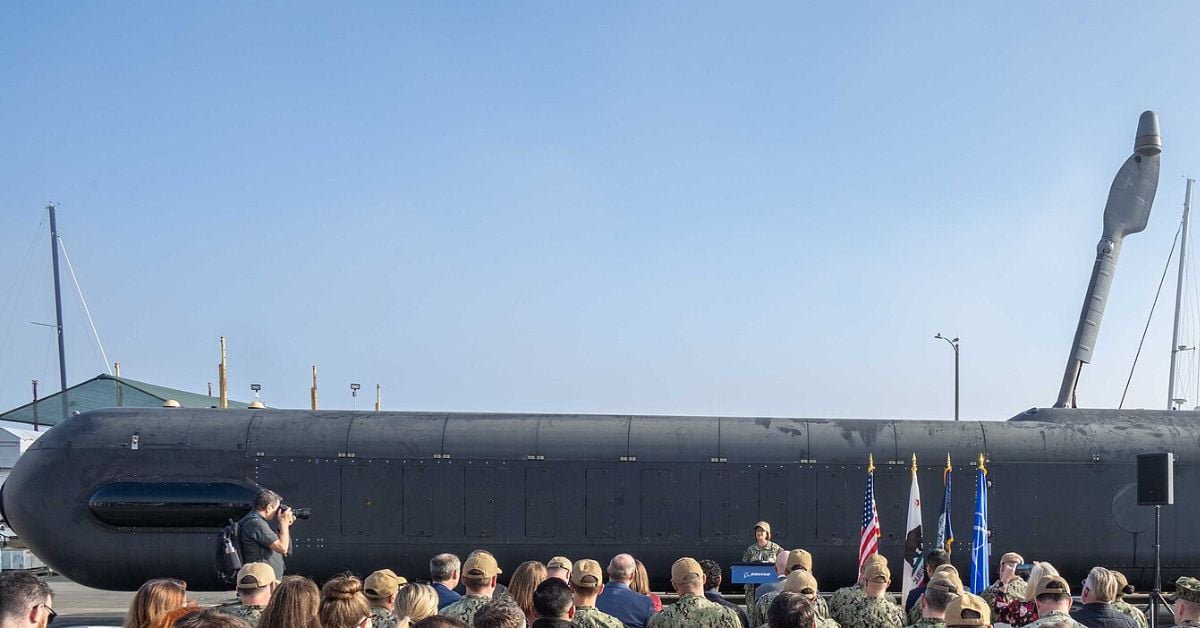
The U.S. Navy’s Orca Extra Large Uncrewed Undersea Vehicle (XLUUV) completed a voyage spanning more than 1,000 nautical miles in the eastern Pacific, the first time that such a distance has been covered by an XLUUV-class system.
It was organised and conducted in cooperation with the Program Executive Office for Unmanned Small Combatants team. A Navy statement revealed that the feat was accomplished in July, though officials did not disclose the exact route taken by the drone submarine or the launch date.
The voyage built upon trials conducted in the past two years, including a 2-day mission in 2024, which added to the operational experience with the XLUUV platform.
The vessel is designed to fulfill an operational requirement for the Pacific Theater and is counted among the largest unmanned underwater systems operated by the U.S. Navy.
It employs diesel-electric propulsion and rarely surfaces, only to recharge its batteries. It has an 18-kilowatt range extender, which means mission endurance is dependent mainly on fuel supplies rather than just stored batteries alone.
The Orca has a 6500 nautical mile range and is engineered for operations in the Pacific, covering long distances and facing tough operational conditions to conduct surveillance, mine warfare, reconnaissance, seabed operations, and offer expeditionary support. The achievement comes amidst the Pentagon’s efforts to scale unmanned systems and integrate them into carrier strike groups.
After a July meeting between Cavanaugh and Rear Adm. Marcos Jasso on the USS Theodore Roosevelt, commanders discussed using unmanned undersea vehicles to transport components between submarines and carriers while eliminating the need for the former to surface or return to port.
However, the program faces uncertainty as a new report published by the Government Accountability Office (GAO) revealed that the Navy may not transition the XLUUV into an official program of record, despite 8 years of development and approximately $885 million investment.
Started in 2017, the initiative contracted Boeing two years later to build prototypes, with the first one delivered in 2023. By 2025, the program was met with repeated setbacks.
According to GAO, five prototypes would be delivered by the end of 2026, a 3-month delay from the previous year’s estimate and many years behind the original schedule.
There are technical challenges as well, with regard to autonomy, battery endurance and navigation. Also, making changes to the XLUUV payloads requires the service to pay Boeing to modify the proprietary software, though officials said that its modular software and payload design offer flexibility with the hardware.
RELATED POSTS


RELATED POSTS
Disclaimer :
The information on this website is for general purposes only. While efforts are made to ensure accuracy, we make no warranties of any kind regarding completeness, reliability, or suitability. Any reliance you place on such information is at your own risk. We are not liable for any loss or damage arising from the use of this website.

About Author
Zahra is a maritime writer with 6 years of technical writing experience spanning port operations, offshore wind, oil and gas, and maritime policy. Her analytical edge...Read More ->
Disclaimer :
The information on this website is for general purposes only. While efforts are made to ensure accuracy, we make no warranties of any kind regarding completeness, reliability, or suitability. Any reliance you place on such information is at your own risk. We are not liable for any loss or damage arising from the use of this website.
Subscribe To Our Daily Newsletter
By subscribing, you agree to our Privacy Policy you can unsubscribe anytime.


