


What is Local or Emergency Manoeuvring on Ship?
Most of the important machineries on ship are always provided with emergency backup or standby system which can be used in case of failure of the main unit. Even power supplies of the essential machineries are provided with emergency generator. Marine engine is also provided with emergency manoeuvring control system in case the remote control system fails to operate.
Main marine engine is responsible for propulsion of the ship and its direction and rotation are controlled from either bridge or Engine Control Room (ECR) through telegraph and fuel lever control. This control system is a remote control type used for both sea voyage and manoeuvring of vessel.
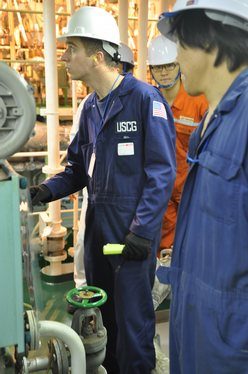
If the remote control manoeuvring system fails to operate from both the remote stations, i.e. bridge and ECR, or the governor of the main marine engine goes faulty, additional safety is given to main marine engine by providing a local manoeuvring control system.
When the ship is in a narrow channel under manoeuvring, then it is very important for all engine room crew to know the change over and operating procedure for local or emergency control. Failure in knowing the remote control manoeuvring system, can lead to accident like collision and grounding.
Procedure for Local or Emergency Manoeuvring
The changeover and operating procedure differs from engine to engine as different control systems are adopted for different engine types; however the basic remains the same. When there is automation or remote control failure alarm then changeover of control is to be done from remote (either wheelhouse or ECR) to Local control stand.
The local control stand is normally located in the engine room near the fuel pump platform of the main marine engine.
Changeover Procedure
- The change over procedure can be done with marine engine in stopped as well as running condition, but if the situation permits it is better to be done when the engine is stopped.
- First change control from wheel house to ECR and both the telegraph on wheel house and ECR are to be in stopped position.
- Bring the fuel lever of wheel house and ECR in stop position.
- A changeover switch is provided in the ECR. Operate the switch from –“ECR to Local”.
- Go to the local control station and changeover the fuel pump control shaft from local to manual.
- A cone clutch arrangement or a mechanical lever arrangement may be provided, depending upon the engine type, which acts as manual control when attached to hand wheel for operating fuel rack.
- A locking pin or clip may be provided for the above arrangement as an additional safety so that it should not come out in normal operation.
Operating procedure
- After the fuel rack is attached to the manual hand wheel control, wait for the wheel house order.
- Respond to the telegraph and give fuel and air to the engine via local control levers.
- If the engine fails to start, give extra amount of fuel and air as now it is controlled manually and the linkage requires more push for the fuel supply.
- Once the marine engine starts, follow the telegraph and maintain the speed from local fuel lever.
Checks and Maintenance
- The remote control failure alarm is to be checked regularly.
- Local telephone and communication system are also to be checked and maintained.
- Local Telegraph bell and indication light are to be checked and maintained.
- All the linkages to be oiled and greased at regular interval of time.
- The safety clips or pins in the cone clutch or any other type of arrangement is to be checked.
- Emergency manoeuvring drills should to be conducted every month.
You may also like to read-Types of Lifeboat Release Mechanisms & SOLAS Requirements
Image Credits:
cdn
seadogs-reunited
Do you have info to share with us ? Suggest a correction

About Author
An ardent sailor and a techie, Anish Wankhede has voyaged on a number of ships as a marine engineer officer. He loves multitasking, networking, and troubleshooting. He is the one behind the unique creativity and aesthetics at Marine Insight.
Latest Marine Navigation Articles You Would Like:



Subscribe To Our Newsletters
By subscribing, you agree to our Privacy Policy and may receive occasional deal communications; you can unsubscribe anytime.
Thank you very much for your help to give up like. I hope you will continue this in future to help the mariners who need some advice for an emergency. You are great.
you gotta brush up. As per manuals it isn’t called either. in fact , it is called Engine Side maneuvering. When Bridge and /or ECR stations fail. you can still run the engine from engine side, which is local control.
@Bhatt: If you refer to a manual of multiple company, you might find different terminology. Emergency manoeuvring is mostly used as a sailing lingo onboard ship.