
Take FREE Online Maritime Courses
Construction and Operation of Loading Arms Used for LNG Carriers
Any ship which loads liquid cargo in bulk has to have a proper loading arrangement. Conventional Tankers usually use flexible rubber hoses or reinforced composite hoses. Some terminals have loading arms for chemicals and clean products.
LPGs are loaded with either hoses or loading arms, and LNGs only through loading arms. This article mainly deals about the construction and operation of loading arms used especially for LNG carriers.
LNG Loading Arrangement
LNG, the fuel for future, is a cryogenic liquid which is usually loaded at any temperature below -159 degree Celsius. Normal steel loading arms or rubber flexible hoses cannot withstand such cryogenic temperatures. Thus, these are usually made of expensive special low temperature alloy which has a very good thermal expansion and contraction properties.
The picture shows some of the main parts of a Loading arm (hand arm). A terminal may have two to five arms which are used for different purposes. Usually two arms for loading and one for vapour return.
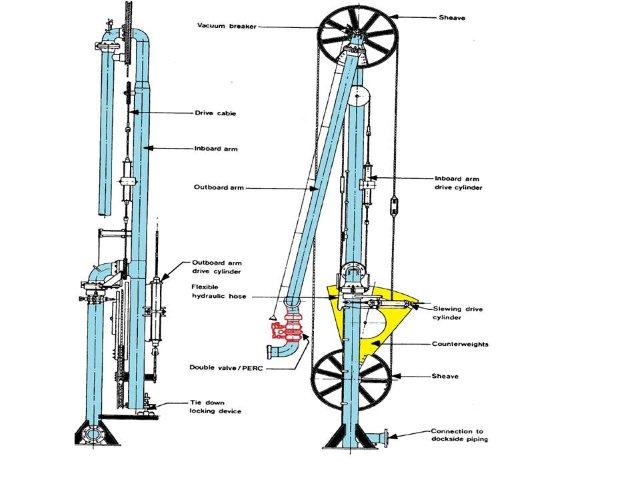
The main reason for using loading arms is their flexibility accommodating any movement/trim/list of the vessel during loading/discharging. These loading arms are always hydraulically operated and are fitted with emergency release couplings and emergency release system.
One important point is fitting of strainers between the loading arm and the ships manifold, which is not usually done in oil/product tankers.
The loading arm has two swivel joints one at the top and the other at bottom. The top swivel and sheave connects both inboard and outboard arms. The bottom swivel and sheave forms the assembly for slewing and shore side dock piping.
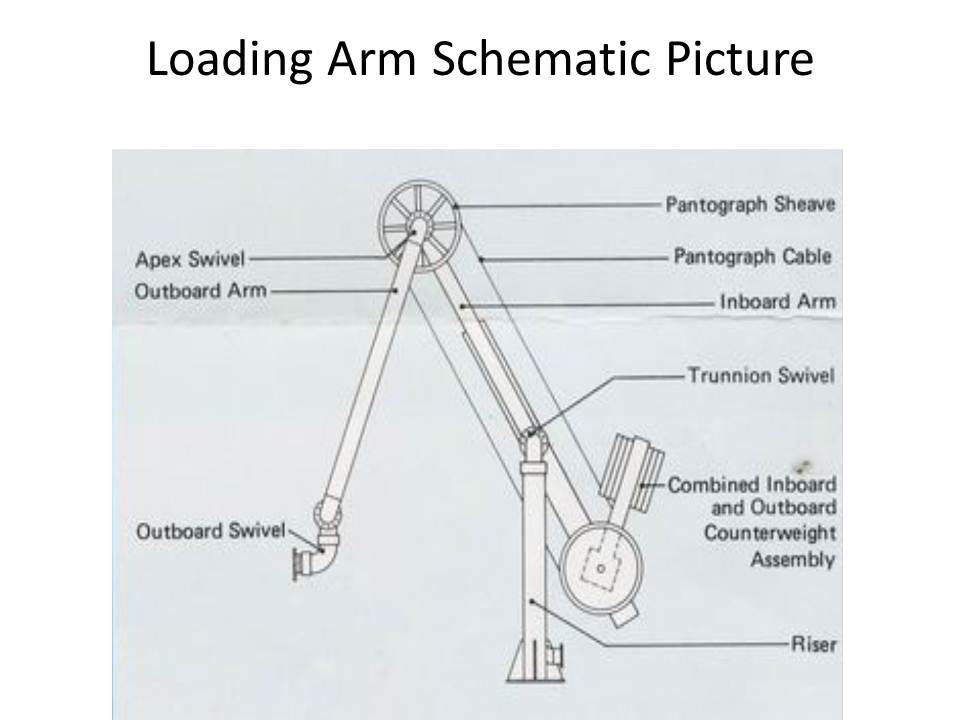
The bottom sheave and swivel incorporates some counterweights to reduce the dead weight of the arm on the ships’ manifold connection and to reduce the power required to manoeuvre the arm into position.
The main idea of using a loading arm is to have sufficient operating envelope. With Flexible hoses, the operating envelope is very less and it cannot accommodate large ships. The picture shows exactly how a loading arm can accommodate large Tidal variations and huge vessels.
The Inter Connections
The connection between the loading arm and the shore side pipe flange may be of two types. One is simple bolted flange connections and the other is recent QCDCs.
LNG terminals usually have QCDCs (Quick Connect/Disconnect Couplings). These are specially used for speedy connections. These couplings are hydraulically operated and manually controlled. The ship and shore flanges are locked mechanically (positive locking) independent of hydraulic power supply.
The main advantage of the loading arm-QCDC connection is the addition of the Emergency release system, what is called as ESD-Emergency Shutdown. When there is any emergency situation during loading/unloading operation, ESD can be activated from multiple points which might cause the loading arm to break away immediately in a safe way to prevent further damage.
There are usually two ball valves remotely linked to the emergency shutdown system. Whenever ESD activates, these two valves immediately shut without any further damage to the cargo system and shore pipe works.
During LNG Loading-cooling down operation, I observed the temperature gauge to monitor the cool down rate. It was graduated in Degree Celsius. It also had the option of Fahrenheit nearby. As the cool down operation went on, at one point both Celsius and Fahrenheit scale read same value. Guess what temperature it could be?
-40 degrees.
I was amazed. I didn’t know that before.
Disclaimer :
The information on this website is for general purposes only. While efforts are made to ensure accuracy, we make no warranties of any kind regarding completeness, reliability, or suitability. Any reliance you place on such information is at your own risk. We are not liable for any loss or damage arising from the use of this website.


Disclaimer :
The information on this website is for general purposes only. While efforts are made to ensure accuracy, we make no warranties of any kind regarding completeness, reliability, or suitability. Any reliance you place on such information is at your own risk. We are not liable for any loss or damage arising from the use of this website.
Related Articles

⚓️ Enhance Your Knowledge. Prevent Accidents. Stay Safe at Sea.
1. eBooks for Engine Department
Master machinery operations, troubleshooting, and safety procedures with expertly written guides tailored for marine engineers. Prevent costly breakdowns and onboard accidents through practical knowledge.
👉 Explore Engine Department eBooks
2. eBooks for Deck Department
Sharpen your seamanship, navigation, and cargo-handling skills with real-world case studies and practical insights designed for deck officers and cadets.
👉Discover Deck Department eBooks
3. eBooks on Electrical Fundamentals & Issues
Understand marine electrical systems, identify potential faults, and prevent onboard electrical failures with step-by-step explanations from industry experts.
4. Pocket Guides for Quick Reference
Compact, handy, and loaded with essential checklists—perfect for on-the-go reference during operations and emergencies at sea.
5. Combo Packs to Save Big
Access multiple expert eBooks at discounted prices. Ideal for professionals seeking complete safety and operational knowledge across various ship departments.
6. Digital Maritime Courses – Learn at Your Own Pace
Upgrade your competence with Marine Insight Academy’s online courses. Learn from industry professionals anytime, anywhere, and become a safer, smarter seafarer.
Subscribe To Our Daily Newsletter
By subscribing, you agree to our Privacy Policy and may receive occasional deal communications; you can unsubscribe anytime.

Informative article