
5 Important Responsibilities Of A Shipowner In Maritime Trade
In maritime trade, the shipowner occupies a central position, not merely as the owner of the vessel but as the party ultimately responsible for ensuring that the ship can safely and legally participate in global commerce. While charterers, shippers, and agents all play defined roles, the shipowner’s responsibilities form the foundation on which the entire operation rests. A clear understanding of these duties is essential for anyone involved in shipping contracts, vessel operations, or maritime risk management.
Below are five key responsibilities of a shipowner that underpin safe and efficient maritime trade.
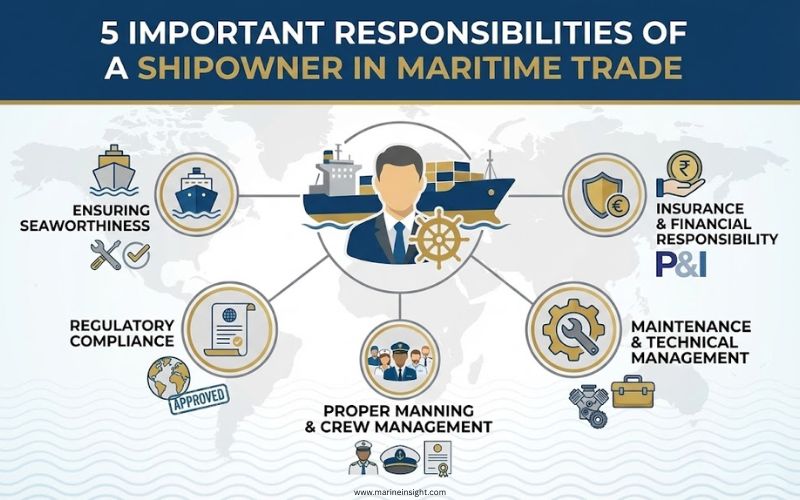
1. Ensuring Seaworthiness of the Vessel
One of the most fundamental obligations of a shipowner is to provide and maintain a seaworthy vessel. This goes beyond basic structural integrity. A seaworthy ship must be properly equipped, adequately maintained, and suitable for the intended voyage and cargo. Failure to meet this standard can expose the shipowner to claims arising from cargo damage, delays, or even personal injury. In practice, seaworthiness is not a one-time requirement but an ongoing duty throughout the vessel’s service.
2. Compliance With International and Local Regulations
Shipowners must ensure that their vessels comply with a wide range of international conventions and national laws and regulations. These include regulations related to safety, pollution prevention, crew certification, and operational standards. Non-compliance can result in port state detentions, financial penalties, and reputational damage. More importantly, regulatory breaches often shift liability squarely onto the shipowner in the event of an incident.
3. Proper Manning and Crew Management
A vessel is only as safe as the people operating it. Shipowners are responsible for employing qualified and certified crew in accordance with international standards. This responsibility extends to providing proper training, ensuring compliance with work-rest requirements, and maintaining acceptable living and working conditions onboard. Inadequate crew management frequently becomes a contributing factor in maritime accidents, making this duty both operationally and legally significant.
4. Maintenance and Technical Management
Routine maintenance and timely repairs are not optional aspects of vessel ownership. Shipowners must implement effective maintenance systems to prevent machinery failures, structural deterioration, and safety hazards. Poor technical management can lead to off-hire disputes, cargo claims, and, in severe cases, total loss of the vessel. From a legal perspective, neglecting maintenance often undermines a shipowner’s ability to rely on contractual protections.
5. Insurance and Financial Responsibility
Shipowners are expected to maintain adequate insurance coverage, particularly for third-party liabilities. Protection and Indemnity (P&I) cover plays a critical role in managing risks related to pollution, crew claims, and cargo damage. Without proper insurance arrangements, even a single incident can have devastating financial consequences, not only for the shipowner but also for other stakeholders connected to the voyage.
Conclusion
The responsibilities of a shipowner extend far beyond owning a ship or entering into charter agreements. They encompass legal, operational, and ethical obligations that directly influence maritime safety and commercial reliability. Understanding these responsibilities helps reduce disputes, clarify liability, and promote smoother shipping operations across the supply chain.
The role of the shipowner is only one part of a much larger framework governing maritime trade. There are several other important concepts and responsibilities of different parties that shape shipping operations, all of which are explored in greater detail in the ebook “Responsibilities of Individual Parties in Shipping.”
You might also like to read-
- 5 Important Responsibilities Of A Shipper In Maritime Trade
- 5 Important Responsibilities Of A Shipper In Maritime Trade
- 5 Important Responsibilities Of Ship Agents
- Duties Of A Maritime Insurance Broker
Disclaimer :
The information on this website is for general purposes only. While efforts are made to ensure accuracy, we make no warranties of any kind regarding completeness, reliability, or suitability. Any reliance you place on such information is at your own risk. We are not liable for any loss or damage arising from the use of this website.
Related Posts


Disclaimer :
The information on this website is for general purposes only. While efforts are made to ensure accuracy, we make no warranties of any kind regarding completeness, reliability, or suitability. Any reliance you place on such information is at your own risk. We are not liable for any loss or damage arising from the use of this website.
Related Articles

About Author
Rishabh Srivastava is a Maritime lawyer dealing in Ship arrests, maritime claims and arbitration in India.
Subscribe To Our Daily Newsletter
By subscribing, you agree to our Privacy Policy you can unsubscribe anytime.


BE THE FIRST TO COMMENT