
10 Extremely Important Checks Before Starting Marine Engines On Ships
The starting procedure of marine engines on ships requires several points to be taken into consideration. While it is necessary that none of these points should be missed, there are a few extremely important things that should be done without fail while starting these ship engines.
Ten of these important points (in no particular sequence) are as followed:
1. Lubrication of Main Engine: Start pre-lubrication of the engine well before starting the marine engine. For the main engine it should be started before 1 hour and for auxiliary 4-stroke engines at least 15 minutes in advance.
Related reading: Ship’s marine engine lubrication system
2. Check All Important Parameters: After starting the lubrication pump, check lube oil levels and all other running pump parameters such as cooling water pressure, fuel oil temp and pressure, control and starting air pressure etc. to ensure that all are in the accepted range.
Related reading: 10 practical tips to handle engine room pumps
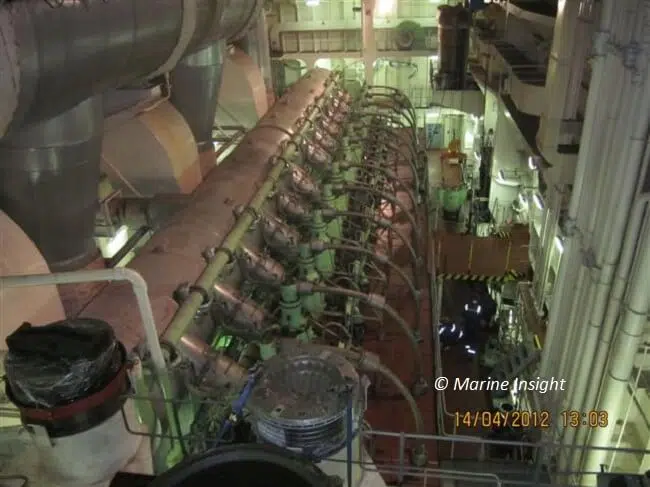
3. Open Indicator Cocks and Blow Through All the indicator cocks of the marine engine must be opened up for blow-through of the combustion chamber prior to starting in order to avoid hydraulic damage because of water leakage
4. Rotate the Crankshaft: Rotate the crankshaft of the marine engine by means of turning gear so that all the parts are thoroughly lubricated before starting.
Related Reading: Main Engine Operations: Running, Starting, Stopping
5. Manually Check Turning Gear: Ensure that the turning gear is properly disengaged by checking it locally even when the remote signal is showing-“disengaged” sign. Some auxiliary engines are provided with a tommy bar for rotation, ensure that it is removed from the flywheel before the engine is started.
6. Check Jacket Cooling Water Temperature: The jacket cooling water temperature of the engine should be maintained at least 60 deg C for the main engine and 40 deg C for the auxiliary engine (it may vary depending upon the KW rating of the engine).
Related Reading: General Overview of Central Cooling System Of Ships
7. Warm up the Engine: The incoming ship generator should be run at no load for at least 5 mins to allow warming up of the system.
8. Put Load Sharing Switch to Manual: When the 2nd generator is started, it will try to come on load as soon as possible due to the autoload automation provided for sharing the equal load (if same rated capacity).
While starting the 2nd generator, keep in mind to put the load sharing switch to manual. This will avoid the “just started” generator coming on load, giving it some time for warm-up.
9. Avoid Excessive Opening of Exhaust Valve: When starting the main engine with hydraulic oil operated exhaust valves, open the spring air first and then start the hydraulic oil to the exhaust valve. This will avoid the excessive opening of valves.
10. Examine the Engine: Responsible engineers of the ships to be present near the engine when it is started from a remote position. Auxiliary engine to be started from a local position (avoid using remote start if possible).
Smooth starting and stopping of engines not only depends on the systematic procedure but also on proper maintenance overhauling procedures of marine engines.

Do you know any other important points that should be considered while starting marine engines? Let us know in the comments below.
Disclaimer :
The information on this website is for general purposes only. While efforts are made to ensure accuracy, we make no warranties of any kind regarding completeness, reliability, or suitability. Any reliance you place on such information is at your own risk. We are not liable for any loss or damage arising from the use of this website.
Disclaimer :
The information on this website is for general purposes only. While efforts are made to ensure accuracy, we make no warranties of any kind regarding completeness, reliability, or suitability. Any reliance you place on such information is at your own risk. We are not liable for any loss or damage arising from the use of this website.
Related Articles



About Author
An ardent sailor and a techie, Anish Wankhede has voyaged on a number of ships as a marine engineer officer. He loves multitasking, networking, and troubleshooting. He is the one behind the unique creativity and aesthetics at Marine Insight.
Subscribe To Our Daily Newsletter
By subscribing, you agree to our Privacy Policy you can unsubscribe anytime.


Ensure that the Air Bottles are drained of water.
That the air pressure in all bottles is correct, and at operatioanal pressure, with all valves open.
That the Air Compressors are fully operational, on auto with the correct valves open and or closed.
Fuel Tanks are full and checked for water.
Ensure Propeller clearance is there prior to turning Main Engine by turning gear.
Ensure all alarms on control system is reset prior to starting Main Engine.
check for the auxiliary blower mode. It should be in ‘AUTO’.
I love this company. my challenge is how to get to where this company is i realy want to learn more about my field am a mariner studied in maritime accademy of Nigeria.pls reply
Sir,
My opinion is that the post is somehow misleading since it is talking about Main Engine and Auxiliary Engine in a single article. If a younger in-experience Engineer would read it, he/she may get lost. I suggest having a separate list for Main Engine and Auxiliary Engine.
C/E Donnie Bagang
Dear Sir,
Thank You for Your Valuable input.This was not an extensive checklist but rechecks to be carried out on engines after following the complete checklists. What you suggested will definitely help the young guns to understand the procedure in a better way i.e separate checks on Auxiliary and Main Engine.
Best Regards
Dear 2E Anish,
Thank you for considering my suggestion. I also apologize if I myself was also mislead by the article and took it as a checklist. Just got a little confuse since the tittle is “10 Extremely Important Checks Before Starting Marine Engines” but as you said its not an extensive checklist but rechecks to be made after the correct checklist, which as we both agreed would be very useful for young engineers and students.
Bgrds,
C/E Donnie Bagang
Dear Sirs,
I am an engine cadet and still no knowledge in the field of Marine Enginnering. That is why I am trying to learn by reading Marine Insight. Because I was asked by my 2/E for the purpose of why we are turning the turning gear prior to departure.
@Diosua:
You can ask all your queries at – https://forums.marineinsight.com under “Marine Engineering” section.
3/ remember to close indicator cock
very insightful. Weldone.
Expansion tank level should be considered before circulation commences.
GOOD INSIGHT. GOOD WORK Mr. ANISH,
I JUST WANTED TO ADD SOME MAYBE MINOR POINTS :
1. .DRAIN F.O. TANKS
2. ENSURE CORRECT HEATING TEMP/ VISCOSITY
3. CORRECT POSITION OF LUBRICATORS.
4. LUBRICATE FUEL RACKS.
5. T/C COVER REMOVED, T/C DRAIN CLOSED.
ALL ARTICLES ARE FOR INFORMATION ONLY, YOUNG ENGINEERS PLS USE IT A GUIDE.
TIA
This 10 points is usually is standard starting procedure for all engines. Every engine has some specially procedure for starting, but all engine starting procedures is wrote in Engine Check List and now, for modern engines or Engine Control is ready in automatic systems.
Good morning
If you accidentally blow the engine with closed cocks ( 4 strok marine engine <1500kWt ) , which bad effects it could bring ? Can not start any more…the governor don't moving the fuel rack….
The fuel rack on each high pressure pump manually have normal movements .
Waiting for any idea
Thanks
What is the importance of starting engine pls be answer me tnx..
Check governor oil level ..
We have purchased 2 man engines two years back and was not commissioned. How to go abt warranty
sir i want to know about high pressure fuel pump and its troubleshooting. plz
@Sobuj: Have you seen this video – https://www.youtube.com/watch?v=BplJ_Ls_ozA
hello , have good days. How to preheating for before starting main engine ? I am sorry for my english level
There is a pre-heat pump provided which is usually electrical or steam operated. Please check this article for more details – https://www.marineinsight.com/main-engine/marine-engine-operations-starting-running-stopping/