
10 Points To Consider When Cleaning Cargo Tanks With IG System
Inert gas system or IG system on a tanker ship is one of the primary fire safety systems. All cargo tanks are provided with IG lines to blanket the top space of the tank with inert gas.
It is very important to clean cargo tanks at regular intervals of time to avoid formation of sludge at the bottom, which reduces the cargo space, or in case of product tanker or OBO carrier- to avoid mixing of different cargoes.
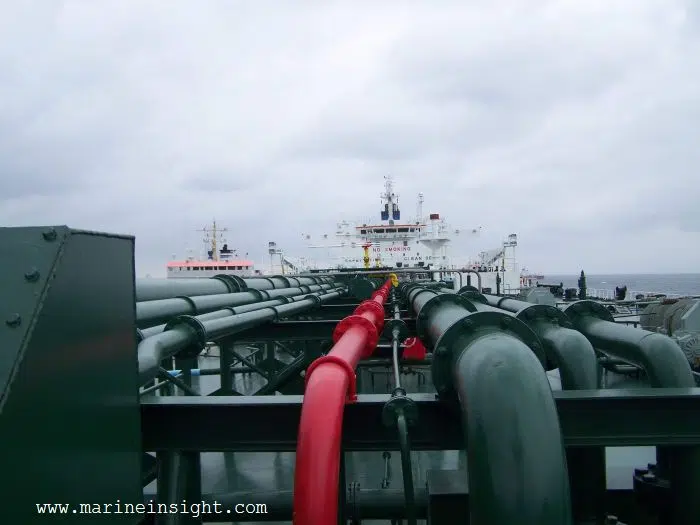
The cargo tank cleaning is an important job carried out by ships crew and supervised by experienced on board officers (Master and Chief officer).
Safety of ship’s crew is of prime importance and cleaning a cargo tank requires step-by-step safety measure to avoid any accident and casualty.
Following steps to be taken when cleaning a tank which is supplied by inert gas via I.G generator or by I. G plant connected to ship’s boiler:
1. One Tank At A Time: Ensure only one tank at a time is chosen for tank washing. All crew involved in the operation are briefed about the hazard and safety aspects in a tool box meeting prior carrying out the operation.
The tank under cleaning must be isolated from main inert gas system, all the other tanks, and from any other common venting system
2. Provide Maximum Ventilation: Maximum ventilation output to be concentrated on tank well ahead of cleaning operation.
The ventilation to be arranged such that it provides good air circulation (free flow of air) from one end of the tank to the other. Officer must ensure enclosed space checklist is duly filled and followed. Rescue from the tank in case of any mishap must be planned ahead of the operation with all the equipment ready at the entry point.
3. Allow Atmosphere Test To Check Acceptable Limits: Washing operation should not commence until atmosphere tests are at acceptable limits at various levels of the cargo tank and the vapour content in any part of the tank is below 10% of the lower flammable limit.
4. Flush Tank Bottom With Water: The tank bottom should be flushed with water and later stripped. The piping lines, cargo pump equipment, cross overs and discharge lines also be flushed with water.
Clean, cold seawater can be used for washing. Ensure recirculating system are not used for tank washing
5. Test Tank Atmosphere Continuously: Testing the tank atmosphere to be carried out during washing at regular intervals. If the vapour level rises to 50% of the lower flammable limit, the washing operation must be immediately stopped until the vapour level has fallen to 20% of the lower flammable limit.
6. Check Washing Machine Capacity: If washing machines for tank cleaning are used with capacity exceeding 60m3 / hour, only one machine shall be used at any one time on ship.
7. Use Portable Machines With Utmost Care: If portable machines are used for washing, ensure all hose connection are properly drawn and bonding cables are tested for continuity before introducing them inside the tank. The should not be broken till the machines are out of the tank.
8. Drain Washing Water Properly: The draining of water from the tank should be continued during the washing operation. In the event of build up of wash water, the operation must be stopped and not to be resumed till all the water is stripped from the tank.
9. Avoid Chemical Additives: Avoid the usage of chemical additives
10. Close Deck Openings That Are Not Required: During washing operation all the deck openings, except those necessary for the operation, must be closed during the procedure
Over to you..
Do you know any other important point that can be added to the list?
Let’s know in the comments below.
You may also like to read – Why is Cargo Ventilation Important on Ships?
Disclaimer :
The information on this website is for general purposes only. While efforts are made to ensure accuracy, we make no warranties of any kind regarding completeness, reliability, or suitability. Any reliance you place on such information is at your own risk. We are not liable for any loss or damage arising from the use of this website.


Related Articles
Disclaimer :
The information on this website is for general purposes only. While efforts are made to ensure accuracy, we make no warranties of any kind regarding completeness, reliability, or suitability. Any reliance you place on such information is at your own risk. We are not liable for any loss or damage arising from the use of this website.

About Author
An ardent sailor and a techie, Anish Wankhede has voyaged on a number of ships as a marine engineer officer. He loves multitasking, networking, and troubleshooting. He is the one behind the unique creativity and aesthetics at Marine Insight.
Subscribe To Our Daily Newsletter
By subscribing, you agree to our Privacy Policy you can unsubscribe anytime.


I feel article discusses two different reasons for tank cleaning, and the procedures differ. The main reason for tank cleaning is because MARPOL requires that every discharge 25% of tanks shall be washed, unless the cargo is not suitable, and listed in the COW manual. As far as blanking off ig lines on the tank that’s being washed, I would argue that’s the last thing that should be done. Maintaining tank pressure while stripping must be done with the ig system, and pumping fresh air into a cargo tank would quickly lead to a dangerous atmosphere. Additionally, why would a crew member check for % of lel? The easier solution seems to be to check for % of o2, and if under 8%; the tank is inert with no chance of ignition. I look forward to discussing different ideas.