
Duties Of Marine Engineer In Merchant Navy
Marine Engineers ensure that all mechanical systems on the ship are in perfect working condition. You can become a marine engineer after doing a marine engineering degree, where you learn about constructing, running and maintaining ships, boats, submarines, and other seagoing vessels. You also gain knowledge about ship engines, propulsion systems, and onboard gear.
Read the article to know more about marine engineers, their roles, responsibilities and salary structure.
Duties Of A Marine Engineer In Merchant Navy
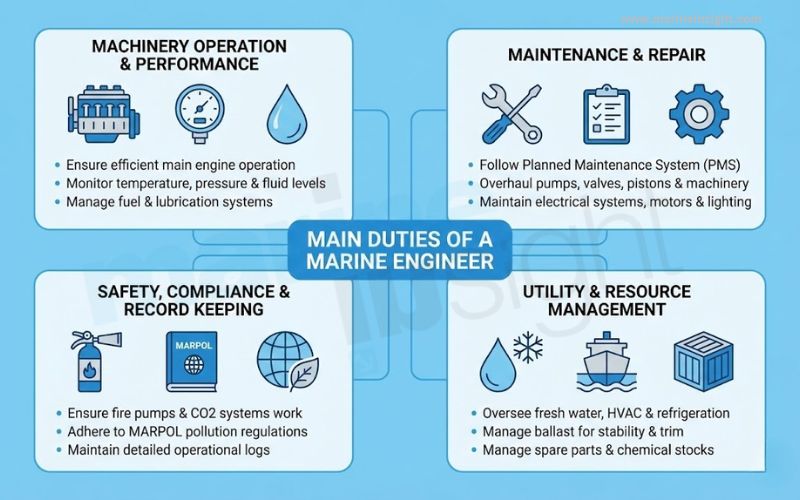
- The most important duty of a marine engineer is to check that the main engine is working properly and efficiently at all times.
- Marine Engineers also have to undertake the maintenance and repair of engines, generators, boilers and other machinery, if needed.
- He or she also has to oversee the performance of the engine room equipment, monitor temperature, pressure and fluid levels to prevent accidents, especially fires.
- Perform daily checks to detect any leaks or malfunctions.
- Follow the Planned Maintenance System to overhaul fuel pumps, valves and pistons before they fail.
- Maintain logs of machinery operations, repair and maintenance for future reference and transparency.
- Monitor how much fuel the vessel is using and manage lubrication systems to comply with environmental laws.
- Lead the staff of the engine room and assign daily tasks.
- Maintaining electrical systems, including motors, starters, and lighting.
- Keeping an eye on the working of fresh water generators, purifiers, and Refrigeration & HVAC systems.
- Maintain records of bunkering operations and soundings.
- Manage spare parts and chemical stocks to ensure the ship never runs out of critical components.
- Marine engineers must also adhere to the MARPOL (Maritime Pollution) regulations, ensuring bilge water pumped overboard has less than 15 ppm of oil. Maintain records of all oil transfers and discharges.
- Monitor the exhaust scrubbers and fuel sulfur content.
- Ensure vessel safety by seeing that fire pumps, carbon dioxide fixed-fire suppression systems and emergency generators are in working condition.
- Manage ballast systems to maintain the ship’s stability and trim in case of a hull breach.
How to become a Marine Engineer?
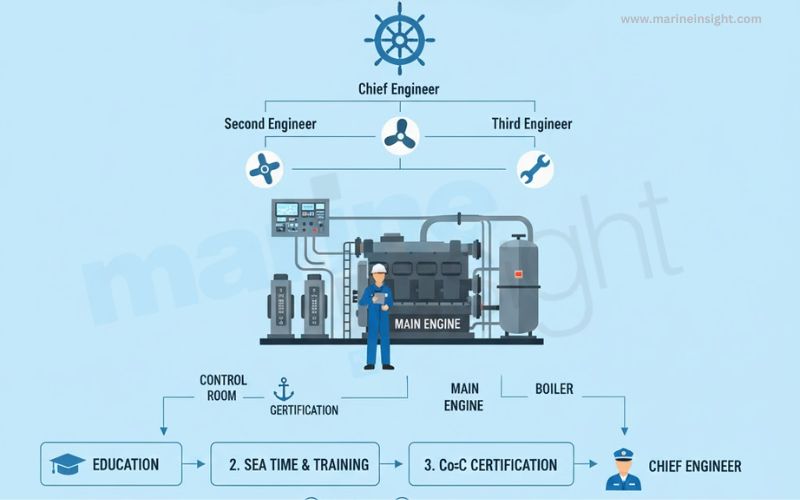
You need to do marine or mechanical engineering, complete the maritime training and sea time, obtain certifications like OOW or CoC from a STCW-compliant body such as the U.K, ensure you are physically fit, meet English/vision requirements, and ultimately progress from junior to chief engineer.
- Do a Bachelor’s in Marine Engineering, Mechanical Engineering, or Naval Architecture.
- Have a solid foundation in Physics, Chemistry, Math, and English.
- Try to get admission in renowned universities in the UK, USA, Netherlands, etc., for quality education, exposure and better career prospects.
- For mechanical graduates, a one-year Graduate Marine Engineering course is needed.
- Obtain certificates like Officer of the Watch (OOW), Engine Officer, and Chief Engineer’s Certificate of Competency (CoC).
- The UK CoC is internationally recognised.
- Gain experience through sea time in training or by joining ships as a junior engineer.
- Meet specific medical standards (vision, hearing, physical health) for sea service.
- Usually, IELTS/TOEFL or minimum marks in English are required.
- Ensure your training and certification meet the Flag State (country where the ship is registered) requirements and STCW standards for international work.
Best maritime colleges for Marine Engineering
| Name of Maritime Institution | Location | Highlights |
|---|---|---|
| Massachusetts Institute of Technology (MIT) | USA | Leader in ocean engineering and autonomous underwater vehicles |
| Shanghai Jiao Tong University | China | Consistently ranked #1 by ShanghaiRankings for Marine/Ocean Engineering research. |
| Delft University of Technology (TU Delft) | Netherlands | Famous for its "Ship Hydromechanics" and "Marine Technology" programs. |
| Norwegian University of Science and Technology (NTNU) | Norway | A European hub for maritime technology, specifically in green shipping. |
| University of Michigan | USA | One of the oldest and most prestigious Naval Architecture departments in the US. |
| University of Strathclyde | UK | A leading UK institution for marine technology and ship safety research. |
| World Maritime University (WMU) | Sweden | Considered the "Harvard of Maritime Studies" for postgraduate policy and management. |
| United States Merchant Marine Academy | USA | Known for its "Sea Year," where students spend a full year working on commercial vessels |
| Australian Maritime College (AMC | Tasmania | Has world-class hydrodynamic testing facilities and is the premier training ground for the Southern Hemisphere. |
| Indian Maritime University | India | With campuses in Chennai, Kolkata, and Mumbai (MERI), it is known for its marine engineering and other courses. |
| Dalian Maritime University | China | One of the largest maritime universities in the world, with over 50 years of history in seafarer training. |
| IIT Madras and IIT Kharagpur | India | Known for their Ocean Engineering and Naval Architecture degrees. |
| Webb Institute | USA | Offers a double major in Naval Architecture and Marine Engineering with full-tuition scholarships for US citizens. |
Salary of Marine Engineers In Merchant Navy
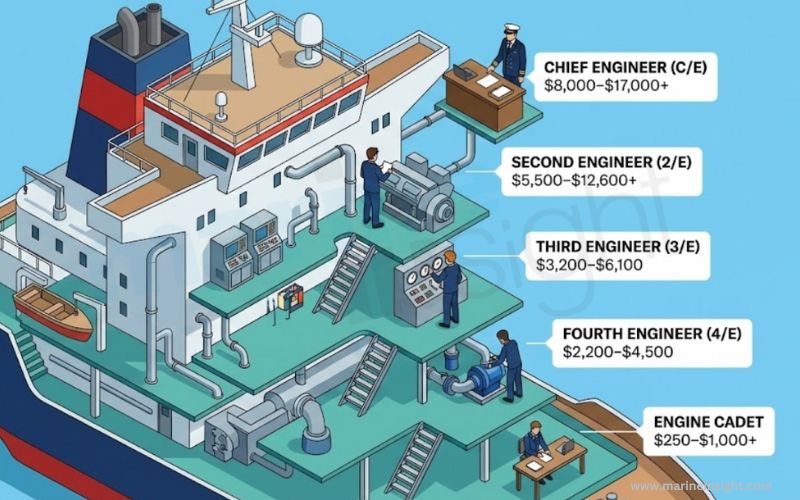
Marine engineers are paid based on their rank, the type of ship they work on, the company they work for, and their experience level. However, their salaries range from 2000 to 4000 USD per month, for a 4th Engineer, to more than 10,000 to 17,000 USD per month for a Chief Engineer. Cadets are paid less, as it is an entry-level position.
Monthly salary for marine engineers based on rank-
- Engine Cadet/Trainee: $250 – $1,000+
- Fourth Engineer (Junior): $2,200 – $4,500
- Third Engineer: $3,200 – $6,100
- Second Engineer (Management Level): $5,500 – $12,600+ (over $11,000 on tankers)
- Chief Engineer: $8,000 – $17,000+ (higher on tankers and specialised vessels)
A few points to remember-
- Oil tankers, LNG Ships and Offshore DP vessels pay more than container ships and bulk carriers.
- Big shipping companies pay more than 3rd party management companies.
- Higher MEO (Marine Engineer Officer) certificates and seniority translate to better pay.
- Sailing through high-risk areas leads to bonuses.
Key Offshore Roles For Marine Engineers
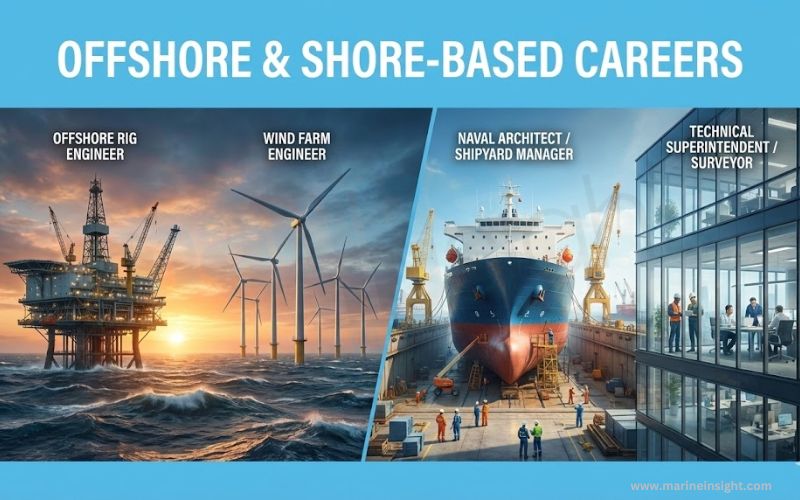
- Marine engineers can secure offshore employment if they choose not to sail.
- Rig Engineer: Maintain and operate drilling equipment and other systems on offshore rigs and structures.
- Maintenance Engineer: Oversee the upkeep of machinery and other vital equipment.
- Structural Engineer: Design and maintain offshore structures.
- Wind Farm Engineer: Design, install, and maintain floating offshore wind turbines.
- Marine Surveyor: Conduct vessel inspections to ensure safety and regulatory compliance.
- Work for DNV, Lloyd’s Register or Other Societies as surveyors or in a technical capacity.
- Naval Architect: Work in shipyards or companies to design new vessels and offshore structures.
- Oversee repairs, construction and maintenance of ships in shipyards.
- Become a fleet superintendent and manage a fleet of ships or a port engineer handling technical operations at a port facility.
- You can also become a marine consultant and offer maritime advice or go into the field of maritime training or education, where you can teach students aspiring to become seafarers.
Conclusion
Being a marine engineer is not easy. The position demands both physical and mental stamina. You might be covered in oil or grease after cleaning a centrifugal filter in the morning, and spend your afternoon analysing the engine indicator cards to calculate the indicated pressure of every cylinder to optimise combustion. If you are passionate and curious about ship machinery, solving problems and living a life at sea, then it might be the ideal career for you. However, you should be ready to work in high temperatures and noisy environments, but the sense of pride when the engine roars to life is worth everything.
You might also like to read-
- How to Become a Marine Engineer?
- Graduate Marine Engineering: Course, Eligibility, Admission, Syllabus, Top Colleges, Career
- B.Tech Marine Engineering: Eligibility, Syllabus, Colleges, Sponsorships, Admission, Career
- What is Marine Engineering: Courses, Job Description & Salary
- How to become a Marine Engineer after doing Mechanical Engineering?
Disclaimer :
The information on this website is for general purposes only. While efforts are made to ensure accuracy, we make no warranties of any kind regarding completeness, reliability, or suitability. Any reliance you place on such information is at your own risk. We are not liable for any loss or damage arising from the use of this website.

About Author
Zahra is an SEO-Strategist & a Technical Writer with over 5 years of experience crafting top-tier content for the shipping world. From news, articles, ebooks, blogs and marketing pieces to industry white papers, she has written it all and now brings that experience to her role as Senior Editor. She makes complex maritime stories clear, sharp, and engaging.
Disclaimer :
The information on this website is for general purposes only. While efforts are made to ensure accuracy, we make no warranties of any kind regarding completeness, reliability, or suitability. Any reliance you place on such information is at your own risk. We are not liable for any loss or damage arising from the use of this website.
Related Articles


⚓️ Enhance Your Knowledge. Prevent Accidents. Stay Safe at Sea.
1. eBooks for Engine Department
Master machinery operations, troubleshooting, and safety procedures with expertly written guides tailored for marine engineers. Prevent costly breakdowns and onboard accidents through practical knowledge.
👉 Explore Engine Department eBooks
2. eBooks for Deck Department
Sharpen your seamanship, navigation, and cargo-handling skills with real-world case studies and practical insights designed for deck officers and cadets.
👉Discover Deck Department eBooks
3. eBooks on Electrical Fundamentals & Issues
Understand marine electrical systems, identify potential faults, and prevent onboard electrical failures with step-by-step explanations from industry experts.
4. Pocket Guides for Quick Reference
Compact, handy, and loaded with essential checklists—perfect for on-the-go reference during operations and emergencies at sea.
5. Combo Packs to Save Big
Access multiple expert eBooks at discounted prices. Ideal for professionals seeking complete safety and operational knowledge across various ship departments.
6. Digital Maritime Courses – Learn at Your Own Pace
Upgrade your competence with Marine Insight Academy’s online courses. Learn from industry professionals anytime, anywhere, and become a safer, smarter seafarer.
Subscribe To Our Daily Newsletter
By subscribing, you agree to our Privacy Policy and may receive occasional deal communications; you can unsubscribe anytime.


BE THE FIRST TO COMMENT