
The Hidden Cost Of Gate Congestion At Ports
In September 2026, the container port of Nhava Sheva, Mumbai, experienced a long truck queue at its gates. The reason behind this was the current geopolitical situation developing in the Middle East; many cargo vessels were diverted to JNPT, increasing the surge in cargo intake, coupled with a shortage of trucks. This led to an increase in container dwell time, Gate-in taking longer than expected and long truck queues.
The FIFO principle (first in, first out) could not be implemented, which resulted in sequenced containers sitting longer in the yard and vessel connections being missed. The export cost rose as the container price also rose dramatically, hitting small and mid-cap businesses.
The chain reaction of the gate congestion was felt in all parts of the port operation, as the trucks were not able to enter with the goods which were assigned to a ship, leading to more delays.
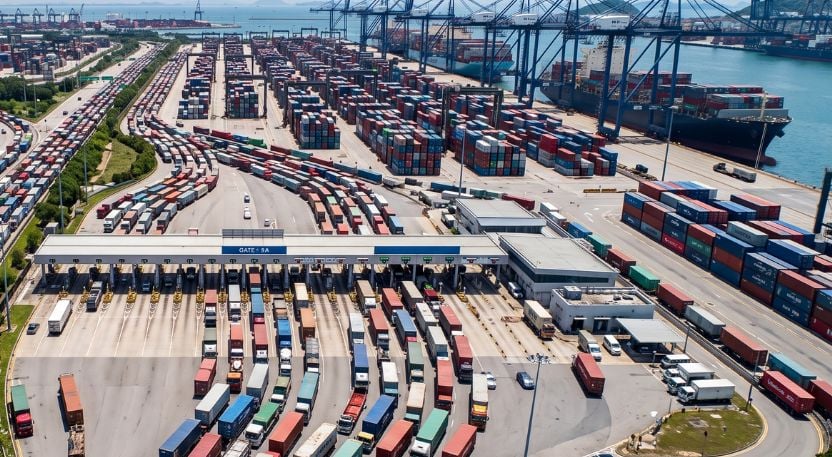
A container gate may look merely like a simple entry-exit point; however, it holds a very critical operational value, as any delay at the gate can impact the export-import volume for the nation.
Congestion isn’t always where you see it
Before we blame everything on the gate, the first thing is to understand where the congestion is developing from. A long truck queue outside the terminal does not always mean it is a gate problem; it can be a problem which has developed someplace else in the port supply chain but is prominently visible at the gate, leading to a bottleneck.
The congestion problem may depend on the capacity of the terminal. If suddenly, for any reason, the terminal is receiving more cargo than usual, as was the case at JNPT for the last few months, it will lead to congestion. If the yard operation is not managed properly, where the first-in, first-out methodology is not followed, and there is no automation in tracking and placing the goods in the right place, it will add to the lead time.
The infrastructure of the port, including roads, parking, bay space, space in the yard, etc., plays a critical role in how smoothly the trucks can do their work. Another important aspect is customs and administration, along with the documentation they demand. If these processes are manual or fragmented, it will lead to queuing of port trucks and lead to congestion.
All these reasons can come together and work together if they are working in silos and are not connected, leading to delays affecting import evacuation and export intake for the designated vessel. For the terminal operators, it is critical to know where the bottleneck is being created and how it can be streamlined.
How does congestion affect the supply chain?
The port and ship infrastructure run the global economy and are interdependent entities, and disruption at one point can affect the operation of the other. A congested port not only affects the land side of operations, but it also hurts the schedule of the vessel and leads to vessel cut-offs, which means the container which was meant to be loaded at this port did not make it to the ship, and it has to either wait or go empty to maintain its running schedule.
The shipper will also face difficulty in evacuating the imported containers from the terminal. All this chaos affects the pricing of the associated port services, including labour, increased truck costs, etc.
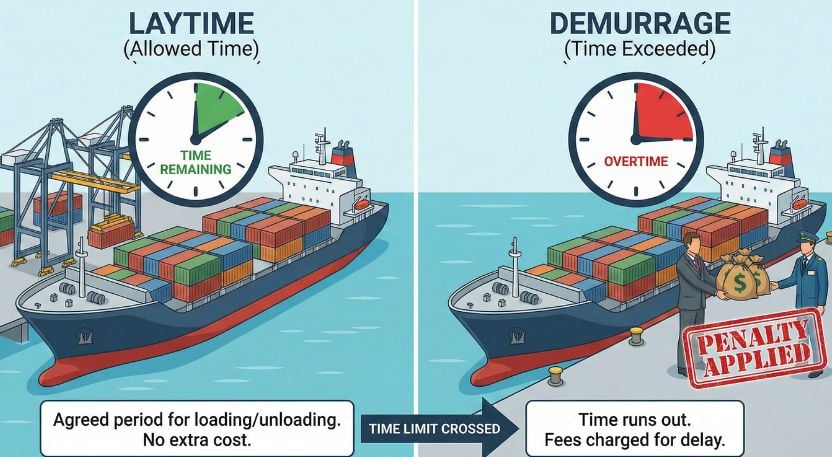
Longer dwell time can lead to port charges, demurrage and detention charges, adding to the expense of the cargo owner, resulting in inventory disruption and uncertainty in the delivery dates for the businesses involved.
Importance of experienced customs broker
During any kind of disruption, the shipper often relies on experienced customs house agents or CHA who have a good situational understanding and information about how the current situation will be unfolding, including gate congestion, truck availability and ETA/ ETD status of the goods. With this information, a customs broker can avoid sending the truck to an already overcrowded and congested gate. This can prevent or minimise the chain reaction and help reduce the pressure on already pressed-up gates, which are the bottleneck.
The hidden cost is the lack of visibility
When there is congestion in the terminal, it adds to the difficulties and becomes harder to manage if the terminal operators do not have visibility of the various systems that work together in the terminal. In a typical containerised flow, the cargo movement is as shown in the image below.
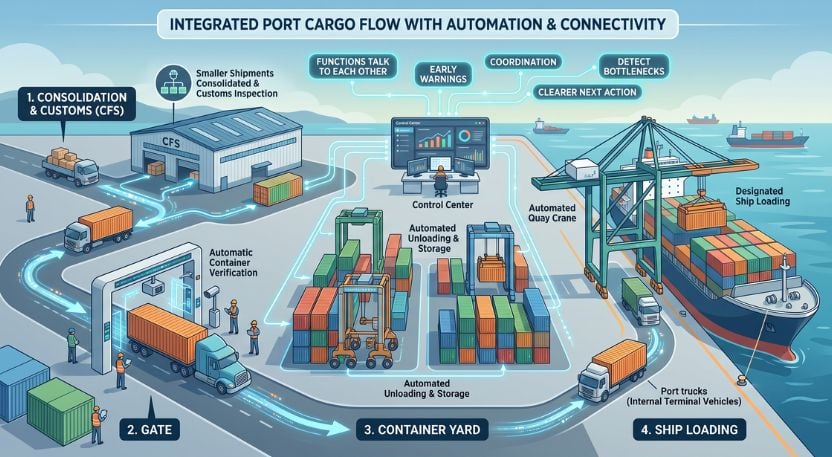
The truck carrying the cargo usually goes to the Container Freight Station, where smaller shipments from multiple businesses are consolidated into one container, and customs also inspects the container at the CFS.
After customs clearance, the truck takes the goods to the gate, where the container is verified. It then goes to the yard, and the container is unloaded there. From the yard, the container will be loaded onto the designated ship using the port trucks and cranes.
When these different functions, which are responsible for the flow of the goods, are connected using automation, they can inform and talk to each other; the operator can get earlier warnings for better coordination and can detect bottlenecks at an early stage for clearer next action.
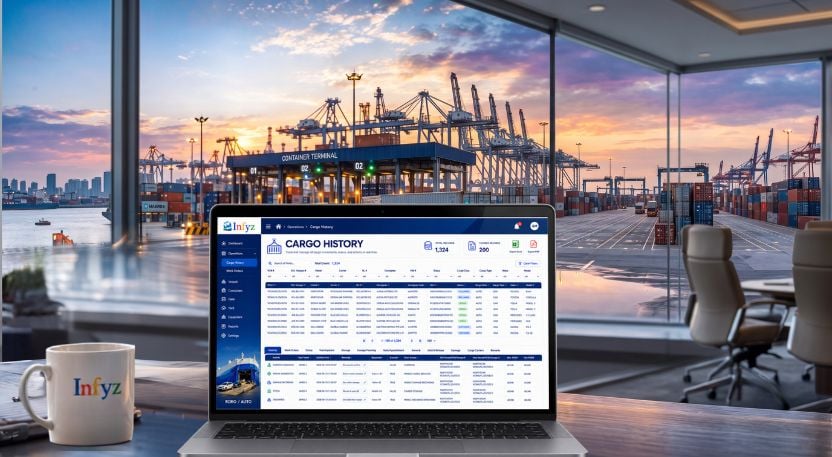
Infyz ITOMs is one of the practical ToS which provides connected visibility to the operators to fill the coordination gaps. It is a connected system which includes gate, yard, cargo and operational information in one place, giving the terminal operator and port management team a broader view which goes beyond what is happening at the gate.
Operators cannot control geopolitics, strikes or weather; with a system like ITOMs, they have the technological assistance in their hands to see and predict the entire terminal operation.
You might also like to read-
- Port Automation: The Reality Nobody Tells You
- The $6.9 Billion Cost of Non-Automated Port Operations: Why Delays Are Becoming More Expensive
- Why Modern Terminals Are Replacing Legacy Software with AI?
- What Can Operators Expect From a Modern Terminal Operating System (TOS) ?
- Small Ports Don’t Need Rotterdam’s Budget To Automate – Here’s What They’re Doing Instead
- Inside the Terminal’s Digital Twin: What Real-Time Yard Visibility Looks Like
- What Happens When An Automated Terminal’s System Goes Down?
Disclaimer :
The information on this website is for general purposes only. While efforts are made to ensure accuracy, we make no warranties of any kind regarding completeness, reliability, or suitability. Any reliance you place on such information is at your own risk. We are not liable for any loss or damage arising from the use of this website.

About Author
Founded in 2007 and headquartered in Hyderabad, India, Infyz Solutions is a premier technology company specialising in cloud-native and AI-enabled software solutions for the ports, shipping, and logistics industries. With nearly two decades of domain excellence, Infyz empowers terminal operators and logistics providers worldwide through its flagship suite of enterprise products, including iTOMS (Terminal Operations Management System), iNauka (Maritime & Shipping Operations), iVBS (Vehicle Booking System), iEPS (Equipment Processing System), iDepot (Container Depot Management System) and iCLMS (Cargo Logistics Management System).


Disclaimer :
The information on this website is for general purposes only. While efforts are made to ensure accuracy, we make no warranties of any kind regarding completeness, reliability, or suitability. Any reliance you place on such information is at your own risk. We are not liable for any loss or damage arising from the use of this website.
Related Articles


Subscribe To Our Daily Newsletter
By subscribing, you agree to our Privacy Policy you can unsubscribe anytime.


BE THE FIRST TO COMMENT