
From Cost Centre To Commercial Edge: How Shipping Companies Are Turning Emissions Compliance Into Leverage
Maritime emissions compliance is evolving from an administrative burden into a commercial strategy. As shipowners and managers navigate a complex framework of overlapping schemes, including the EU ETS, the newly live UK ETS, and FuelEU Maritime, the gap between meeting regulations and effectively managing them is widening.
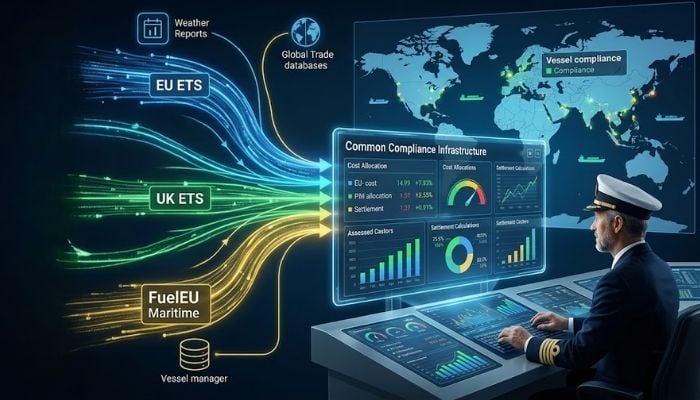
The following discussion breaks down how operators and managers can unify their compliance infrastructure, optimise charterparty cost recovery, and monetise environmental performance to turn regulatory mandates into a competitive edge.
1. 18 months ago, the EU ETS was the only carbon compliance conversation in the room. Now the UK ETS is live too. How has that changed the day-to-day reality for compliance and finance teams?
The main change is that compliance teams are now managing several regulatory and commercial processes at the same time. UK ETS has a much narrower scope than EU ETS today; hence, the immediate financial exposure may be small for many international shipping companies. But that does not make the work behind it proportionally smaller.
Companies still have to identify the emissions covered by UK ETS, manage a separate allowance type, establish the relevant reporting and registry processes, and determine how costs should be allocated between owners, managers and charterers. Finance teams then need those calculations to flow correctly into invoices, settlements and reconciliation.
What makes this challenging is the overlap. A shipping company does not manage EU ETS, UK ETS and FuelEU Maritime in completely separate operational worlds. The same vessel, voyage and charter party can feed into several regulatory and commercial processes. As more schemes are added, relying on separate spreadsheets and workflows for each one becomes difficult to manage.
That is why the focus is shifting towards having a common compliance infrastructure. We have now added UK ETS to OceanScore’s Compliance Manager so that companies can handle it alongside EU ETS and FuelEU Maritime, rather than creating another standalone process.
For compliance and finance teams, that means keeping the additional regulation manageable while maintaining consistent data, cost allocation and settlement processes across the different schemes.
2. UK ETS’s first allowance surrender isn’t due until 2028, unlike EU ETS’s annual deadline. Is that longer runway a relief for owners, or does it risk creating a false sense of security?
It gives owners some breathing room, but the risk is assuming that a later surrender deadline means UK ETS can also be dealt with later. The scheme is already in force, and the work starts well before allowances ultimately need to be surrendered.
Companies need to establish which emissions are in scope, distinguish their UKA exposure from their EUA exposure, put the necessary reporting and registry processes in place, and decide how costs and responsibilities will be handled between owners, managers and charterers.
Those processes also need to connect with invoicing and settlement, so there is value in getting them right early rather than waiting for the surrender deadline.
There is also the prospect of UK ETS becoming more significant. The UK Government has indicated that it intends to expand the scheme to voyages to and from the UK from around 2028. If that happens, the emissions exposure could increase substantially, while the basic processes companies need will remain largely the same.
So I would use the longer runway as an opportunity to integrate UK ETS efficiently into existing compliance processes. The aim should be to make it a small operational addition today, so companies are ready if and when the scope becomes much larger.
3. You describe this shift as going “from cost centre to commercial edge.” At what point does a compliance obligation actually start generating commercial value?
It starts when companies look beyond the obligation itself and understand the commercial choices around it. Compliance will always have a cost, but the outcome depends on how well companies manage that cost and the opportunities created by environmental regulation and performance.
FuelEU Maritime is a good example. A company with a compliance surplus has an asset that can be banked or monetised through pooling, while a company with a deficit can compare different ways of achieving compliance. The first compliance cycle has shown that the economics can shift significantly depending on factors such as fuel and carbon prices, so compliance decisions are becoming commercial decisions as well.
There is another important dimension for owners and managers: cost recovery. It is not enough to calculate the regulatory cost correctly. Companies also need clear charterparty or SHIPMAN arrangements defining what can be charged to customers, and then need to manage the underlying compliance cost efficiently. The difference between those two can have a direct impact on the commercial result.
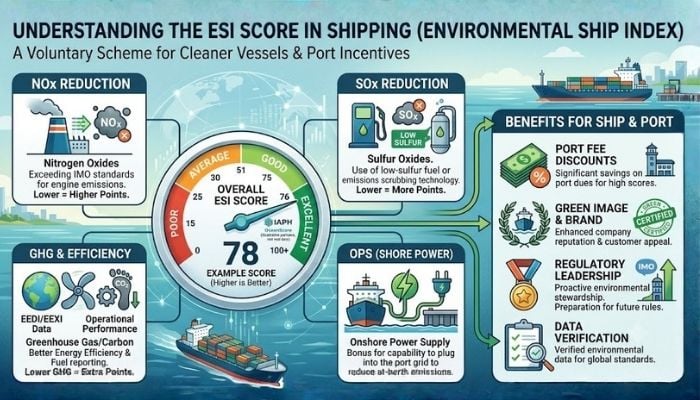
And value can also come from environmental performance outside mandatory regulation. Through Environmental Ship Index (ESI), for example, vessels with good environmental performance can receive reduced port dues at participating ports. So the commercial edge comes from being able to see the full picture: where environmental requirements create costs, where those costs can be recovered or optimised, and where better environmental performance can generate additional value.
4. Walk us through how ESI works in practice; how does a vessel’s environmental score translate into an actual discount at the port gate?
ESI is designed to make that connection quite straightforward. A vessel provides a limited set of environmental data, which is used to calculate an ESI score from 1 to 100, reflecting its environmental performance beyond the relevant IMO standards. Participating ports then determine how they translate that score into a monetary incentive. Some ports set a minimum ESI score that a vessel must reach before an incentive applies, while others offer benefits starting from a score of 1 and increase the incentive as the score rises.
For the vessel operator, the important part is that the process requires little ongoing effort. Once the vessel participates and has an ESI score, eligible reductions can be applied by participating ports without the operator having to identify and apply for every individual incentive. Today, more than 100 ports and over 7,200 vessels participate in ESI globally.
The financial benefit depends on the vessel, its score and where it trades, but it can become meaningful quite quickly. For some vessels, one or two eligible port calls can already offset the annual participation cost, while frequent calls at participating ports can generate more substantial savings.
5. For an owner already buried in EU ETS and UK ETS reporting, what’s the real incremental effort required to also participate in ESI?
The incremental effort is relatively small, particularly compared with adding another regulatory regime. ESI largely relies on environmental data that shipping companies already handle as part of their existing compliance and performance management processes. From 2027, reporting will also be streamlined to one annual submission, closely aligned with the IMO DCS reporting cycle, helping to keep the additional administrative burden low.
Unlike the EU ETS or UK ETS, ESI does not introduce another complex compliance and settlement workflow. It is an opportunity to use environmental performance to access incentives at participating ports.
Many vessels may already qualify based on how they operate today. So participation is not necessarily about making additional investments or changing vessel operations; it can simply be about making existing environmental performance visible and ensuring its commercial value is captured.
That makes the effort-to-value equation quite attractive: limited additional administration and the opportunity to generate financial benefits from environmental performance and data that companies may already have in place.
6. If you had to give one piece of advice to a mid-sized owner still treating all of this- EU ETS, UK ETS, ESI- as just another cost of doing business, what would it be?
My advice would be to look beyond the cost itself and focus on how well you manage it. With the EU ETS and UK ETS, the commercial outcome is not determined only by the allowance price. It also depends on whether costs are allocated correctly, whether the right charterparty or SHIPMAN mechanisms are in place, and whether those costs can be recovered efficiently from the relevant counterparties.
At the same time, environmental performance is starting to create opportunities as well as costs. ESI is a good example: a vessel may already qualify for reduced port dues based on its existing performance. FuelEU adds another dimension, with choices around pooling, compliance surpluses and different pathways to compliance.
The key is having the data and processes to see both sides of that equation. As more schemes emerge, managing each one through separate spreadsheets and workflows makes it harder to understand the true commercial position and increases operational risk.
So rather than asking only “What is compliance costing us?”, owners should also be asking “Are we recovering those costs where we can, managing them efficiently, and capturing the value our environmental performance already creates?” That is where compliance starts becoming part of commercial management rather than simply another overhead.
7. What’s the single biggest misconception shipowners have about what “being compliant” actually gets them commercially?
The biggest misconception is that compliance itself equals commercial success. Being compliant means meeting the regulatory requirement, but it says very little about whether the associated costs and opportunities have been managed well.
For EU ETS and UK ETS, two companies can both be fully compliant and still achieve very different commercial outcomes. The difference can come down to how accurately costs are allocated, whether contractual mechanisms allow those costs to be recovered, and how efficiently invoicing and settlements are handled.
The same principle applies more broadly. FuelEU creates choices around pooling and compliance surpluses, while ESI can reward environmental performance through reduced port dues. These opportunities do not materialise simply because a company is compliant; they need to be identified and actively managed.
So compliance is really the baseline. The commercial advantage comes from understanding what the data means financially and using it to make better decisions- controlling and recovering costs, reducing risk and capturing value where environmental performance creates an opportunity.
You might also like to read
- Understanding Compliance Under Fuel EU Maritime
- Interview With Castrol’s Global Technical Services Director On 2015 ECA Compliance For Ships
- Building Confidence For 2020 Compliance
- The Green Marine Environmental Program: A General Overview
Disclaimer :
The information on this website is for general purposes only. While efforts are made to ensure accuracy, we make no warranties of any kind regarding completeness, reliability, or suitability. Any reliance you place on such information is at your own risk. We are not liable for any loss or damage arising from the use of this website.


Disclaimer :
The information on this website is for general purposes only. While efforts are made to ensure accuracy, we make no warranties of any kind regarding completeness, reliability, or suitability. Any reliance you place on such information is at your own risk. We are not liable for any loss or damage arising from the use of this website.
Related Articles



About Author
Founded in 2020 by industry veterans Jörg Molzahn and Albrecht Gundermann, OceanScore equips the shipping industry with digital solutions to handle complex environmental regulations like the EU Emissions Trading System (EU ETS), FuelEU Maritime and UK ETS, which increasingly influence commercial decisions, including fuel strategies, charter party negotiations and emissions cost management.
Subscribe To Our Daily Newsletter
By subscribing, you agree to our Privacy Policy you can unsubscribe anytime.


