
Download 18 FREE Maritime eBooks
What are Semi-Displacement Vessels?
A vessel’s hull is one of the essential functional structures which protects its cargo space, machinery, and equipment from harsh outer conditions while maintaining stability in water. Three common types of hulls include planing, displacement, and semi-displacement hulls. Semi-displacement vessels have characteristics of both planing and displacement hulled vessels.
Most vessels have a displacement hull that adheres to the classical laws of simple weight-buoyancy relationship, or in other words, the Archimedes’ Principle. The entire weight is supported by the buoyant force derived from the volume of water displaced by the hull, which is nothing but the vessel’s displacement.
Planing hulls are governed by a complex and much more exciting principle. Above a certain speed, the forward part of the vessel remains somewhat above water due to the hydrodynamic lift. The rest of the ship or the hull’s submerged surface is supported by the balance buoyancy, which is reduced as it doesn’t support the part of the hull above water. As a result, the vessel encounters decreased frictional or viscous resistance.
The hydrodynamic pressure is proportionately efficient at higher speeds, and such vessels are designed to operate beyond a threshold speed. Hence, planing crafts are fast and have high powering requirements to attain desired speeds. Though planing crafts come in a wide range of sizes, such hulls are not for larger vessels as it would be difficult to achieve the hydrodynamic lift.
Semi-Displacement Crafts and the Physics of Planing
Before delving into semi-displacement hulls, let us understand the physics of planing. Let me begin by asking a question: How many of you have ever skimped stones or pebbles in a pond or river during the good old days or even have kept the child in you alive till now? Most of us have or still do if given a chance!
So, during this fun activity, we hold the stone or pebble at a certain angle and then lodge it into the water with significant force. The stone merrily glides or jumps over the water surface for some time before slowing down and inevitably sinking. In this case, the stone or the pebble initially has a considerable amount of energy which helps it skimp over the water for some time.
When this energy dissipates, it loses its velocity and slows down. At this instant, Archimedes’ principle comes to play once again. The actual weight of the stone now acts directly on the water surface. In other words, now it is subjected to only hydrostatic forces. For rock, the dimensions and the weight distribution are unsuitable for being supported by the reactionary influence of buoyancy that is dependent on the displacement. As a result, the restoring force of buoyancy gets overpowered by the weight, and the stone sinks.
This is precisely the case for planing and, to some extent, for semi-displacement crafts. At high speeds, the vessel acts as a ‘skimping stone’ where there is an immense amount of hydrodynamic lift or dynamic pressure, which keeps most of the ship above the water surface. As a result, the forward and the middle sections remain above water without getting immersed.
However, they have two significant differences compared to a simple skimping stone. The skimping stone glides over the water surface only for a few moments because it is subjected to the limited physical force from your hand. Soon it drowns as the energy to continue in its initial state of motion runs out. It is overpowered by water resistance and stalls to a halt before sinking.
However, for a planing or semi-displacement craft, the power is supplied by a high-load engine or motor. The high speed is persistently maintained to help generate the desired hydrodynamic lift or pressure. And of course, when the rate reduces, or the craft even comes to a halt, it acts like any other typical displacement vessel.
It follows the linear weight-buoyancy relationship, which helps it remain afloat based on its displacement. The hydrodynamic forces diminish, and purely hydrostatic forces are in action now. On the other hand, as it comes to rest, the stone behaves like any other non-floatable stone and sinks in no time!
Now let us briefly discuss how this hydrodynamic pressure is generated at high speed. When the hull surface is at an angle to the water surface, known as the angle of attack, the following forces distribution occurs.
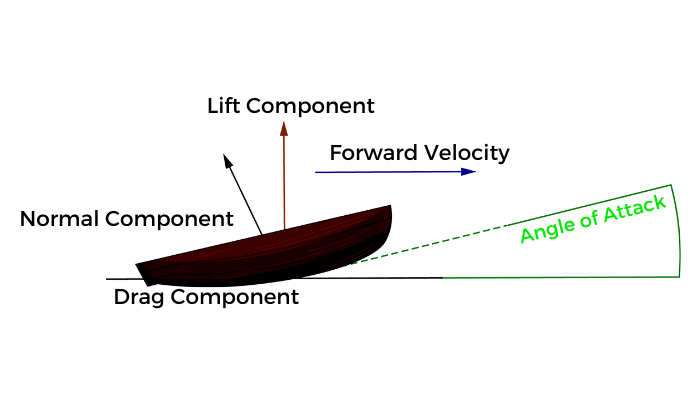
Newton’s third law shows that the reaction force at that particular orientation can be divided into two components in the horizontal and vertical directions. The horizontal component is the drag, which is a form of resistance. And the upward part is the basis for the design of all planing and semi-displacement/semi-planing hulls, called the dynamic lift. This is similar to the aerodynamic lift for aerofoil designs.
The extent of this hydrodynamic lift is directly dependent on the forward velocity of the body. For the same reason, the speed needs to be maintained above a specific high value for planing characteristics. As the speed reduces, the lift gradually diminishes, and the upthrust or buoyant force becomes predominant, making the vessel act like a traditional displacement-type craft. Since less surface is submerged in planing conditions, the frictional and wave resistance is also low.
However, planing crafts are less efficient at low speeds, are uncomfortable compared to displacement hulls, and are less stable. On the other hand, displacement crafts cannot attain very high rates. A semi-displacement or semi-planing craft combines and optimizes the positive features of both planing and displacement types.
It is purely displacement at lower speeds and is planing at higher speeds. In both scenarios, it is equally very efficient. Compared to planing hulls, at low speeds, it has better stability and propulsive characteristics, almost similar to displacement crafts. Also, they are hydrodynamically more efficient and attain higher rates owing to their design and lift-generating ability.
Semi-planing crafts can attain better planing abilities at lower speeds than purely planing crafts. Thus, they perform better than planing vessels at moderate or intermediate rates. However, their maximum speeds remain lower than planing.
During planing, the portion of the hull able to surf above the water surface is also lower than the planing crafts, and this is mainly the forwardmost bow region. This is also known as ‘semi-plane.’ Moreover, owing to their comparatively fuller form compared to planing crafts, they have increased storage space.
They have lesser drafts as compared to fully displacement vessels. This amounts to a less wetted surface and less water resistance. This is why they can generate more speed at the same engine load compared to fully displacement ones.
Design of Semi-Displacement Hulls
Like their characteristics are suited to a wide range of speeds, their design is an optimum blend of planing and displacement. They are fuller in form like displacement-type vessels, but at the extreme forward and aft ends, they are more like planing crafts.
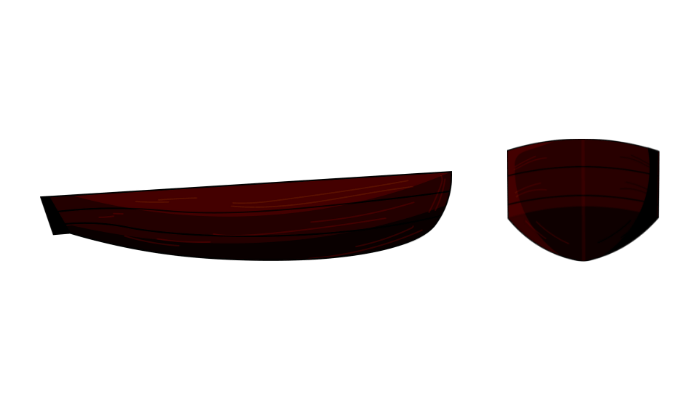
Semi-displacement vessels have a flattened aft for better lifting and trimming capabilities which turns bulky towards the front. Their middle body is bulkier and voluminous, with broad shoulder lines. Most of their weight is supported by buoyancy that changes towards the bow region, which is fine and narrow like planing vessels. However, their hull form at the bow is deeper than planing, like a deep-V.
They commonly have a chine hull, making them stable at all speed ranges. Sometimes their stability and sea-worthiness are even better than fully displacement hulls.
They have a lower draft and hence, lower frictional resistance than displacement-type vessels. For higher speeds, only the fine bow region tends to lift above the water surface, whereas most hull remains balanced by buoyant forces.
You might also like to read
- Intact Statical Transverse Stability Of Displacement Vessels
- The Ultimate Guide to Different Types of Boats – Top 20
- What is a SWATH Ship?
- 4 Types of Anti-fouling Systems Used on Board Ships to Prevent Marine Growth


Disclaimer :
The information on this website is for general purposes only. While efforts are made to ensure accuracy, we make no warranties of any kind regarding completeness, reliability, or suitability. Any reliance you place on such information is at your own risk. We are not liable for any loss or damage arising from the use of this website.
Related Articles

About Author
Subhodeep is a Graduate of Naval Architecture and Ocean Engineering. He has deep interest in marine structures and goal-based design aspects, and is dedicated to sharing and propagating technical knowledge of the industry.
Disclaimer :
The information on this website is for general purposes only. While efforts are made to ensure accuracy, we make no warranties of any kind regarding completeness, reliability, or suitability. Any reliance you place on such information is at your own risk. We are not liable for any loss or damage arising from the use of this website.
⚓️ Enhance Your Knowledge. Prevent Accidents. Stay Safe at Sea.
1. eBooks for Engine Department
Master machinery operations, troubleshooting, and safety procedures with expertly written guides tailored for marine engineers. Prevent costly breakdowns and onboard accidents through practical knowledge.
👉 Explore Engine Department eBooks
2. eBooks for Deck Department
Sharpen your seamanship, navigation, and cargo-handling skills with real-world case studies and practical insights designed for deck officers and cadets.
👉Discover Deck Department eBooks
3. eBooks on Electrical Fundamentals & Issues
Understand marine electrical systems, identify potential faults, and prevent onboard electrical failures with step-by-step explanations from industry experts.
4. Pocket Guides for Quick Reference
Compact, handy, and loaded with essential checklists—perfect for on-the-go reference during operations and emergencies at sea.
5. Combo Packs to Save Big
Access multiple expert eBooks at discounted prices. Ideal for professionals seeking complete safety and operational knowledge across various ship departments.
6. Digital Maritime Courses – Learn at Your Own Pace
Upgrade your competence with Marine Insight Academy’s online courses. Learn from industry professionals anytime, anywhere, and become a safer, smarter seafarer.
Subscribe To Our Daily Newsletter
By subscribing, you agree to our Privacy Policy and may receive occasional deal communications; you can unsubscribe anytime.
WHAT ABOUT STABILITY IN HIGH SEAS ROUGH WEATHER???