The U.S Navy Cruiser That Sailed Home Missing One-Third of Her Hull During WWII
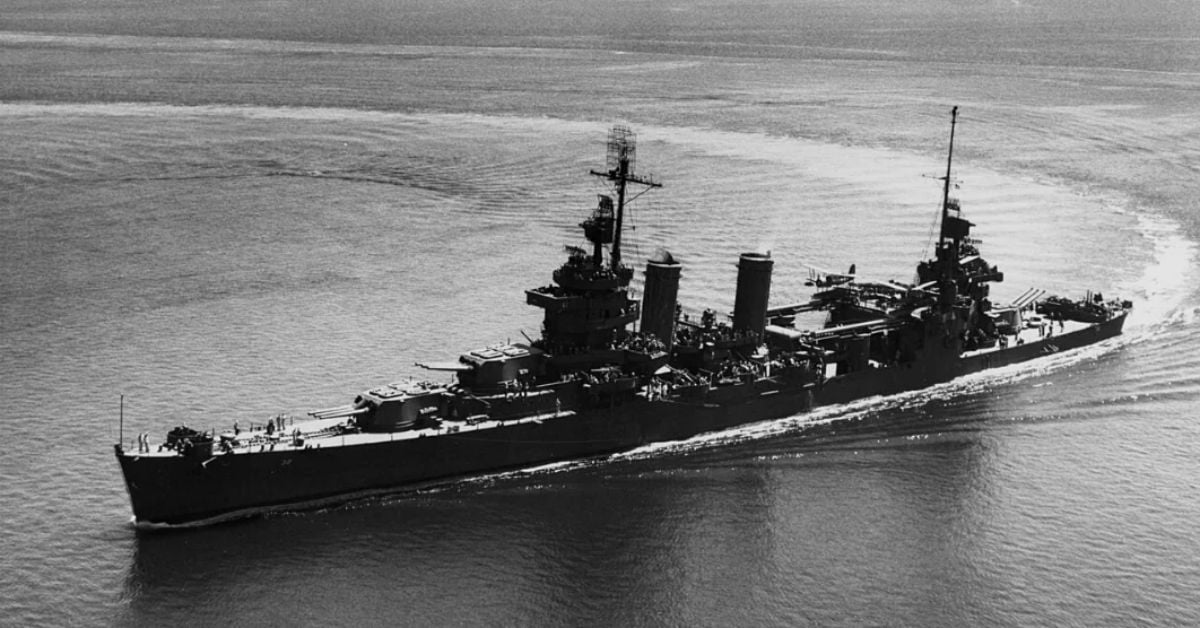
Researchers onboard the Exploration Vessel Nautilus found the damaged bow of the Second World War Cruiser USS New Orleans (CA-32) on July 7, 2025, at a depth of about 675 m in Iron Bottom Sound close to Guadalcanal, Solomon Islands.
Led by the Ocean Exploration Trust (OET) during the Maritime Archaeology of Guadalcanal expedition, the uncrewed surface vessel DriX identified the wreck while mapping the seabed, after which an ROV was used to capture its images.
These were later compared with the anchor collar and structural details to pre-war and dry-dock photos of the USS New Orleans.
The USS New Orleans was saved by its crew after it suffered damage from a Japanese ‘long-lance’ torpedo during the battle of Tassafaronga on November 30, 1942. An explosion detonated its forward magazines, which killed 182 crew and tore off one-third of the vessel, including the bow.
The ship began taking in water after the attack; however, its damage control crew remained at their positions and saved it from sinking, at the cost of their own lives.
The damage control officer, US Navy Lieutenant Commander Hubert M. Hayter, and two of his men, Lieutenant Richard A. Haines and Ensign Andrew L. Forman, died due to inhaling toxic fumes and received posthumous Navy Crosses.
The chaplain, Howell M. Forgy, wrote about Hayter that he was not afraid in the situation. Ultimately, the limping vessel reached the Tulagi harbour, where the crew used coconut logs to stabilise it and sail back to the U.S for repairs.
A piece of the coconut log bow was displayed during a special exhibition, ‘The Pelican State Goes to War: Louisiana in World War II’ at The National WWII Museum in New Orleans.
The Naval History and Heritage Command Director, Samuel J. Cox, a retired rear admiral, said that the ship would have sunk if not for the heroic efforts of its crew, which made it the most damaged U.S cruiser in the Second World War to survive.
Chief Scientist of the Ocean Exploration Trust, Danile Wagner, said that the discovery of the USS New Orleans wreck shows the power of several experts, including scientists and technologies, working together to achieve a common goal.
The USS New Orleans was the lead ship of the New Orleans-class of the U.S Navy and the first seven such ships built for the US Navy in the 1930s.
The class represented the last cruisers constructed according to the specifications laid down by the 1922 Washington Naval Treaty, earning them the name Treaty Cruisers.
The USS New Orleans was classified as a light cruiser due to the thin armour, but was then reclassified as a heavy cruiser due to her 8-inch guns.
The cruiser was part of many important battles, including the one at Pearl Harbour on December 7, 1941, in the Marianas, the Okinawa and the Philippines campaigns. It was awarded 17 battle stars for serving in the Pacific Theatre.
Iron Bottom Sound, where the shipwreck has been found, is the resting place of over 111 naval ships, 1450 aircraft from allied forces and the Empire of Japan.
Explorer Robert Ballard, the leader of the Ocean Exploration Trust, has been exploring wrecks in the region; however, just 30 have been identified till now.
Disclaimer :
The information on this website is for general purposes only. While efforts are made to ensure accuracy, we make no warranties of any kind regarding completeness, reliability, or suitability. Any reliance you place on such information is at your own risk. We are not liable for any loss or damage arising from the use of this website.


About Author
Zahra is a maritime writer with 6 years of technical writing experience spanning port operations, offshore wind, oil and gas, and maritime policy. Her analytical edge...Read More ->
Disclaimer :
The information on this website is for general purposes only. While efforts are made to ensure accuracy, we make no warranties of any kind regarding completeness, reliability, or suitability. Any reliance you place on such information is at your own risk. We are not liable for any loss or damage arising from the use of this website.
Subscribe To Our Daily Newsletter
By subscribing, you agree to our Privacy Policy you can unsubscribe anytime.