
Different Parts Of A Ship Explained
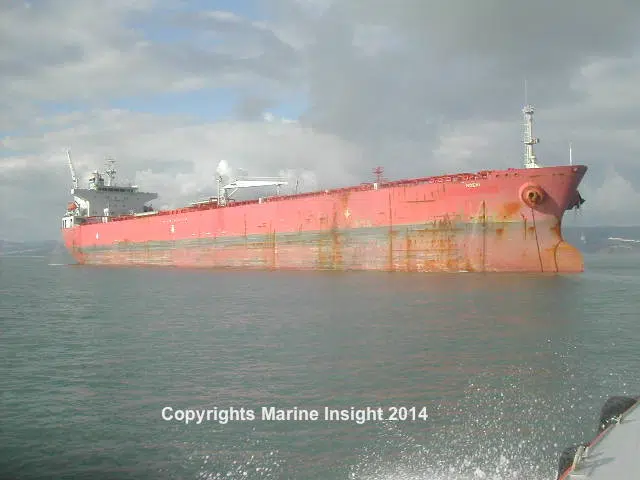
All types of cargo ships, be it container vessels, bulk carriers, oil tankers or Ro-Ro vessels, have 3 main parts: namely the hull, the engine room and the navigation bridge. Understanding their role is important, along with categorising other structures, both visible, including the bow, propeller, stern and rudder, and those which are hidden, such as cargo holds, ballast tanks, bulkheads, etc which will be discussed in this article to offer a clear understanding of a modern ship’s anatomy.
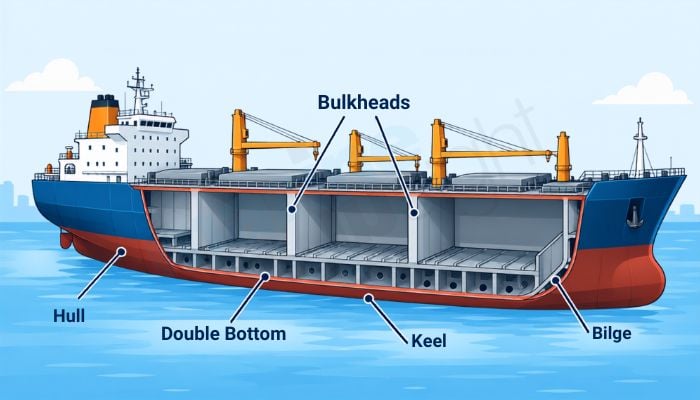
Primary Structural Parts Of A Ship
Hull
It is a ship’s watertight body which keeps it buoyant or afloat. All other components are connected to it or sit within the hull, which might be open or partially covered with a deck. A hull has several watertight decks and bulkheads. Most hulls are built of steel, which makes them sturdy enough to withstand saltwater, powerful waves and rough weather.
The Keel
Just like a human spine supports the body, the keel supports the entire frame of a ship. It runs from the bottom centreline along the length of the vessel from the front to the back, i.e from the bow to the stern. Builders construct a vessel around the keel, and laying it is the first step in starting construction. The keel helps to distribute load across the ship evenly and lowers its centre of gravity, thereby keeping it balanced even in rough waters.
Bulkheads
These are upright watertight walls inside the hull which act like an internal partition, dividing the ship into different compartments or sections. Bulkheads strengthen the ship and prevent it from twisting under heavy loads at sea. In case of emergencies like flooding, they trap water in one of the compartments, allowing the vessel to remain afloat. They also act as a barrier and prevent fire from spreading to the entire ship. They also separate different kinds of cargo and machinery spaces from each other.
Double Bottom
This is a hull design with two watertight layers of plating at the bottom, which provide strength and create a safety barrier in case of collision or grounding. For example, if the outer layer hits a rock, the inner layer prevents water from gushing into the cargo holds or engine room. International Maritime Organization’s SOLAS Convention states that passenger ships and large cargo vessels must have double bottoms.
Bilge
Bilge is the lowest section of the hull where water, waste liquid and oil naturally collect as a result of routine operations. It lies on each side of the keel at the bottom of the ship, and the water from it is pumped overboard using dedicated equipment.
The Front & Back, Commonly Called Bow & Stern
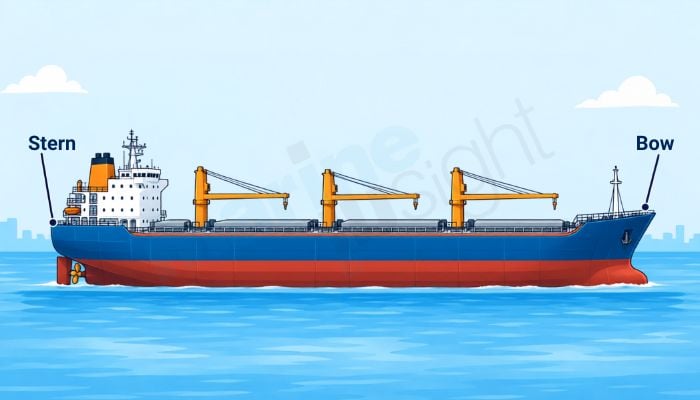
Bow
It is the front or forward part of a ship, shaped like a point or wedge to cut through the waves, reducing drag and keeping excessive water from splashing on the deck. It houses equipment such as the anchor, anchor pit and anchoring chain. Many vessels have a bulbous bow, which is a round projection below the waterline which enhances fuel efficiency by 10 to 15%.
Stern
The aft-end structure of a ship is called its stern, which reduces vibrations and maximises propulsion efficiency. It can be flat, tapered or have a sharp profile, and terminates at a surface called the transom, which works as a point to mount equipment. It houses the rudder, propellers, engine, cockpit, engine controls, steering gear systems and stern access points.
Sides Of Ship
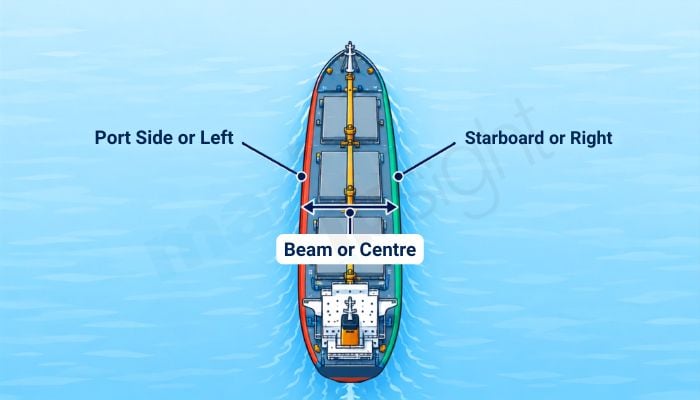
- Starboard or Right: If one looks at the vessel from the stern, the part to the right is termed starboard.
- Portside or Left: If we look at the ship from the stern, the left side is the port side.
- Beam or Centre: It is the hull’s widest part, located in the ship’s middle.
Navigation & Superstructure Components
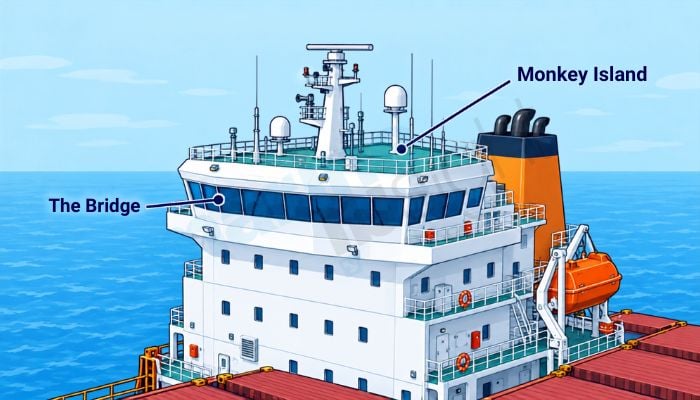
The Bridge
This is the commanding station of a vessel, which has deck machinery, the main engine and navigation systems. The crew can control the ship’s speed and direction, monitor the weather and sea conditions and maintain lookout from the bridge. They can also determine or fix the ship’s position using GPS or electronic charts and maintain communication with the engine room or with other ships or shore authorities. Modern vessels have electronic navigation equipment, which is now mandatory under international maritime law to ensure compliance with SOLAS.
Monkey Island
Monkey Island is a sort of deck located at the topmost accessible height of the ship and just above the bridge. This part of a ship is sometimes also referred to as a flying bridge and, in the past, was used by the sailors for solar and stellar observations. In addition, it houses a magnetic compass.
It is an integral part of the ship and houses driving units such as the VDR capsule, AIS Tx/Rx antennae, Radar scanner(s) attached to the radar mast, Sat C/F77 Tx/Rx antennae, communication equipment gear, various halyards connected to the yardarm to hoist flags, a weather vane, and the masts leading up to the ‘Christmas Tree’ (navigation lights) and the ship’s aft whistle.
Propulsion, Steering and Machinery Components
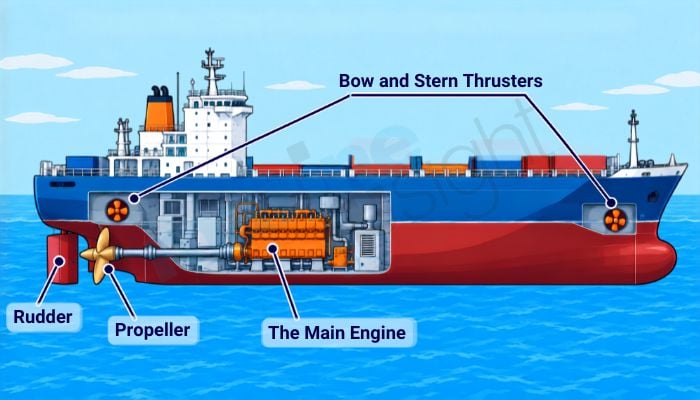
The Main Engine
Situated in the lower aft section of a ship’s hull below the waterline, the main engine room is the heart of a vessel as it houses the main engine, auxiliary generators which produce electrical power, boilers, fuel purifiers and oil treatment equipment, pumps, heat exchangers, compressors and other vital equipment necessary for operating a ship in open waters.
It is extremely hot in an engine room, usually above 45 degrees Celsius due to all the heavy machinery, and constant maintenance and care are required to ensure the engine and all other machinery work smoothly without any issues.
Given the risks of fire and other accidents in this congested place, its construction and operations are governed by SOLAS Chapter II-1 for structural fire safety and MARPOL Annex VI for Tier III NOx and SOx exhaust emission compliance.
Propeller
It is a mechanical device having blades fitted on a central shaft. These blades rotate, and their rotational energy is converted into pressure energy. Due to this, the propeller produces the thrust required for propulsion. It pushes the seawater backwards, and, in turn, the seawater helps the ship move forward. The ship’s engine, shaft and propeller together constitute a propulsion unit.
The propeller should be made up of aluminium, bronze, manganese, etc., which are corrosion-resistant alloys. A vessel can have two or three propellers, depending on the size and requirements. It is the most important part of the ship, without which a ship can’t move. Its working principles are Newton’s third law of motion and Bernoulli’s theorem.
Rudder
Without steering, we can’t move a vehicle in the desired direction, so the propeller propels the ship, and the rudder steers the ship. The rudder is a flat hollow structure housed in the aft of the propeller. It consists of the rudder trunk, movable flap, main rudder blade, hinge system, links and rudder carrier bearing. Rudders are of three types: balanced type, semi-balanced type and unbalanced type rudder.
The rudder has a steering gear system that controls its movement. The main rudder must be able to move from 35 degrees port to 35 degrees starboard within 28 seconds as per international safety regulations.
Bow and Stern Thrusters
These are special transverse propulsion systems which can be found at the forward and aft ends of a vessel’s hull that, by generating lateral force, enable ships to move sideways when sailing at low speeds in congested channels, harbours or offshore stations. They reduce dependence on tugs and also the total running cost of a ship. These are either hydraulically or electrically powered.
They are extremely important for offshore vessels and ferries. Thrusters are also critical for dynamic positioning systems, which help a ship remain in place against strong winds, waves or currents, enabling safe berthing without depending on the main engine.
Cargo and Storage Areas of Ship
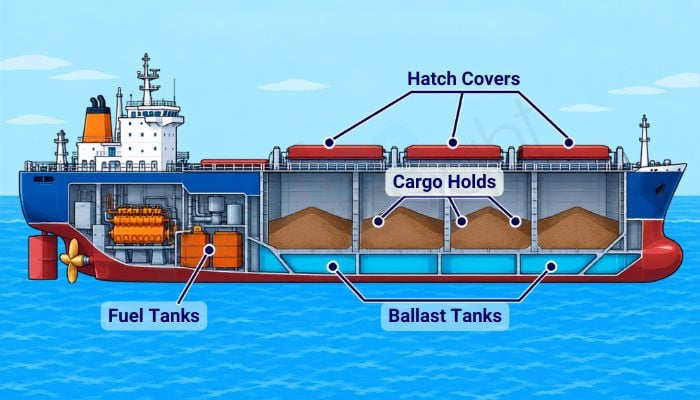
Cargo Holds
This is an enclosed space where cargo is kept safe during transit. A ship might have several such holds, depending on the type of vessel and its size, with a capacity ranging from 20 tons to 200,000 tons. The cargo hold is located under the ship’s deck and can be accessed through the hatch openings. Tankers carrying liquid cargo have specialised tanks instead of conventional cargo holds.
Hatch Covers
They act as a seal to prevent cargo from being exposed to the salty ocean water or even moisture-laden air while a ship sails to its destination. They are watertight and airtight and are hydraulically controlled so they can be easily opened and closed.
Ballast Tanks
Compartments that hold water to maintain vessel stability and proper trim. Proper ballast management is essential for safe ship operation, fuel efficiency, and environmental compliance. Ballast water is regulated internationally to prevent the spread of invasive marine species between ocean regions.
The compartments that carry water to stabilise the vessel and maintain proper trim are called Ballast Tanks. They require care to prevent corrosion and are important to maintain fuel efficiency and compliance with environmental regulations. Discharge of ballast water is regulated to prevent the spread of invasive species from one ocean to another.
Bunker tanks
These tanks store fuel and lube oils needed for safer machinery operations, while the fuel is used for emergency or regular operations. As these tanks store sludge, diesel, oils, etc., which can catch fire immediately, they are located far from ignition-prone areas.
Deck Structures
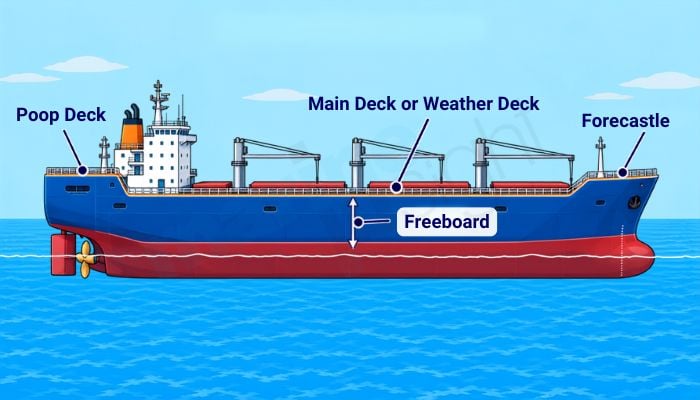
The deck covers the hull of a vessel horizontally, forming a working platform for the crew and a structure that offers support. Ships have different deck levels, and each has a different purpose. The common ones are described below.
Main Deck or Weather Deck
It is the topmost deck exposed to the weather conditions. The foredeck is the forward part of the weather deck, between the superstructure and the foc’sle superstructure. Basically, it is a part of the vessel, forward of the mast.
Forecastle
The forecastle is one of the foremost parts of the ship, of length less than 7% of the total deck length, having anchoring equipment and ground tackle. It was initially used in military vessels, where soldiers used forecastles to take defensive positions. But today, the forecastle holds windlass and anchor chain systems.
Poop Deck
It serves as a roof to the cabin constructed in the aft of the ship and allows the captain and helmsman to supervise the entire working crew. But in modern ships, the poop decks are provided either in the centre of the ship or on the starboard.
Freeboard
Freeboard can be defined as the distance measured from the waterline to the higher edge of the freeboard plating/deck plating at the sides of amidships. The classification society must approve the minimum freeboard calculation for a vessel. The calculation of freeboard plays a critical role in defining the load line marks of the vessel, which in turn, is directly related to the cargo-carrying or the earning capacity of the vessel.
Additional Components Of A Ship
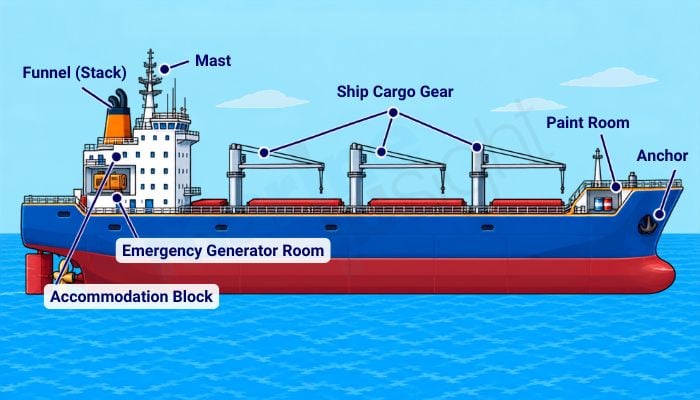
Accommodation Block
The accommodation area is where the ship’s crew lives, eats and relaxes. It has all the amenities like meeting rooms, gym, medical room, cabins, salon, recreation room, common rooms, laundry, and galley. According to international law, the accommodation area should be spacious enough and should be safe and properly ventilated.
Mast
The mast is a steel structure that is elevated vertically to the Centreline of a ship, or mounted on the bridge or close to the bow. It has several purposes, including carrying derricks and giving fundamental height to the navigation light, salient yards, radio or radar aerials, and scanners.
Funnel (Stack)
It is a chimney on a vessel which discharges engine and boiler smoke. Funnels are inclined at an angle towards the stern so that the smoke is directed away from the deck and bridge.
Anchor
It is a heavy metal equipment which is dropped to the ocean floor to keep a vessel in place while waiting for a berth at anchorage. It usually weighs 15 to 20 tons and is connected to a chain cable which is hundreds of metres long. The anchor is kept in the hawse pipe when it is not being used.
Paint Room
It is a specialised compartment, built away from the accommodation area and cargo holds, to safely store paints, varnishes, chemicals and thinners, which are flammable. In this room, the electrical fixtures and lights are explosion-proof to prevent fires.
Emergency Generator Room
When the main supply goes out of order, a separate generator supplies electricity for emergency loads. It is located above the topmost deck, away from main and secondary machinery and the collision bulkhead, and has its own switchboard in its surroundings. This generator should be easily operable and can be started at even 0°C.
Ship Cargo gear
Derricks (Cranes) are used to lift and carry the safe working load on a ship. These are electrically or hydraulically operated equipment for easier operations. The capacity of ship cargo cranes and gear is around 15 tons to 4000 tons per hour.
Conclusion
For every professional working in the maritime industry, understanding the role and importance of the main parts of a ship is important to know how these massive behemoths sail across the world’s oceans and seas with thousands of tonnes of cargo.
From the strength provided by the keel, to the support offered by the hull, and the command centre on the bridge, every component of the ship has a critical function in safety and performance. All these parts make the ship more than just a floating structure; it is an integrated system where all the sections work together to make maritime trade possible.
Frequently Asked Questions (FAQ)
1. What are the three main parts of a ship?
The hull, engine room and navigation bridge form the three most important parts of a vessel, be it a boat or a large commercial ship.
2. What is the difference between port and starboard?
When facing the bow of a vessel, port refers to the left side, and starboard refers to the right side.
3. What is the lowest point of a ship called?
The lowest structural point of a ship is the keel, which acts as the central backbone running along the bottom of the hull from bow to stern.
4. What is a monkey Island on a ship?
The monkey island is the highest open deck located directly above the bridge. It houses the primary magnetic compass away from electrical interference, along with radar antennas, navigation lights, and communication equipment, while providing lookouts with an unobstructed 360-degree view.
5. What is the bow of a ship?
The bow is the frontmost part of a ship’s hull, shaped like a wedge to cut through water and reduce resistance while the vessel is underway.
You might also like to read-
- Bow Thrusters and Types of Bow Thrusters
- Types of Rudders Used For Ships
- What Is Monkey Island On Ships?
- 10 Types of Decks Every Seafarer Should Know
- A Guide to Ballast Tanks on Ships
Disclaimer :
The information on this website is for general purposes only. While efforts are made to ensure accuracy, we make no warranties of any kind regarding completeness, reliability, or suitability. Any reliance you place on such information is at your own risk. We are not liable for any loss or damage arising from the use of this website.


About Author
Zahra is a maritime writer with 6 years of technical writing experience spanning port operations, offshore wind, oil and gas, and maritime policy. Her analytical edge...Read More ->
Disclaimer :
The information on this website is for general purposes only. While efforts are made to ensure accuracy, we make no warranties of any kind regarding completeness, reliability, or suitability. Any reliance you place on such information is at your own risk. We are not liable for any loss or damage arising from the use of this website.
Related Articles


Subscribe To Our Daily Newsletter
By subscribing, you agree to our Privacy Policy you can unsubscribe anytime.


