
Lifting Techniques: How to Lift Heavy Load and Avoid Back Injury On board Ship?
“Backbone” is a word which describes a strong pillar or support to a system or an organisation, and without which it becomes difficult to sustain or make progress. When it comes to human body, the spinal bone holds utmost importance. Back bone is a critical part of our body structure as it is responsible for our movements and gives our body a shape and form.
Back injury or back pain is the most common but neglected problem experienced by ships’ crew. One of the reasons for this problem is the amount of physical activity involved in a ship’s operation, which even includes lifting of heavy loads by the crew member.
In order to avoid this problem and ensure its long term consequences, it is very important to understand and train the personnel onboard for correct lifting techniques as once a back problem occurs; the chance of its prolongation is extremely high.
Main Reasons for Back Injuries are:
1) Lack of Training: No proper training or instructions are given to the person lifting the load.
2) Unaware of Technique: How you lift your load is the main reason for back injury as wrong twist and posture leads to straining of one’s back.
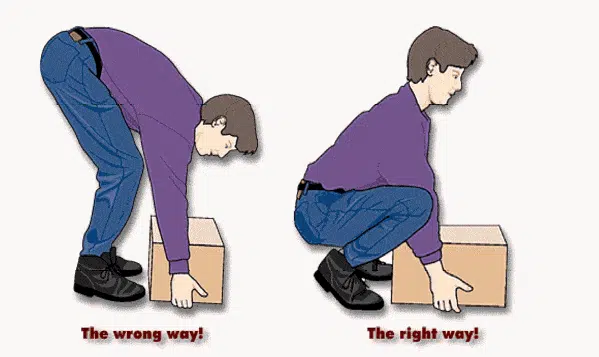
3) Size: The size of the load to be considered before lifting. If the load is over sized as compare to your capacity or handling, it may strain and damage your back.
4) Physical Strength: Different people have different physical strengths depending upon their muscle power. You must know the limits of your own strength.
5) Teamwork: Ship operation is all about team work. A load can be lifted by two persons more easily and without any problem as compared to a single person lifting it. If out of two persons, one is not lifting it properly, unnecessary strain will cause back injury to other or both the persons involved.
Following are some basic rules applied while performing a physical lifting task on board ship:
- Always warm up your body before lifting any kind of load involving stretching of muscular parts.
- Check the size and weight of the load. If it’s out of your strength call for help and never lift alone.
- Check the surroundings and course from which the load to be carried and transferred for any hurdles and skidding surface.
- On a level floor and take firm stance to place your legs apart from each other with one leg behind the other.
- Sit with knees bend to lift the load.
- Wrap one entire arm over the object and other in appropriate position to lift the load.
- Keep you back straight nearly vertical and chin tuck inside.
- Be as much close to the load and Start lifting the load with your foot and knees. Do not use your back for this task.
- Lift the load smoothly and slowly and avoid sudden and jerky motion.
- Never twist your body to change direction, always turn the whole body together.
- Always ask for help when needed and be careful when using stares.
Awareness posters and instructions along with visual pictures must be pasted at important places on the ship to make sure that every person onboard ship understands the important of safe lifting procedure.
Personnel safety is of utmost importance on ship and it can be taken care of by each person working on board. The bottom line is – Be careful, lift safely, and use proper lifting procedure.
Disclaimer :
The information on this website is for general purposes only. While efforts are made to ensure accuracy, we make no warranties of any kind regarding completeness, reliability, or suitability. Any reliance you place on such information is at your own risk. We are not liable for any loss or damage arising from the use of this website.


Related Articles
Disclaimer :
The information on this website is for general purposes only. While efforts are made to ensure accuracy, we make no warranties of any kind regarding completeness, reliability, or suitability. Any reliance you place on such information is at your own risk. We are not liable for any loss or damage arising from the use of this website.

About Author
An ardent sailor and a techie, Anish Wankhede has voyaged on a number of ships as a marine engineer officer. He loves multitasking, networking, and troubleshooting. He is the one behind the unique creativity and aesthetics at Marine Insight.
Subscribe To Our Daily Newsletter
By subscribing, you agree to our Privacy Policy you can unsubscribe anytime.


BE THE FIRST TO COMMENT