
How to Become a Marine Engineer?
An Engineer in the Merchant Navy can be a great career choice, especially as the field has seen tremendous growth in recent years. Many students are opting for marine engineering, given the rising scale of global maritime trade, an increase in the number of ships and demand for skilled and experienced engineers.
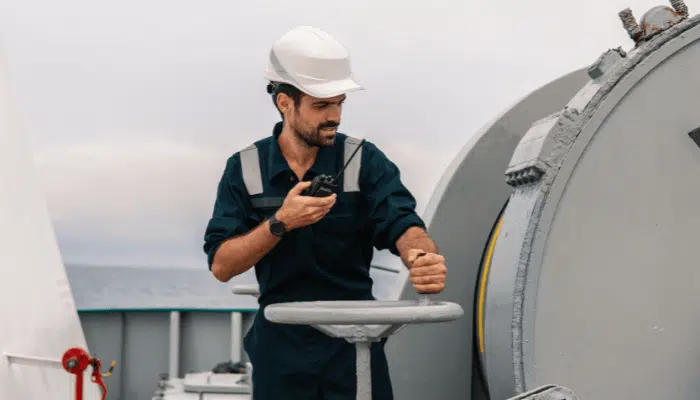
Engineers in the Merchant Navy deal with onboard machinery, including the main engine, auxiliary engines, boilers, generators, etc. They also ensure that all equipment, valves, and filters are functioning properly. This role is vital, and with it comes great responsibility.
Becoming A Marine Engineer In the Merchant Navy
A candidate can take different paths to become an engineer, including opting for B.Tech Marine Engineering after completing class 12th, after B.Tech Mechanical Engineering and going for Graduate Marine Engineering (GME) and after completing a Diploma in Mechanical Engineering.

Btech. Marine Engineering After Completing Class 12th
| Education | 10+2/equivalent (Physics, Chemistry, Maths Average – Minimum 60%) |
| Minimum of 50% marks in English in10th OR 12th Class. | |
| Age | Minimum: 17years |
| Maximum: | |
| Male : General-25 years, OBC(NCL)-28 years, SC/ST-30 years | |
| Female: General-27 years, OBC(NCL)-30 years, SC/ST-32 years. | |
| Reference date for calculating age will be from the date of commencement of the academic Session. | |
| For SC/ST candidates | 5% relaxation in eligibility marks of PCM; no relaxation in English Marks. Relaxation of 5% in English marks applicable for candidates who are natives of Lakshadweep and Andaman & Nicobar Islands and belong to their Scheduled Tribes (ST) & both of whose parents were born there & belong to the ST of those islands. |
| Medical | Medically fit with eyesight & hearing as prescribed in the Merchant Shipping (Medical Examination) Rules, 2000, as amended. |
| Eyesight | There should be no morbid condition in either eye or lids of either eye which may be liable to risk of aggravation or recurrence. Good binocular vision (Fusion faculty and the full field of vision in both eyes). Movement of the eyeballs must be full in all directions and the pupils should react normally to light and accommodation. |
| Distance Vision unaided 0.5(6/12) in each eye or 0.67(6/9) in the better eye and 0.33*(6/18) in the worst eye. |
Candidates have to clear the IMU CET examination, and only then can they join the four-year marine engineering course, divided into 8 semesters. After course completion, trainees join ships as junior engineers.
Two indian institutions known for their B.Tech Marine Engineering Course include-
- IMU Kolkata (erstwhile DMET / MERI)
- Tolani Maritime Institute (TMI).
You can read more about the course here- B.Tech Marine Engineering: Eligibility, Syllabus, Colleges, Sponsorships, Admission, Career
Graduate Marine Engineering (GME), After Doing B.Tech Mechanical Engineering
| Educational Criteria | BE/B. Tech in Mechanical Engineering/ Naval Architecture with at least 50% marks in final year from a recognized University/AICTE-approved Institute/IIT. |
| OR | |
| Full-time BE/BTech in Mechanical Engineering Streams with at least 50% marks in the final year. e.g. Mechanical and Automation, Mechanical and Electronics, Mechanical and Automobile, etc. | |
| OR | |
| Degree in any Naval Architecture stream with at least 50% marks in the final year, e.g. Naval Architecture and Ocean Engineering, Naval Architecture, Ship Building, etc. | |
| OR | |
| Degree in Marine Engineering with at least 50% marks in the final year from a Non-DG shipping-approved Insitute. | |
| AND | |
| Minimum 50% marks in the English in either10th, 12th or in Degree examination. | |
| Age | Not more than 28 years on the day training commences. |
| Physical | Eyesight and hearing as prescribed in the Merchant Shipping (Medical Examination) Rules, 2000, as amended |
| Eyesight | No morbid condition in either eye or lids of either eye which may be liable to risk of aggravation or recurrence. Good binocular vision (Fusion faculty and the full field of vision in both eyes). Movement of the eyeballs must be full in all directions and the pupils should react normally to light and accommodation. Normal color vision shall be tested by Ishihara Test Chart. |
| Distance Vision unaided 0.5(6/12) in each eye or 0.67(6/9) in the better eye and 0.33*(6/18) in the worst eye. |
Graduate Marine Engineering (GME) is a 1-year PG diploma course having 2 semesters. Those who have done a Bachelor of Engineering in Mechanical Engineering or Naval Architecture can opt for this course.
Each institution has its own entrance, and the written paper includes questions from Mechanical Engineering, Aptitude, and English. This is followed by a Psychometric Test. After clearing both exams, candidates appear for a panel interview.
If you clear the entrance, you have to obtain a medical fitness certificate from a DG Shipping-approved doctor, and then only you can join the college.
Some reputed institutions you can choose for the GME Course include IMS Goa, Anglo-Eastern Maritime Academy in Khandpe, Maharashtra and Great Eastern Institute of Maritime Studies in Pune, Maharashtra.
Read more about the course here- Graduate Marine Engineering: Course, Eligibility, Admission, Syllabus, Top Colleges, Career
Diploma Mechanical Engineering
After a diploma in Mechanical Engineering, candidates can become marine engineers by directly joining the 2nd year of the 4-year marine engineering course after completing the 3-year diploma in Marine Engineering.
Diploma Marine Engineering (DME)
| Education | Degree in Diploma in Mechanical/ Electrical/ Electrical & Electronics/ Naval Architecture with at least 50% marks in the final year. |
| Minimum 50% marks in English in 10th or 12th or in Degree Exam | |
| Age | Not older than 28 years, the day training commences |
| Physical | Should be medically fit with eyesight and hearing as prescribed in the Merchant Shipping (Medical Examination) Rules, 2000, as amended. |
| Eyesight | No morbid condition in either eye or lids of either eye which may be liable to risk of aggravation or recurrence. Candidates must possess good binocular vision (Fusion faculty and the full field of vision in both eyes). |
| Movement of the eyeballs must be full in all directions and the pupils should react normally to light and accommodation. Normal color vision shall be tested by Ishihara Test Chart. | |
| Distance Vision unaided 0.5(6/12) in each eye or 0.67(6/9) in the better eye and 0.33*(6/18) in the worst eye. |
A Diploma in Marine Engineering is a 2-year, pre-sea training course which prepares cadets to join the ship as marine engineers.
IMS Goa is great for pursuing a DME course. For students who have done their diploma in either Mechanical, Electrical, Marine or Electronics field, the institution offers a pre-sea training program to become an engineer in the merchant navy.
It has collaborated with many other training centres to offer the best theoretical and practical knowledge to its students, not to forget its excellent placement record and tie-ups with shipping companies.
There is another way to become a marine engineer. After doing the 3-year Diploma in Marine Engineering course, cadets can join the 2nd year of B.Tech Mechanical Engineering.
After completing their B.Tech Mechanical Engineering, they can opt for the 1-year Graduate Marine Engineering Course.
Whatever path you choose to become an engineer in the Merchant Navy, be sure to search for the institution’s or college’s placement records before making your final choice.
The maritime sector cannot exist without skilled engineers who operate cargo ships, container carriers, gas tankers, etc. They ensure the ship’s machinery works properly to avoid maritime accidents or collisions. A career as a marine engineer can be extremely challenging yet equally rewarding for those passionate about the sea and machinery.
You might also like to read-
- 20 Institutes Offering Graduate Marine Engineering (GME) Course in India
- Graduate Marine Engineering: Course, Eligibility, Admission, Syllabus, Top Colleges, Career
- Joining The Merchant Navy After Class 12th in India
- How to become a Marine Engineer after doing Mechanical Engineering?
Disclaimer :
The information on this website is for general purposes only. While efforts are made to ensure accuracy, we make no warranties of any kind regarding completeness, reliability, or suitability. Any reliance you place on such information is at your own risk. We are not liable for any loss or damage arising from the use of this website.

About Author
Zahra is a maritime writer with 6 years of technical writing experience spanning port operations, offshore wind, oil and gas, and maritime policy. Her analytical edge...Read More ->
Disclaimer :
The information on this website is for general purposes only. While efforts are made to ensure accuracy, we make no warranties of any kind regarding completeness, reliability, or suitability. Any reliance you place on such information is at your own risk. We are not liable for any loss or damage arising from the use of this website.
Related Articles


Subscribe To Our Daily Newsletter
By subscribing, you agree to our Privacy Policy you can unsubscribe anytime.


