
Third Officer in Merchant Navy: Duties, Qualifications, Salary and Career Path
A third officer, also known as a ‘third mate’, is the most junior deck officer rank in the merchant navy. It is the first officer-level job for a deck cadet after completing the training. It is also when the cadet starts holding legal responsibility for safe navigation of the ship during a watch.
The duties of a third officer in the merchant navy vary by company and ship type. However, in most ships, the third officer stands a navigational watch as officer of the watch (OOW), looks after the ship’s lifesaving and firefighting equipment, and reports to the second officer, chief officer and master.
Third Officer or Third Mate : What’s the difference?
Both the third officer and the third mate describe the same rank. “Third officer” is more common in many shipping companies, especially among Asian crews, while “third mate” is commonly used on US and European certificates.
Where Does Third Officer Sit on a Ship?

The master, or captain, leads the deck department and is also first in command of the vessel. He is responsible for the ship, crew and the cargo. Second in command is the Chief Officer or First Officer, who looks after the ship’s maintenance, environment, and safety compliance. Then comes the second officer or second mate, who is responsible for passage planning, navigation, maintaining the medical locker, and the correction and maintenance of charts and publications.

Next is the Third Officer, who supports the above ranks in different areas.
The primary role of the 3rd Officer in the Merchant Navy is to assist with navigational watchkeeping as an officer on watch (OOW) for the vessel’s safe navigation and as instructed by the captain. He also assists the chief officer in cargo operations and the second officer in correcting and maintaining nautical charts and publications.
The 3rd Officer is also responsible for maintaining the life-saving appliances (LSA) & firefighting equipment (FFE) and assists the master with routine paperwork.
For a wider view of every position on board, see the guide to merchant navy ranks.
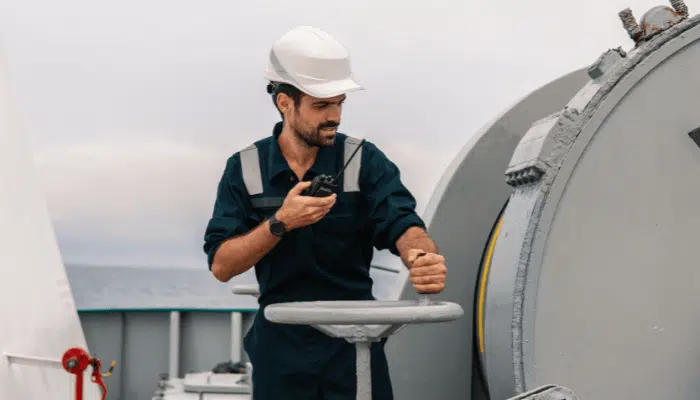
How To Become A Third Officer
A person becomes a third officer by completing the necessary pre-sea training, serving as a deck cadet to gain sea time, and obtaining a certificate of competency to be the officer in charge of a navigational watch.
For more information on how to join after school, read our guide to joining the merchant navy after Class 12 in India. The requirement differs by pre-sea route and shipboard training programme, so a candidate should check the current DG Shipping notices or the Mercantile Marine Department before applying.
International Requirements
According to regulation II/1 of the STCW Convention, which covers officers in charge of a navigational watch on ships of 500 gross tonnage or more, a person to become third officer must:
- be at least 18 years old
- complete approved education and training that meets the standard of competence in Section A-II/1 of the STCW Code
- complete at least 12 months of approved seagoing service as part of an approved training programme with on-board training, or 36 months of approved seagoing service where there is no such programme
- perform bridge watchkeeping duties under the supervision of the master or a qualified officer for at least six months of that service
- meet the competence standards for basic safety, survival craft and rescue boats, advanced firefighting and medical first aid (Sections A-VI/1 to A-VI/4)
- meet the radio requirements of STCW Chapter IV, which in practice means holding a GMDSS operator certificate
Each flag state issues the actual certificate and may have its own conditions.


What Does a Third Officer Do?
The duties of the 3rd officer vary according to the company and type of ship, but can be divided into four main categories:
- Navigational Watchkeeping Duties
- Maintenance of Safety Equipment
- Cargo/Port Watchkeeping Duties
- Administrative Duties
Navigational Watchkeeping Duties
- 3rd Officer or 3rd Mate is responsible for carrying out independent navigational watches on the bridge to ensure the safe navigation of the vessel, generally from 0800–1200 and 2000–2400 hours, or as directed by the ship’s master.
- 3rd Officer is responsible for assisting the 2nd Officer in correcting and maintaining nautical charts and publications, along with any other duties assigned by the 2nd Officer. This may include tasks such as assisting in passage planning, distance and noon calculations, or any other reporting during his watch.

- Assist in maintaining navigational and meteorological equipment on board, keeping it up to date and in operational condition.
- Responsible for maintaining all national/signal flags (as per International Codes of Signal), navigational shapes, and sound signalling equipment and ensuring all required flags are available before reaching the port and displayed correctly.
- Assist in carrying out pre-arrival and pre-departure tests as per company procedure and report all deficiencies found to the second officer and master.
- Assist in recordkeeping of the ship’s deck logbook, navigational checklists, official logbook, and all events that occurred during the watch.
- Assist the master in sending distress, urgency, and safety alerts via the Global Maritime Distress and Safety System (GMDSS).
- Assist in training deck cadets or other trainees on board.
- Assist in preparing the bridge for any navigational and third-party audits.
- Assist in Port State Control (PSC) and Vetting Inspections.
- Assist in any other navigational duties as directed by the ship’s master.
As officer on watch, the third officer keeps a lookout, monitors the ship’s position and surrounding traffic, ensures collision regulations are followed, and calls the master when the situation requires it. Most modern ships now carry an Electronic Chart Display and Information System (ECDIS), which is the main tool for tracking the ship’s position against the planned passage.
Maintenance of Safety Equipment
- 3rd Officer, under the supervision of the Chief Officer (Safety Officer), is responsible for inspecting and maintaining the life-saving appliances (LSA) and firefighting equipment (FFE) on board.
- Responsible for maintaining the life-saving appliances (LSA) and firefighting equipment (FFE) maintenance records.
- Notify the Chief Officer (Safety Officer) or Master when any shore inspection, such as annual or 5-yearly shore services related to life-saving appliances (LSA) and firefighting equipment (FFE), is due.

- Responsible for carrying out maintenance as per the PMS (Planned Maintenance System) and reporting all deficiencies found in safety equipment to the Chief Officer (Safety Officer) and Master.
- Responsible for maintaining and updating the SOLAS training manuals and getting all crew members familiar with them.
- Maintaining inventory of spares required for LSA and FFA equipment, keeping in mind the items expiring in the next few months, and raising requisitions for the same.
- Giving on-signers safety and security familiarisation after their joining.
- Maintaining inventory of all IMO safety posters and company posters and ensuring all are in place and correctly displayed.
Cargo/Port Watchkeeping Duties
- During arrival or departure in the port, if the third officer is on bridge duty, he assists the master and the bridge team in manoeuvring.
- Otherwise, when not on bridge duty, the third officer is in charge of the aft mooring station during the vessel’s berthing and unberthing, with the forward mooring station of the ship led by the chief officer. Thus, at any given time, either the second officer or the third officer will be on the bridge, and one of them will be at the aft mooring station.
- In port, the third officer keeps watchkeeping from 0600–1200 and 1800–2400 hours, or as directed by the Chief Officer or the ship’s master.

- The third officer is responsible for maintaining a safe cargo/port watch and ensuring compliance with all international and local regulations. During the watch, the 3rd officer oversees all cargo operations, including ballasting or deballasting, ensuring the ship remains upright, monitoring stress levels within limits, and adequately recording events.
- The third officer is also responsible for maintaining security measures as per the ISPS security level during his watch. Their duties also involve preventing pollution, reporting incidents, supporting environmental policies, ensuring regulatory compliance, and fostering environmental awareness within the organisation.
- Before reaching the port, the 3rd Officer ensures that LSA (lifesaving appliances) and FFA (firefighting appliances) are in order, in place, and ready at all times in case of any emergency.
- 3rd Officer also assists the master in port with customs, immigration, and agent formalities.
Administrative Duties
- Administrative duties involve assisting the master during crew sign-on and sign-off, ensuring all formalities are completed, and checking crew documents/certificates during joining. This includes verifying the validity and availability of all crew documents, such as passports, CDCs, licenses, STCW certificates, medical records, contract papers, company courses, etc.
- Additionally, the third officer assists the master in article signing, stamping CDC, arranging passports, and maintaining crew documentation, including updating ship certificates and scanning the same.
- Preparing the drill matrix and scheduling drills as per the matrix under the supervision of the chief officer or master, ensuring all drills are conducted within the given intervals. Additionally, ensure that all the company-specific training, such as CBTS, resilience, or reflective learning, is conducted on time.
- The third officer is responsible for maintaining records of the drills and updating the drill records in the relevant deck or official logbook. After the drill is completed, ensure that all safety equipment used in the drill, such as SCBA sets, fireman outfits, hoses, etc., is put back in place and ready to be used in case of an emergency.
- Preparing port papers prior to arriving at the port, including emergency contact sheets and updating crew lists, stowage plans, MSDS in common places, and fire plans as designated by the company or ship’s master.
- Keeping Emergency Muster Plan and Lists up-to-date with all present crew and their duties in emergencies.
- Assisting the master in distributing cash advances to the crew.
- Maintaining bonded/slop chest store on board, including managing the inventory.
- Assisting the crew in processing their claims and any other paperwork.
- Assisting the master in accounts and wage calculations during month end.
- Ensuring that all recommendations from Safety Committee meetings are carried out without delay and regularly participating in BBS and near-miss observations.

Duties On Different Ship Types
The core duties of a third officer usually stay the same across ship types, but the extra tasks can change. A third officer may be asked to assist the chief officer with tank cleaning on tankers, anchoring operations, receiving stores and spares in port, or work during dry dock. Cruise and passenger ships carry additional duties that dry cargo ships and tankers do not. The company’s Safety Management System (SMS) normally contains the written job description for the rank.

Salary Of Third Officer
There is no fixed salary range for a third officer. Pay depends on the company, flag, ship type, contract length, and experience. They should be read as indicative ranges.
For example, according to industry sources, a third officer’s salary ranges from USD 2500 to 4500 per month. (i.e about INR 2,00,000 to 3,50,000 in India).
Tankers and other specialised ships generally pay more than standard dry cargo ships. Seafarers usually work on fixed-term contracts with leave between them, so annual earnings depend on how much of the year is spent on board.
While the article has covered most aspects of the role of the Third Officer, there are additional duties that may arise. For example, depending on the situation, sometimes the Third Officer may assist the chief officer in tank cleaning operations, anchoring operations, receiving stores and spares in ports, or handling additional duties in dry dock.
More specific duties of the third officer can be found in the job description provided by the company. The company’s Safety Management System (SMS) typically includes a section on crew duties, where additional responsibilities unique to the company and the third officer’s role may be detailed.
Frequently Asked Questions
What does a third officer do on a ship?
A third officer keeps a navigational watch as OOW, maintains LSA and FFA, assists with cargo and port watches, and handles drills and paperwork under the second officer, chief officer and master.
What is the minimum age to become a third officer?
STCW Regulation II/1 requires officers in charge of a navigational watch to be at least 18 years old.
How many hours does a third officer work?
At sea, a third officer typically keeps two four-hour watches a day, from 0800 to 1200 and 2000 to 2400, plus maintenance and administrative work. STCW rest rules require at least 10 hours of rest in any 24 hours and 77 hours in any 7 days.
Is a third officer the same as a third mate?
Yes. The two titles describe the same rank.
Who does the third officer report to?
To the second officer for navigation, the chief officer for safety equipment and cargo, and the master for bridge watch instructions.
You might also like to read-
- What is the Difference between Merchant Navy and Defence Navy?
- 10 Reasons Why a Career in Merchant Navy is Unlike Any Other
- A Guide to Merchant Navy Ranks
- A Guide To Merchant Navy Uniform
- 8 Things to Keep in Mind Before Joining Merchant Navy
- Joining The Merchant Navy After Class 12th in India
Disclaimer :
The information on this website is for general purposes only. While efforts are made to ensure accuracy, we make no warranties of any kind regarding completeness, reliability, or suitability. Any reliance you place on such information is at your own risk. We are not liable for any loss or damage arising from the use of this website.

About Author
Bhupinder Marriya is an experienced seafarer currently serving as a Third Mate on chemical tankers. Holding a Second Mate Foreign Going COC (Indian), Bhupinder possesses extensive knowledge of tank cleaning operations, navigation, and cargo work, along with expertise in life-saving appliances and fire-fighting equipment (LSA & FFE). Combining his practical experience at sea with a passion for maritime education, Bhupinder actively contributes as a freelance writer, sharing valuable insights and educating readers about the maritime industry.
Disclaimer :
The information on this website is for general purposes only. While efforts are made to ensure accuracy, we make no warranties of any kind regarding completeness, reliability, or suitability. Any reliance you place on such information is at your own risk. We are not liable for any loss or damage arising from the use of this website.
Related Articles


Subscribe To Our Daily Newsletter
By subscribing, you agree to our Privacy Policy you can unsubscribe anytime.


