
World’s First Global Maritime Competition
What Are PyroTechnics on Ship?
Pyrotechnics is the science of using materials capable of undergoing self-contained and self-sustained exothermic chemical reactions for the production of heat, light, gas, smoke and/or sound.
Used under extreme emergencies (such as distress), these are provided onboard ships to grab the attention/inform ships within range so as to seek help and assistance of the vessels for rescue. Basically, it is a visual method of sending SOS signals. These pyrotechnics are used in times of distress, as mentioned in Annex 4 of COLREGs.

In the unfortunate event (such as an ‘abandon ship’ situation) wherein one’s own ship is beyond saving, pyrotechnics can be one of the last resorts for the ship personnel’s survival and rescue at sea. Pictorial representation for usage at sea is displayed on the cover of each of the units mentioned below.
Location of pyrotechnics (in parentheses is the minimum carriage requirement as per SOLAS)
- Bridge
- Hand Flares (06 nos)
- Rocket Parachute Flares (12 nos)
- Buoyant smoke signal (02 nos; 01 on each side, port, and starboard)
- Line throwing appliance (at least 01 no)
- Lifeboat (each)
- Hand Flares (06 nos)
- Rocket Parachute Flares (04 nos)
- Buoyant smoke signal (02 nos)
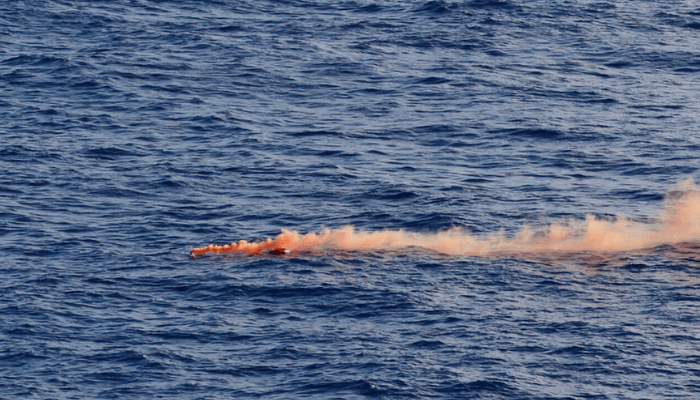
Different Types of Pyrotechnics Available Onboard Ships
Hand flare
A hand flare is a small cylindrical stick which, when activated, produces an intense red smoke or light without an explosion. It should be held out leeward when activated. It can be used during the day and also at night.
This hand-held emergency signalling device is close-range and burns for one or two minutes. It can be seen from a distance of five to ten miles.
Rocket parachute flare
This long-range distress signal is designed to fire a single red star to a height of approximately 300m. It is launched at a minimum height of 300 m in the air and self-activates to produce intense red smoke. A parachute opens up and reduces the rate of descent, which gives more time for the flare to remain at a height and provide a clear view to nearby ships.
The flare burns with a bright red light for 30 to 40 seconds in the air, and can be seen from a distance of 10 to 40 miles. Good quality flares burn even in water for some time.
Buoyant smoke signals
This pyro tech equipment is held in a compact container with a buoyant nature so it can float on the water’s surface to signal a distress situation. Mostly for use during the day, this indicates the position of distress with a bright orange smoke that lasts for 3 minutes and can be seen from a range of 2-5 miles.
Line Throwing Appliances
A line-throwing appliance is not a distress signalling equipment, but is counteracting equipment in distress situations. It is used so that a connection is made in terms of a strong line between the distressed ship and the safe ship (to create a bridge) to pass on towing lines or another kind of help.

Working of Pyrotechnics
The principle behind the working of pyrotechnics is similar to the firecrackers we light on festivals. There is an ignition source which leads to a chemical reaction, generating energy in the form of heat, light and sound.
Pyrotechnics usually comprise oxidisers, colourants, fuel and substances such as potassium nitrate, sulphur and other metals.
Igniting the electrical ignitor produces a self-contained and sustained chemical reaction.
The design of the signal is such that it can sustain the chemical reaction to offer the desired effect, like the emission of smoke.
Maintenance and disposal
- All pyrotechnics must be kept in safe storage with the cases properly shut. This is especially important after a safety brief to the personnel on board about pyrotechnics usage.
- Keep flares away from fuel or combustibles and store them in an accessible dry place.
- Carry out maintenance work (cleaning, expiry date check, etc) weekly as well as monthly as per the LSA maintenance schedule of the ship, as instructed under the company’s ISM requirements.
- In case of expiry of the pyrotechnics out at sea, hold on to them for disposal to an authorised entity once in port. Do not throw them out at sea or use them after expiry; being a product that produces an exothermic, usage after expiry can be risky.
More on the SOLAS requirements for pyrotechnics can be read here
You might also like to read-
- Video: How to Use Maritime Distress Flares & Signals (Pyrotechnics)?
- Requirements Regarding PyroTechnics Put Forth by SOLAS
- Different Types of Non-Pyrotechnic Marine Distress Signals Used On Ships
Disclaimer :
The information on this website is for general purposes only. While efforts are made to ensure accuracy, we make no warranties of any kind regarding completeness, reliability, or suitability. Any reliance you place on such information is at your own risk. We are not liable for any loss or damage arising from the use of this website.

Related Articles

About Author
Shilavadra Bhattacharjee is a shipbroker with a background in commercial operations after having sailed onboard as a Third Officer. His interests primarily lie in the energy sector, books and travelling.
Disclaimer :
The information on this website is for general purposes only. While efforts are made to ensure accuracy, we make no warranties of any kind regarding completeness, reliability, or suitability. Any reliance you place on such information is at your own risk. We are not liable for any loss or damage arising from the use of this website.
⚓️ Enhance Your Knowledge. Prevent Accidents. Stay Safe at Sea.
1. eBooks for Engine Department
Master machinery operations, troubleshooting, and safety procedures with expertly written guides tailored for marine engineers. Prevent costly breakdowns and onboard accidents through practical knowledge.
👉 Explore Engine Department eBooks
2. eBooks for Deck Department
Sharpen your seamanship, navigation, and cargo-handling skills with real-world case studies and practical insights designed for deck officers and cadets.
👉Discover Deck Department eBooks
3. eBooks on Electrical Fundamentals & Issues
Understand marine electrical systems, identify potential faults, and prevent onboard electrical failures with step-by-step explanations from industry experts.
4. Pocket Guides for Quick Reference
Compact, handy, and loaded with essential checklists—perfect for on-the-go reference during operations and emergencies at sea.
5. Combo Packs to Save Big
Access multiple expert eBooks at discounted prices. Ideal for professionals seeking complete safety and operational knowledge across various ship departments.
6. Digital Maritime Courses – Learn at Your Own Pace
Upgrade your competence with Marine Insight Academy’s online courses. Learn from industry professionals anytime, anywhere, and become a safer, smarter seafarer.
Subscribe To Our Daily Newsletter
By subscribing, you agree to our Privacy Policy and may receive occasional deal communications; you can unsubscribe anytime.
BE THE FIRST TO COMMENT