
World’s First Global Maritime Competition
What are Fast Rescue Boats?
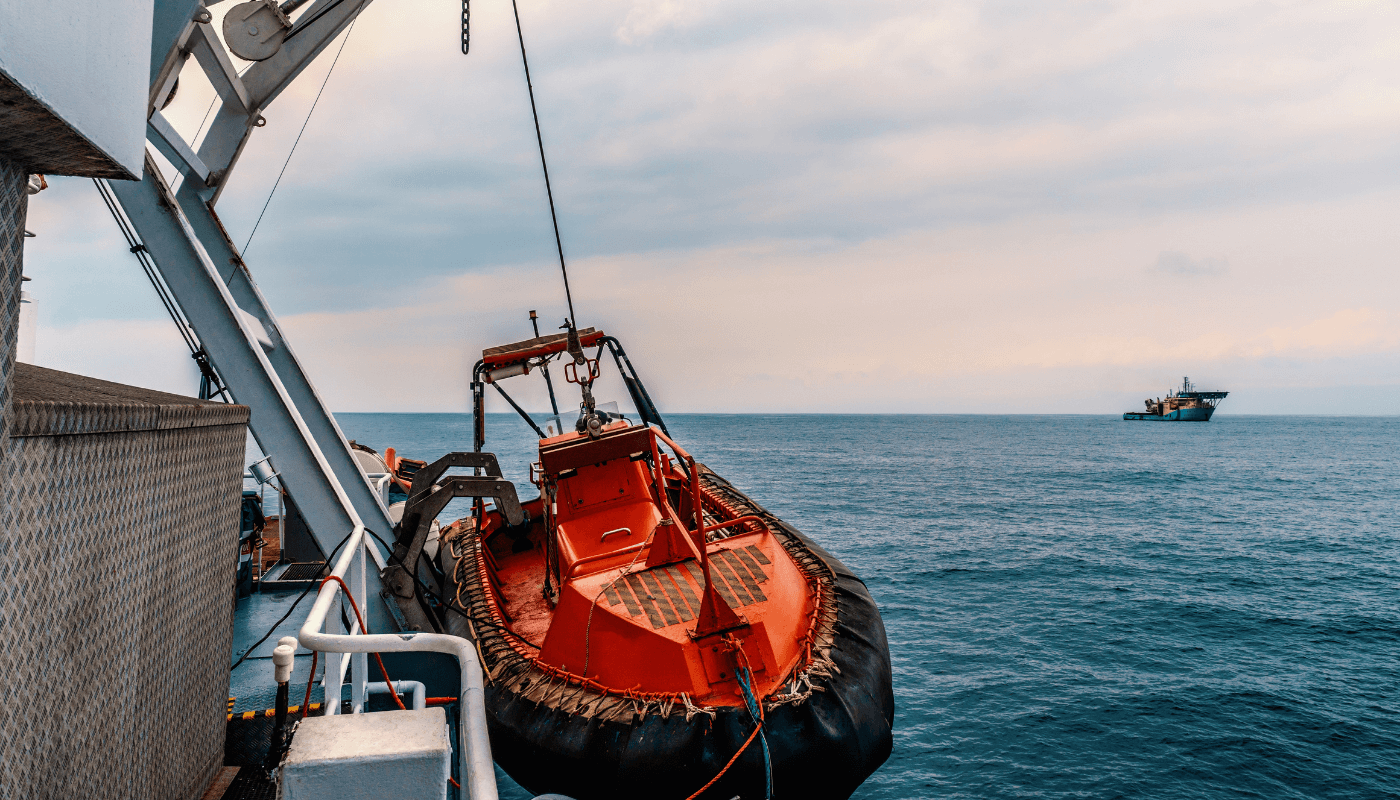
Lifeboats are floating crafts that can rescue crew and passengers from a vessel in distress. They can be rigid or inflatable and vary in size and build.
However, though interchangeably used, lifeboats are somewhat different from rescue boats, which are to be deployed immediately in an emergency.
While lifeboats, life rafts, and other rescue crafts are deployed on vessels, it is equally important that, if the situation allows, other means of evacuation and rescue from external sources should be available.
This means that evacuation should be prioritised without delay when a vessel is in distress due to an accident or mishap and if another vessel is in the vicinity or some landmass is equipped with suitable means of addressing such issues.
The most feasible way to do so is to send vessels that can act as relief crafts, quickly and scrupulously evacuating people in distress to a safer location, like the shore or another nearby vessel.
Fast rescue boats are essentially specialised high-speed crafts, which are smaller and used extensively for response and rescue operations in water. The high-speed characteristics of these vessels are crucial so they can reach the distressed location as soon as possible, as time is of utmost importance for saving lives.
The main design requirements in a Fast rescue boat are:
Speed: The foremost requirement is catered to by high-performance engines, efficient propulsion systems, and the overall hull design. For all practical purposes, nowadays, most fast rescue boats are planned in nature (To attain better speed and resistance characteristics).
Superior manoeuvring characteristics for seamlessly navigating through all forms of obstacles are an essential requirement in challenging scenarios.
Good stability and seakeeping characteristics for rescue operations under all weather conditions and sea states. There is adequate space for holding a maximum number of people in one go and carrying essential equipment and systems for rescue operations.
Strength and durability for enduring all kinds of weather conditions.
Fast rescue boats are usually rigid or inflatable. Rigid ones are usually larger and can accommodate more people.
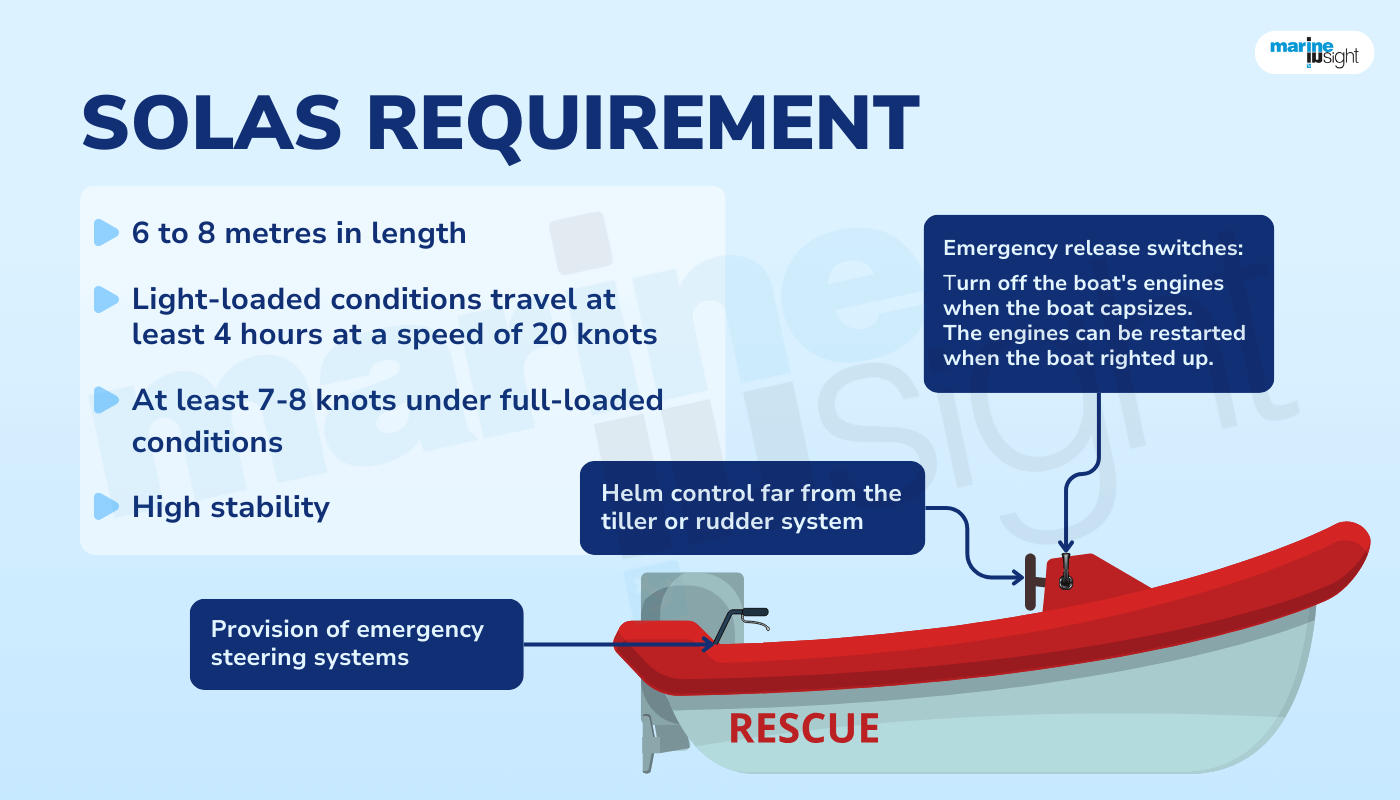
Safety of Lives at Sea or SOLAS defined specific requirements for fast rescue boats as follows:
- Fast rescue boats are between 6 to 8 metres in length.
- Under light-loaded conditions (only including bare minimum crew), fast rescue boats should be capable of travelling for at least 4 hours at a speed of 20 knots and at least 7-8 knots under full-loaded conditions.
- They shall have high stability characteristics such that they are self-righting in themselves.
- The control from the helm should be far from the tiller or rudder system (unlike many speedboats or motorboats).
- Provision of emergency steering systems.
- Emergency release switches turn off the boat’s engines automatically when the boat capsizes. The engines can be restarted when the boat righted up again, preventing fuel loss.
You might also like to read-
- Types of Lifeboat Release Mechanisms & SOLAS Requirements for Lifeboats
- Nadiro Lifeboat: The Next Level of Safety in Lifeboat Launching Systems of Ships
- Measures to Stop Accidents on Lifeboats
- Common Reasons for Ship’s Lifeboat Engine Starting Failure
- Difference Between Lifeboats and Rescue Boats
- Types of Lifeboats Used On Ship
Disclaimer :
The information on this website is for general purposes only. While efforts are made to ensure accuracy, we make no warranties of any kind regarding completeness, reliability, or suitability. Any reliance you place on such information is at your own risk. We are not liable for any loss or damage arising from the use of this website.



Related Articles

About Author
Subhodeep is a Graduate of Naval Architecture and Ocean Engineering. He has deep interest in marine structures and goal-based design aspects, and is dedicated to sharing and propagating technical knowledge of the industry.
Disclaimer :
The information on this website is for general purposes only. While efforts are made to ensure accuracy, we make no warranties of any kind regarding completeness, reliability, or suitability. Any reliance you place on such information is at your own risk. We are not liable for any loss or damage arising from the use of this website.
⚓️ Enhance Your Knowledge. Prevent Accidents. Stay Safe at Sea.
1. eBooks for Engine Department
Master machinery operations, troubleshooting, and safety procedures with expertly written guides tailored for marine engineers. Prevent costly breakdowns and onboard accidents through practical knowledge.
👉 Explore Engine Department eBooks
2. eBooks for Deck Department
Sharpen your seamanship, navigation, and cargo-handling skills with real-world case studies and practical insights designed for deck officers and cadets.
👉Discover Deck Department eBooks
3. eBooks on Electrical Fundamentals & Issues
Understand marine electrical systems, identify potential faults, and prevent onboard electrical failures with step-by-step explanations from industry experts.
4. Pocket Guides for Quick Reference
Compact, handy, and loaded with essential checklists—perfect for on-the-go reference during operations and emergencies at sea.
5. Combo Packs to Save Big
Access multiple expert eBooks at discounted prices. Ideal for professionals seeking complete safety and operational knowledge across various ship departments.
6. Digital Maritime Courses – Learn at Your Own Pace
Upgrade your competence with Marine Insight Academy’s online courses. Learn from industry professionals anytime, anywhere, and become a safer, smarter seafarer.
Subscribe To Our Daily Newsletter
By subscribing, you agree to our Privacy Policy and may receive occasional deal communications; you can unsubscribe anytime.
BE THE FIRST TO COMMENT