
Types Of Mooring Lines
A ship’s mooring arrangement is only as reliable as the lines that hold her in place. While mooring may appear routine, the behaviour, construction, and performance of mooring lines vary significantly—and understanding these differences is essential for safe operations. Modern vessels rely on a mix of traditional and advanced line types, each with distinct strengths and limitations.
A Guide to Mooring Operations Onboard Ships digs into the evolution of mooring lines, explaining why the right selection is crucial for operational safety and efficiency. Below is a practical overview of the three major categories of mooring lines used onboard ships today.
1. Wire Ropes
Wire ropes have remained a cornerstone of maritime mooring for decades, and for good reason. Built from multiple strands of steel wire twisted together, they offer exceptional breaking strength, abrasion resistance, and dimensional stability under load.
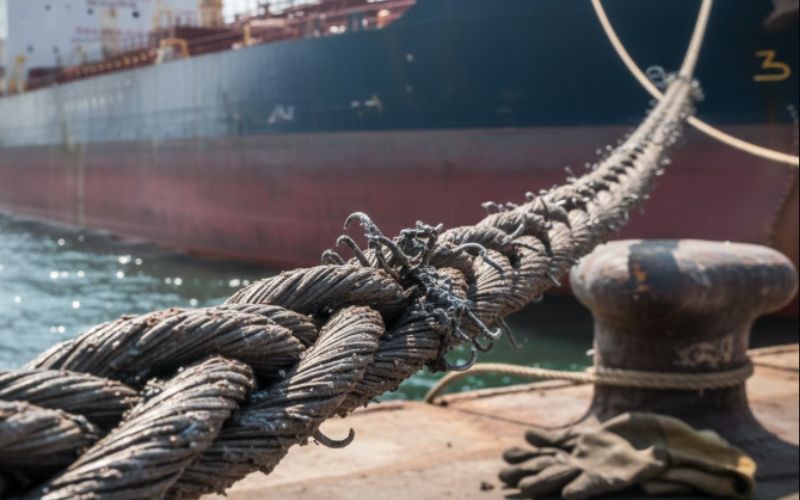
Their biggest advantage is also their drawback: wire ropes stretch very little. This makes them ideal for vessels that require firm, predictable restraint, such as tankers and bulk carriers, but it also means they absorb less energy during dynamic load conditions. A sudden shock load—caused by a swell, wind gust, or a passing vessel—can result in a dangerous line failure.
Wire ropes also require careful, regular lubrication to prevent internal corrosion, and they are heavier and more demanding to handle than their synthetic counterparts. Crew must also be alert for “fishhooks”—small broken strands that can easily puncture gloves or skin.
Despite these limitations, wire ropes continue to be indispensable in high-load mooring operations due to their reliability and long service life when properly maintained.
2. Synthetic Fibre Ropes
Synthetic ropes have transformed the way modern mooring stations operate. Lighter, easier to handle, and available in several material types, they now dominate the mooring arrangements of most commercial vessels.
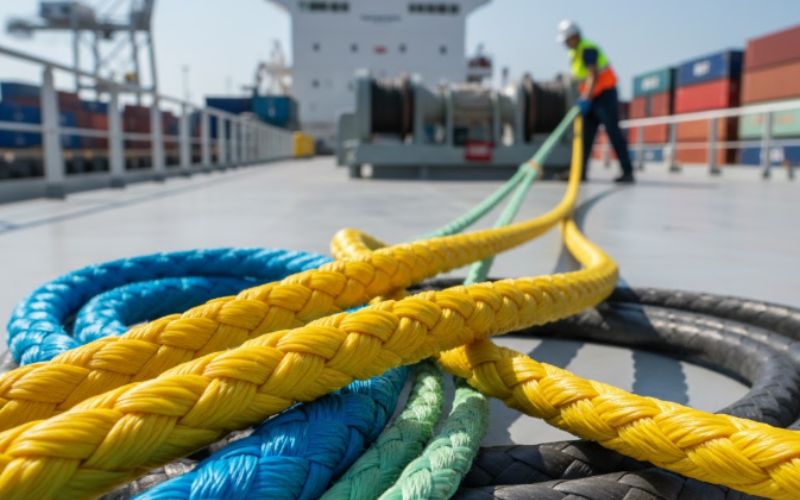
Different synthetic fibres offer different performance characteristics:
Nylon (Polyamide) Ropes
Highly elastic and capable of stretching up to 40% before failure, nylon ropes are excellent for absorbing dynamic loads. Their shock-absorbing qualities help reduce stress on deck equipment and fittings during rough conditions. They do, however, lose some strength when wet.
Polyester Ropes
With lower stretch but excellent UV and abrasion resistance, polyester ropes maintain strength even when wet, making them reliable all-weather performers.
Polypropylene Ropes
Lightweight and buoyant, these ropes are easy to use but offer lower strength and reduced UV resistance compared to other synthetic fibres.
High-Modulus Polyethylene (HMPE) Ropes
HMPE ropes represent the high-tech end of synthetic line development. Extremely strong, very low stretch, yet light enough to float, HMPE ropes are increasingly popular in specialised operations. Their cost is significantly higher, but so is their performance.
Together, synthetic fibre ropes offer flexibility and ease that wire ropes cannot match, which explains their widespread use across modern fleets.
3. Combination Ropes
Combination or hybrid mooring ropes bring together the advantages of wire ropes and synthetic fibres. The most common design features a wire core surrounded by a synthetic outer layer, combining the strength of steel with the handling comfort of fibre.

These lines offer better fatigue resistance than pure wire ropes, reducing the risk of injury from broken strands. However, they are more complex to inspect and maintain, and their cost is generally higher than that of single-material lines.
Combination ropes are often chosen for demanding mooring environments where both strength and ease of handling are critical.
Conclusion
Mooring lines may appear similar on deck, but their internal construction and operational behaviour vary widely. Choosing the right line—and understanding how it performs under load—is a skill every deck officer must master. Whether handling traditional wire ropes, modern synthetics, or hybrid combinations, a well-informed team makes the difference in both efficiency and safety during mooring operations.
This overview highlights only the essential characteristics of each line type. The ebook A Guide to Mooring Operations Onboard Ships offers deeper insights into line properties, selection criteria, care and maintenance practices, and other advanced concepts that every maritime professional will find invaluable.
You might also like to read-
- 5 Important Types of Mooring Every Deck Officer Should Be Aware Of
- All About Mooring And Mooring Master
- What Is Mooring Analysis?
Disclaimer :
The information on this website is for general purposes only. While efforts are made to ensure accuracy, we make no warranties of any kind regarding completeness, reliability, or suitability. Any reliance you place on such information is at your own risk. We are not liable for any loss or damage arising from the use of this website.

About Author
Karthik, a former navigating officer now turned into a maritime tech innovator focused on advancing the shipping industry through digital transformation. As the co-founder of MarineGPT and a product leader at Marine Insight, he develops AI-driven solutions and tech tools to make knowledge accessible to maritime professionals worldwide.


Disclaimer :
The information on this website is for general purposes only. While efforts are made to ensure accuracy, we make no warranties of any kind regarding completeness, reliability, or suitability. Any reliance you place on such information is at your own risk. We are not liable for any loss or damage arising from the use of this website.
Related Articles


Subscribe To Our Daily Newsletter
By subscribing, you agree to our Privacy Policy you can unsubscribe anytime.


