
Top 10 Major Dry Bulk Export Terminals In The World
The dry bulk export market thrives on increased demand for raw materials like iron ore, coal or grain, fertilisers, etc, commodities which are loaded directly onto the cargo holds of bulk carriers.

There are specialised dry bulk terminals in ports which handle these goods.
The Top 10 major ones will be discussed in this article, but before that, let’s look at the trends of the dry bulk export market.
Dry Bulk Export Market Trends 2025
In 2025, this market has shown signs of contraction, influenced by geopolitical issues such as Houthi attacks on commercial shipping in the Red Sea, the Russia-Ukraine war and US-China trade tensions and tariff imposition.
Asia-Pacific is a pivotal aspect in the dry bulk sector, and China is a key importer of bulk commodities. However, increased domestic production has reduced imports in recent years. The market experienced a short recovery in the second half of 2025 due to Brazil’s soybean season and China rebuilding its iron ore stocks.
A few segments saw spikes because of rising chartering activity in specific trades, but the general market outlook shows low overall earnings compared to previous years.
Major Dry Bulk Export Terminals
1. Port Hedland, Australia
Located on the northwest coast of Western Australia, Port Hedland is the world’s biggest bulk export terminal by tonnage. It is known for exporting iron ore, but it also handles salt and lithium.
It is a crucial gateway connecting the mines of Pilbara to the steel-producing centres of the world, contributing immensely to the Australian economy.
The inner harbour has 12 berths, of which 4 are owned and operated by the Port Authority, 6 are owned and operated by BHP Billiton Iron Ore and 2 by Fortescue Metals Group at the Herb Elliott Port. The port is being expanded with 3 new berths that are under construction, per reports.
Other exports include manganese, copper concentrate, chromite and livestock, while imports comprise general cargo, fuel, cement and sulphuric acid.
Approximately 1500 ships and more than 199,000,000 tonnes of cargo are handled annually here.
2. Port Taman Dry Bulk Terminal, Russia
This is a coal export facility in the Port of Taman, owned by Oteko Portservice LLC. It is the first and largest terminal for loose cargo in the Azov-Black Sea Basin of Russia.
OTEKO group is a private investor which has invested in port infrastructure in southern Russia. It has already built and launched the Taman Liquid Bulk Terminal for LPG, oil and oil products.
The Taman Dry Bulk Terminal opened in 2019 and has a coal capacity of 50 million tonnes per annum. It uses advanced dust control measures and can handle ships up to 220,000 DWT.
The port has facilities to handle ammonia, grain, fertilisers, iron ore, sulfur, steel products, containerised cargo, liquified petroleum gases, oil and oil products, etc.
It also has warehouses for 3.5 million tonnes of coal and can store 300,000 tonnes each of sulfur and mineral fertilisers.
3. Port of Qingdao, China
Qingdao Port lies on the eastern shore of Jiaozhou Bay, on the northern coast of the Yellow Sea in Shandong.
It has facilities for handling containers, crude oil, iron ore, coal and grain. New container berths are being developed across the bay at Qianwan to increase the port’s general cargo throughput and transhipment capacity.

However, the port has significant capacity for dry bulk cargo at its Dongjiakou port area. A major facility there is the automated 400,000 DWT dry bulk terminal with advanced shore unloaders and a massive landside storage site. The terminal is a major focus for the Shandong Port Group.
The port handles more than 300,000,000 tonnes of cargo and 10,000,000 TEU handled annually.
4. Port of Santos, Brazil
This is the largest facility in Latin America, which connects to more than 600 ports in 200 countries.
It has 58 terminals and 62 berths, which handle dry and liquid bulk, RORO, general cargo, containers, project cargo, etc.
The port does not have a singular dry bulk terminal but several facilities handling different types of dry bulk cargo.

A recent construction is the DP World agribulk terminal for handling grain and fertilisers, while other terminals also process soybean, corn and sugar.
The Agribulk terminal has two berths, a railway dispatch system and is well-connected to roadways.
This facility can handle 12.5 million tonnes of grain and fertilisers. It has silos and warehouses along with modern loading and unloading equipment.
Around 133,000,000 tonnes of cargo, 4,100,000 TEU, 5,230 vessels and 746,600 passengers are handled annually at the port of Santos.
5. Port of New Orleans, USA
The Port of New Orleans lies in the U.S state of Louisiana, located along the Mississippi River, 100 miles from the Gulf of Mexico. It is a deepwater facility on both sides of the river.
It links the U.S and Canadian markets to international routes via the river and the Gulf. The port has 40 berths, a 20 million square foot cargo handling area, and over 3.1 million square feet of covered storage area.
The New Orleans Bulk Terminal, operated by Associated Terminals, lies at mile marker 15 on the Michoud Canal and offers services including barge-to-rail, rail-to-barge, barge-to-truck, barge-to-container transfers and bagging services.
Approximately 69,750,000 tonnes of general and bulk cargo, 477,500 TEU, 2,000 ships, and 750,000 cruise passengers are handled annually.
6. Port of Rotterdam, Netherlands
Located along the North Sea coast and the Rhine River Delta, the Port of Rotterdam is Europe’s largest facility, featuring numerous dry bulk terminals that handle iron ore, coal, grains, and biomass.
They are equipped with advanced systems which enable efficient loading, unloading and storage, offering deep-water access and excellent intermodal connections to Europe’s hinterland through barges, railways and road networks.
HES Bulk Terminal Maasdelta (HBTM) is a multipurpose operator with two terminals in the port, dealing with agri minerals and biomass.
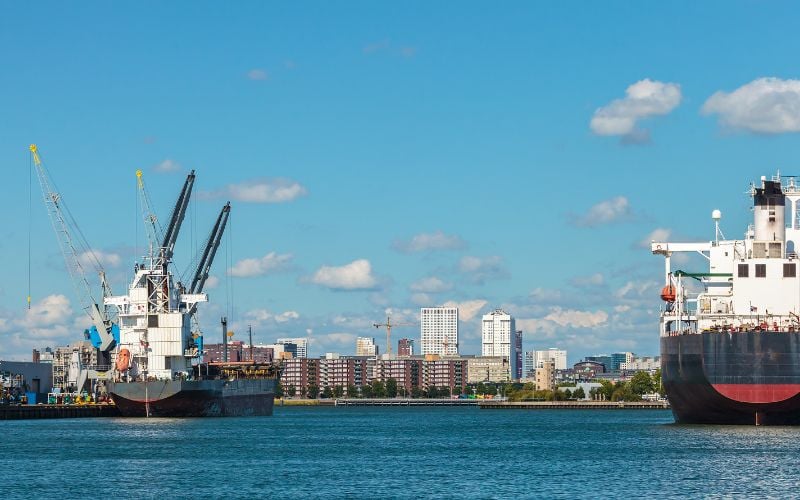
EMO Rotterdam is a large dry bulk terminal handling iron ore and coal for the European steel and energy industries.
HES Bulk Terminal Rotterdam is another facility focusing on commodities for the steel, silicon metal and energy sectors.
About 33,700 ships, 434,600,000 tonnes of cargo and 10,000,000 TEU are handled every year at the Rotterdam Port.
7. Port of Richards Bay, South Africa
This facility lies in Richards Bay Harbour on South Africa’s Indian Ocean Coast and contains the Richards Bay Coal Terminal, the biggest coal export facility in Africa.
Originally built to handle coal exports, the facility has transformed into South Africa’s most modern port and a premier bulk port, handling liquid bulk and breakbulk cargoes.
The port has 21 berths, which can accommodate 4 capesize ships and load 4 vessels at a time. The coal terminal has a storage capacity of 8.2 million tonnes of coal and has 7 stacker reclaimers, two stackers and a reclaimer.
The entrance channel is dredged to a permissible draught of 17.5 m, and berthing varies between 8 m and 19 m.
The port handles 86,300,000 tonnes of cargo and 1,500 vessels annually.
8. Jurong Port, Singapore
A part of the Port of Singapore, Jurong Port is a multi-purpose port operator which has a general cargo terminal, container terminal, a bulk terminal, Penjuru Terminal and Marina South Wharves, a Small Craft Terminal and mechanical ramps for RORO.
The Bulk Cargo Terminal deals with cement, furnace slag, copper slag and liquid bulk. Its cement terminal is one of the world’s biggest common-user cement facilities and has 2 berths with 3 cement screw unloaders linked to an enclosed air-slide and non-pollution-causing conveyor system.
Jurong handles over 90% of the cement throughput into Singapore. The port serves over 7000 ships, up to 150,000 deadweight tonnes and 4,000,000 tonnes of cargo every year.
9. Port of Narvik, Norway
This deepwater port is located at the eastern end of Vestfjorden in Narvik municipality in Nordland county.
The harbour entrance is 746 m wide with varying depths between 20 m and 30 m, offering good manoeuvring conditions for massive ships.
It remains ice-free throughout the year, handling around 14,146,000 tonnes of cargo and 10,156 passengers annually.
The port has dedicated infrastructure for bulk exports, including LKAB’s Iron Ore Berths No. 3, 4 and 5 at the northern side of the port basin.
The deep-sea berth is at Fagernes near the entrance of Beisfjord. The port also deals with general cargo, containers and cruise ships.
10. Port of Visakhapatnam, India
Situated on India’s east coast on the Bay of Bengal, this is the country’s second-largest port by cargo volume.
It has two harbours, the outer and the inner, with the former having 8 berths and the latter having 18 berths, with an LOA of 390 m and 240 m respectively. An SPM allows berthing during daytime only.
The port has several dry bulk terminals. The Essar Vizag Terminal is India’s biggest iron ore handling complex, using a mechanised and eco-friendly infrastructure to handle massive ships and iron-ore-based products.
West Quay-6 Terminal, operated by OSL Group, handles dry bulk cargo and began operations in 2024.
Major exports include iron ore, alumina, iron, steel, pig iron, petroleum products, thermal coal, cement clinker, general cargo and containers.
Imports comprise crude and LPG products, coking coal, magnesite, phosphoric acid, caustic soda, edible oil, fertilisers, etc.
Approximately 2,400 vessels, 65,500,000 tonnes of cargo, 55,790 TEUs and 16,780 passengers are handled annually.
You might also like to read-
- Top 10 Busiest Container Terminals In Europe
- Top 5 Maritime Hubs In The World
- 5 Major LNG Terminals in the United States
Disclaimer :
The information on this website is for general purposes only. While efforts are made to ensure accuracy, we make no warranties of any kind regarding completeness, reliability, or suitability. Any reliance you place on such information is at your own risk. We are not liable for any loss or damage arising from the use of this website.


About Author
Zahra is a maritime writer with 6 years of technical writing experience spanning port operations, offshore wind, oil and gas, and maritime policy. Her analytical edge...Read More ->
Disclaimer :
The information on this website is for general purposes only. While efforts are made to ensure accuracy, we make no warranties of any kind regarding completeness, reliability, or suitability. Any reliance you place on such information is at your own risk. We are not liable for any loss or damage arising from the use of this website.
Related Articles


Subscribe To Our Daily Newsletter
By subscribing, you agree to our Privacy Policy you can unsubscribe anytime.


