China Launches World’s Most Powerful Assembled Cutter Suction Dredger
Large ocean-going dredgers can access and deepen coastal ports and shipping lanes, however they cannot sail past dams, low bridges, or shallow riverbeds to reach landlocked lakes and inland reservoirs. Hence, inland waterways have had to depend on smaller, less powerful machines to clear out mud and sand.
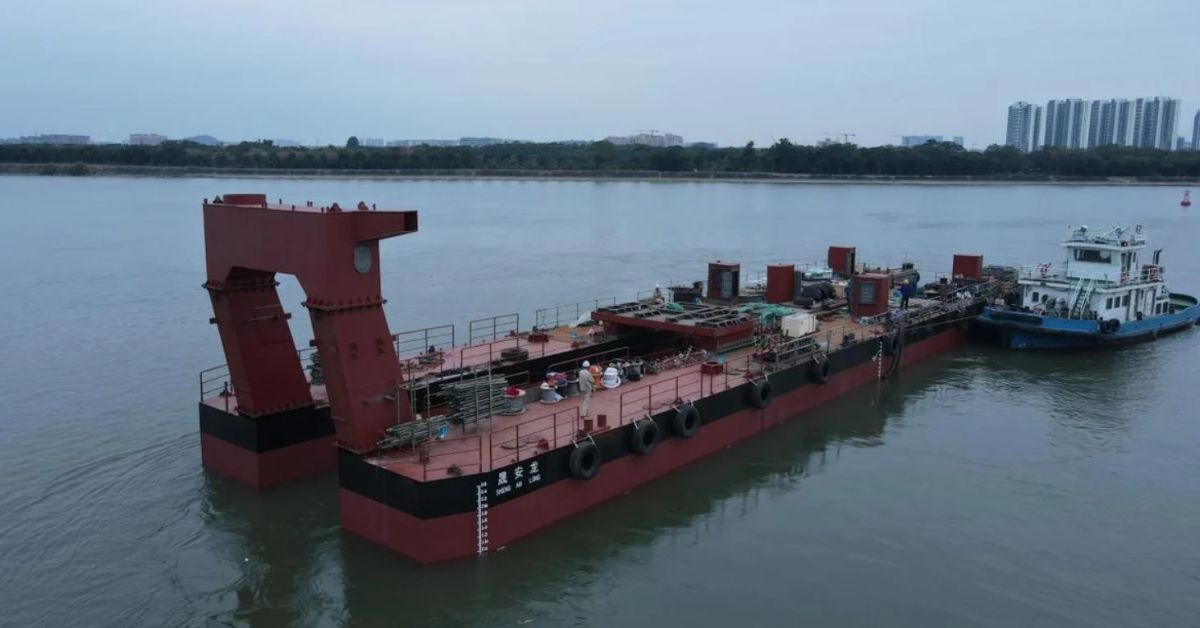
On November 19, 2026, China launched a clever solution to that problem; the Sheng An Long or Sheng’an Long, built by CCCC Guangzhou Dredging in Nansha, claiming that it is the most powerful take-apart cutter suction dredger in the world.
What Is the Sheng’an Long and Why Is It Record-Breaking?
The Sheng’an Long is not a cargo ship that can carry goods between ports, rather it is a floating excavation machine that can dig up and remove sediment like mud, silt and sand from the bed of rivers, lakes and reservoirs at a maximum depth of 27 m using a 1000 kilowatt cutting tool.
It is 70 m long, 13.14 m wide and 2.95 m deep with a total installed power of 6,738 kilowatts, which is more than any dismountable cutter suction dredger in operation.
How Can a 70-Meter Vessel Be Transported Overland?
Moving a dredger of this size to an isolated or landlocked lake is nearly impossible if there is a dam in the way or if a river is too shallow.
To solve this issue, the engineers design its hull from 7 interlocking floating sections. When the work at one site is complete, crew can take it apart and load the pieces separately onto rucks, trains or river barges. Once the pieces reach the site of the next project, the dredger can be reassembled and launched into the waters.
Sheng’an Long’s Pumping System
The Sheng’an Long uses a clever two-part hull design for its pumping system. It has a double-walled section above the deck and a single-walled section below the waterline. This keeps the ship light to move in pieces while strong enough to pump up to 10,000 cubic meters of clear water per hour.
The amount of mud removed in an hour depends on how thick the soil is. More so, the dredger can pump the excavated material through pipelines up to 8 km away without requiring extra booster stations along its way.
The Electric Power System and how it reduces carbon emissions
Conventional dredgers burn enormous amounts of diesel fuel, especially when they sit in a single spot, working for months. However, the Sheng’an Long handles this with its dual-source electric system.
The dredger can generate its electricity using onboard generators when working in remote areas. It can also plug into local onshore power grids where such infrastructure is available, thus burning zero fuel onboard. This is useful during reservoir clean ups.
The electric setup can decrease carbon emissions by 2300 tonnes annually, though exact savings depend on how often shore power is used and how the local grid receives electricity.
The ship also uses smart, automated controls to adjust digging speed and power use automatically, keeping operations efficient at all times.
How Does It Compare to Other Modular Dredgers?
The concept of modular-dredgers is not new as European Shipbuilders including Dutch companies Damen and Royal IHC have also constructed these types of dredgers for years.
What makes Sheng’an Long different from its counterparts is the combination of sheer power and green technology. Take apart dredgers are usually less powerful, but by packing it with tremendous power, a dual-source electric system and smart controls, China has filled a major gap in the dredging market.
Why Do Inland Lakes and Reservoirs Need Heavy Dredging?
Clearing mud from waterways isn’t just about keeping boats moving, it is critical for water supply and clean energy.
Over time, rivers naturally wash silt and sand into lakes and hydropower reservoirs. As that sediment piles up on the bottom, it takes up space meant for water, shrinking storage capacity, increasing flood risks, and making hydropower dams less efficient.
Countries around the world are taking this problem seriously. In Brazil, for example, national water and energy regulators (ANA and ANEEL) issued Joint Resolution No. 127 in 2022, requiring hydropower plants over 1,000 kilowatts to closely track sediment buildup and water storage levels.
The Sheng’an Long has a two-stage rollout planned to meet this growing demand. First, it will go to work on reservoir cleanup and environmental restoration projects in China. After that, it will help build and maintain ports in partner countries along the Belt and Road Initiative.
What Does This Mean for the Future of Water Infrastructure?
The launch of the Sheng’an Long shows that heavy marine engineering no longer has to choose between raw power, portability, and lower emissions. By proving that a high-power dredger can be packed up and driven to a landlocked reservoir, CCCC Guangzhou Dredging has opened a new chapter for maintaining the world’s inland lakes, dams, and ports in a cleaner, more flexible way.
You might also like to read-
- What Are Cutting Suction Dredgers?
- Different Types of Dredgers Used in the Maritime Industry
- World’s Most Powerful Subsea Trencher Delivering 3600 Horsepower Can Install 18 Feet Below Seabed
- Understanding The Difference Between Salvage, Towage & Pilotage
- Biggest Dredger In The World
Disclaimer :
The information on this website is for general purposes only. While efforts are made to ensure accuracy, we make no warranties of any kind regarding completeness, reliability, or suitability. Any reliance you place on such information is at your own risk. We are not liable for any loss or damage arising from the use of this website.
Related Posts


About Author
Zahra is a maritime writer with 6 years of technical writing experience spanning port operations, offshore wind, oil and gas, and maritime policy. Her analytical edge...Read More ->
Disclaimer :
The information on this website is for general purposes only. While efforts are made to ensure accuracy, we make no warranties of any kind regarding completeness, reliability, or suitability. Any reliance you place on such information is at your own risk. We are not liable for any loss or damage arising from the use of this website.
Subscribe To Our Daily Newsletter
By subscribing, you agree to our Privacy Policy you can unsubscribe anytime.