
5 Important Responsibilities Of Ship Agents
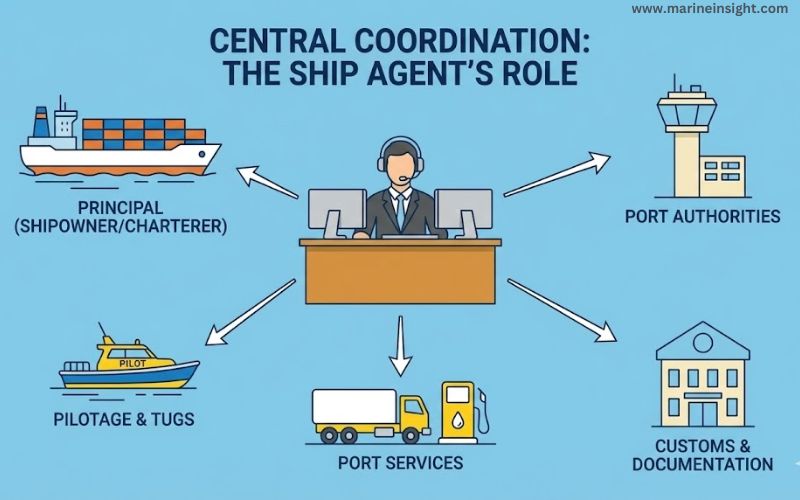
In modern shipping, port calls involve far more than a vessel’s physical arrival and departure. Each call requires coordination between shipowners, charterers, port authorities, service providers, and regulators. At the centre of this coordination sits the ship agent, often working quietly in the background, yet playing a decisive role in ensuring that port operations run smoothly. Understanding the responsibilities of ship agents is essential for appreciating how ships transition efficiently between sea and shore.
Below are five key responsibilities that define the professional role of a ship agent.
1. Acting as the Principal’s Local Representative
A ship agent functions as the local representative of the shipowner or charterer at the port. Since the principal is usually based in another country, the agent becomes the primary point of contact for all matters related to the port. This includes liaising with port authorities, terminals, pilots, and service providers, while ensuring that the principal’s instructions are accurately carried out. Clear communication and adherence to authority limits are critical, as agents act on behalf of others rather than in their own capacity.
2. Coordinating Port Services and Berthing Arrangements
One of the most visible responsibilities of a ship agent is arranging essential port services. This includes securing berth allocation, coordinating pilotage and tug assistance, and scheduling services such as bunkering, fresh water supply, and waste disposal. Timely coordination helps prevent congestion, reduces idle time, and ensures the vessel remains on schedule. A lapse at this stage can lead to delays, operational inefficiencies, and financial consequences for multiple parties.
3. Managing Port and Customs Documentation
Ports operate within strict regulatory frameworks, and ship agents are responsible for ensuring that all required documentation is submitted correctly and on time. This may include arrival notices, port clearance papers, customs declarations, crew immigration documents, and cargo-related filings. Accuracy is essential, as errors or omissions can result in vessel detention, fines, or demurrage. Effective document management is often what separates a smooth port call from a costly delay.

4. Facilitating Communication Between Ship and Shore
During a port stay, numerous stakeholders require timely information—terminal operators, surveyors, chandlers, repair teams, and authorities. The ship agent serves as the communication bridge between the vessel and these shore-side entities. By relaying updates, coordinating schedules, and resolving minor operational issues, agents help prevent misunderstandings that could escalate into disputes or operational standstills.
5. Protecting the Principal’s Operational Interests
While ship agents do not replace shipowners or charterers, they are expected to safeguard their principals’ operational interests within the scope of their authority. This includes monitoring port costs, ensuring services are delivered as agreed, and flagging potential issues before they become liabilities. Agents must exercise reasonable skill and diligence, as negligence—particularly in documentation or coordination—can expose them to contractual or legal consequences.

Conclusion
Ship agents play a pivotal yet often understated role in maritime operations. Their responsibilities span logistics, compliance, communication, and representation, all of which directly influence the efficiency and cost of a vessel’s port call. A competent agent contributes not only to smooth port operations but also to risk management and commercial certainty in shipping.
Beyond these core duties, ship agents operate within defined legal boundaries, exceptions, and contractual frameworks that shape their liabilities and responsibilities. These aspects, along with practical scenarios and a deeper legal context, are explored in greater detail in the eBook “Responsibilities of Individual Parties in Shipping.”
You might also like to read-
- How To Identify Fake Or Fraudulent Shipping Agents And Institutes?
- 7 Important Parties In Shipping
- Who is a Shipping Agent?
Disclaimer :
The information on this website is for general purposes only. While efforts are made to ensure accuracy, we make no warranties of any kind regarding completeness, reliability, or suitability. Any reliance you place on such information is at your own risk. We are not liable for any loss or damage arising from the use of this website.
Related Posts


Disclaimer :
The information on this website is for general purposes only. While efforts are made to ensure accuracy, we make no warranties of any kind regarding completeness, reliability, or suitability. Any reliance you place on such information is at your own risk. We are not liable for any loss or damage arising from the use of this website.
Related Articles

About Author
Rishabh Srivastava is a Maritime lawyer dealing in Ship arrests, maritime claims and arbitration in India.
Subscribe To Our Daily Newsletter
By subscribing, you agree to our Privacy Policy you can unsubscribe anytime.


BE THE FIRST TO COMMENT