
What Is Global Maritime Distress Safety System (GMDSS)?

Introduction to GMDSS
In the 18th century, ships used Morse code to send any distress signal to a coastal authority or other ships during an emergency.
However, this message could not convey the kind of emergency a ship was facing.
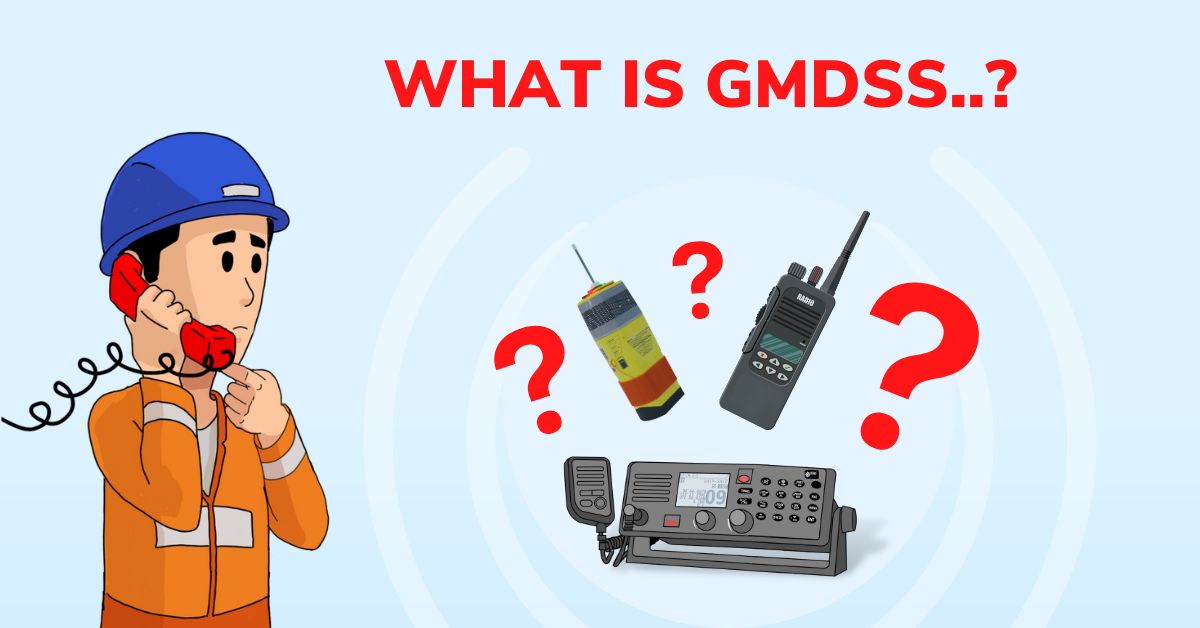
Therefore, an internationally agreed safety procedure was adopted by IMO under SOLAS chapter IV, known as GMDSS- Global Maritime Distress Safety System.
GMDSS and Its Uses
On 1st February 1999, the fully implemented GMDSS came into place. It was a set standard for the usage of communication protocol, procedures, and safety equipment to be used by a ship when in distress.
Under GMDSS, all the passenger ships and cargo ships above 300 GT sailing in international waters have to carry equipment as per GMDSS.
Read -> SOLAS requirements for GMDSS
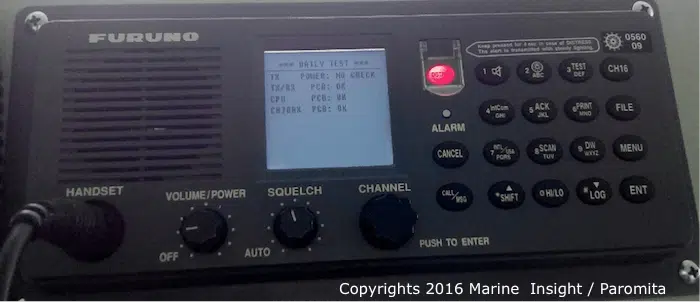
When a ship uses GMDSS, it basically sends a distress signal via satellite or radio communication equipment. It’s also used as a medium for sending or receiving maritime safety information and general communication channel.
Read -> Daily, Monthly and Weekly Tests of GMDSS equipment on board Ships
In the GMDSS framework, there are different Sea Areas to allot the working equipment in the respective area. They are as follows:
| AREA | RANGE | EQUIPMENT |
|---|---|---|
| A1 | 20 to 50 M | VHF DSC |
| A2 | 50 to 400 M | VHF + MF |
| A3 | 70° N to 70° S | VHF + MF + One INMARSAT |
| A4 | Above 70° N or S | HF + MF + VHF |
To understand the above table further, the following are the ranges of frequencies in a specific band:
- Medium Frequencies: 300 KHz to 3 MHz
- High Frequencies: 3 MHz to 30 MHz
- Very High Frequencies: 30 MHz to 300 MHz
Very High Frequencies (VHF)
For maritime communication, the range of 156 MHz to 174 MHz is allocated. Channel 16, which is set at 156.800 MHz, is for Distress, Urgency and Safety communication. Channel 70, set at 156.525 MHz, is for routine VHF DSC (Digital Selective Calling) watch.
GUARD channels are set above and below Channel 16 to avoid any interference on Channel 16. One cannot have seamless traffic on Channel 16 with interference with regard to other communication aside from distress, safety and urgency. So the Guard channel frequencies are 156.775 MHz and 156.825 MHz.
Among other things, the VHF set runs on a 24 Volt DC supply with J3E type of transmission for Radiotelephony and G2B type of transmission for VHF DSC.
Different Elements of GMDSS
- INMARSAT: It is a satellite-operated system that includes ship earth station terminals – Inmarsat B, C and F77. It provides telex, telephone and data transfer services between ship-to-ship, ship to shore, and shore to ship, along with a priority telex and telephone service connected to shore rescue centres.
- NAVTEX: NAVTEX is an internationally adopted automated system used to distribute MSI-maritime safety information, and includes weather forecasts and warnings, navigational warnings, search and rescue notices and other similar safety information.
- Emergency Position Indicating Radio Beacon (EPIRB): It helps determine the position of survivors during a SAR operation. It is a secondary means of distress alerting. Read about EPIRB here.
- Search and Rescue Locating Equipment: The Search and Rescue Radar Transponder is used to send Search and Rescue units to the position of distress, which it transmits upon interrogation. Read about Search and Rescue equipment here.
- Digital Selective Calling (DSC): This is a calling service between ship to ship, ship to shore or vice versa for safety and distress information, mainly on high or medium frequency and VHF maritime radio.
Documents to be carried onboard with regard to GMDSS:
- Ship’s Radio License
- Radio Operators Certificates
- Safety Radio Certificate
- GMDSS Radio Log Book
- ITU List of Cell Signs and Numerical Identities of Stations used by Maritime Mobile and Maritime Mobile Satellite Services
- ITU List of Coast Stations
- ITU List of Ship Stations
- ITU List of Radio Determination and Special Service Stations
- Antenna Rigging Plan
- Valid Shore-Based Maintenance Certificate
GMDSS Training
The handling of GMDSS equipment requires certified training as well as licensing from the Telecommunication department. The General Operators Certificate (GOC) is mandatory for an officer to be allowed to handle GMDSS equipment onboard the ship.
To obtain this GOC, a short course is compulsory, following which an exam is conducted (written and oral), which needs to be cleared. This training is for Cadets who want to become licensed Radio Operators to operate all the equipment in conjunction with the regulations laid out for GMDSS.
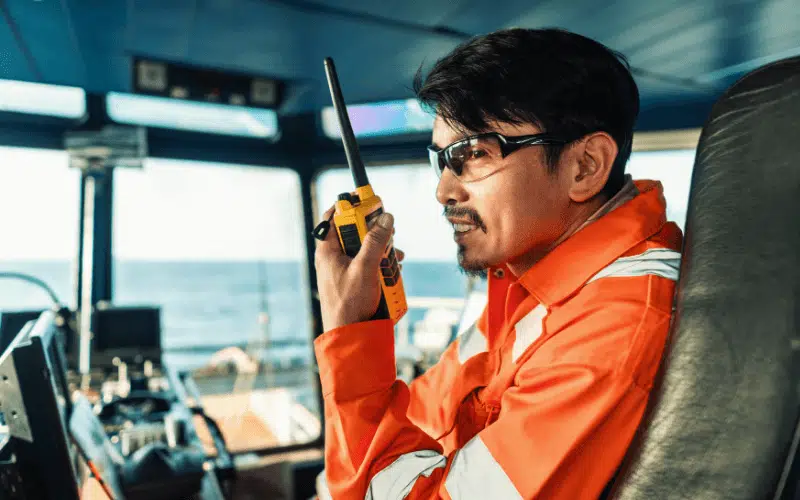
The training period is around 12 days, and owing to the course being mandatory, it is advised to call into an approved institute to book a seat for a future date, well in advance. Depending on which country the individual is from, they must check the respective institute websites as well as the Ministry of Shipping (whichever is applicable for their country) website to get the full details on eligibility and criteria for admission into the GMDSS course.
Over the period of the course, the officer is taught about the various aspects of GMDSS, ranging from Radio Log to sending INMARSAT messages. The written exam tests the theory, whereas the oral examination is a one-on-one session with a surveyor who tests the individual on the different aspects of GMDSS, covering the whole syllabus (theory as well as practical).
Recommended GMDSS Books
- GMDSS – A Guide For Global Maritime Distress Safety System
- GMDSS – A User’s Handbook
Admiralty List of Radio Signals (ALRS) Volume 5: GMDSS
NP285 or ALRS Vol. 5 is the publication with extensive information on theory as well as practical use for all things about the GMDSS. The correction for this is found in Section 6 of the weekly Notices To Mariners (TNM). Its contents cover is as follows-
- Distress Communication And False Alert
- Operation Procedure For Use Of DSC Equipment
- Search And Rescue Transponder
- Extract From ITU Radio Regulations
- VHF DSC List Of Coast Stations For Sea Area A1
- MF DSC List Of Coast Stations For Sea Area A2
- HF DSC List Of Coast Stations For Sea Area A3
- INMARSAT
- Maritime Safety Information (MSI)
- SafetyNet
- NAVTEX
- Distress, Search And Rescue
Portable Marine Radio
The portable marine radio or the survival craft transceiver is a very important element of the GMDSS. It is a piece of equipment located on the bridge in case the ship’s personnel have to board the survival craft, but it may also be used for communication on board.
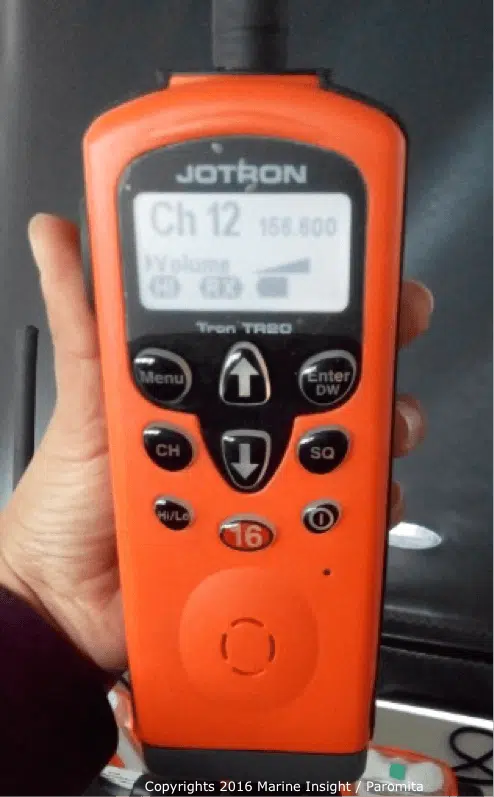
In case it’s used in an emergency, it is used for on-scene coordination between the survival craft and the search and rescue units. The IMO requirements for the survival craft transceivers are as follows:
- Can be operated by unskilled personnel
- Transmission and Reception on 156.8 MHz (Channel 16) and 156.3 MHz (Channel 6)
- Withstand a drop of 1 meter
- Watertight to a depth of 1 meter for 5 minutes
- Minimum power of 0.25 watts
- A power reduction switch is available
- The antenna must be omnidirectional and vertically polarised
- Battery power capacity for 8 hours (Nickel Cadmium or Lithium Battery)
Being a mandatory setup onboard ships, which is also the key setup with regard to emergencies, it is actually in the self-interest of the ship’s officer to gain maximum know-how on every aspect of the GMDSS.
You might also like to read:
- Daily, Monthly And Weekly Tests Of GMDSS Equipment On Board Ships
- SOLAS requirement for Global Maritime Distress Safety System (GMDSS)
- A Guide To Verified Gross Mass (VGM) For Shipping
- How to get a GMDSS Endorsement Certificate?
- What is An Emergency Position Indicating Radio Beacon (EPIRB)?
- What are SSB Radios?


Disclaimer :
The information on this website is for general purposes only. While efforts are made to ensure accuracy, we make no warranties of any kind regarding completeness, reliability, or suitability. Any reliance you place on such information is at your own risk. We are not liable for any loss or damage arising from the use of this website.

About Author
Shilavadra Bhattacharjee is a shipbroker with a background in commercial operations after having sailed onboard as a Third Officer. His interests primarily lie in the energy sector, books and travelling.
Disclaimer :
The information on this website is for general purposes only. While efforts are made to ensure accuracy, we make no warranties of any kind regarding completeness, reliability, or suitability. Any reliance you place on such information is at your own risk. We are not liable for any loss or damage arising from the use of this website.
Related Articles


Subscribe To Our Daily Newsletter
By subscribing, you agree to our Privacy Policy you can unsubscribe anytime.


Could u please tell me how long we are required to maintain sat c logs for?
do we need to have a print out of all messages or only distress messages?
do we need to maitain a log of all rcvd and send messages? if yes? for how long?
we do not have the facility to copy the messages anymore since there is no floppy or usb port
thanks
I like to be one of the team in the travel ship, I have an ( GMDSS ) license but
GMDSS
Can we send the urgency calls for doing weekly tests???
I have read only about distress calls cannot be made for tests.
Hi my name is Craig I am working for a private fishing company .I am passionate of the work and the courses I have dune have not yet in counter a emergency call yet ,but starting a new course on gmdss global looking forward to start the course.
@Craig: Good luck.