
World’s First Global Maritime Competition
10 Biggest Navies of the World
Naval forces play a vital role in the realm of global maritime security. They protect trade routes, keep a check on piracy, smuggling, etc and also project power. The biggest navies of the world have the most modern warships with advanced technologies and systems, enabling them to shape global geopolitics.
In this article, we will rank the Top 10 Biggest and most powerful navies in the world based on the rankings of the World Directory of Modern Military Warships, which uses a formula that takes into consideration all the factors, not just the size or number of ships in the naval fleet. This includes the level of modernisation in the fleet, logistical support, attack and defense capabilities, local shipyards, etc.
As per this criteria, the biggest and strongest navy is the U.S Navy.
Let’s take a look at the other members of this list comprising the biggest navies of the world.
1. U.S Navy
The U.S. Navy has 232 ships in its active naval inventory.
It boasts the biggest aircraft carrier fleet in the world, led by the USS Gerald R. Ford, said to be one of the most advanced warships.

The majority of its surface force is made of destroyers, with 74 active Arleigh Burke-class destroyers and 19 planned to enter service. It also has two active Zumwalt-class destroyers and one under trials. These ships comprise about 33% of its strength.
The Navy also has Littoral Combat Ships and Amphibious Assault Ships.
It also has the most capable submarine fleet in the world, with 53 fast attack submarines, 14 ballistic-missile submarines and 4 guided-missile submarines.
2. People’s Liberation Army Navy
China has 405 ships in its active service, making it the biggest navy in the world, if the number of ships is taken as a criteria of classification. However, its fleet lags behind in terms of modernisation when compared with U.S. naval ships.
Nonetheless, the PLAN Navy is growing rapidly, both in number and in technological upgrades, focusing on more advanced surface and undersea ships as well as critical support ships.

It has a fixed-wing carrier fleet, numbering two units and a submarine fleet consisting of over 70 vessels with only a few beginning to age. Its fleet of destroyers and frigates is also relatively young.
The navy also has 70 corvettes and 8 mine/countermine boats. The amphibious assault force is also considerable, and there are at least 24 ships on order.
Its 127 Offshore patrol vessels make up around 31% of its total strength, followed by submarines at 18% and destroyers, frigates and corvettes, contributing 12% each.
3. Russian Navy
The Russian Navy has 283 active ships in its fleet, of which corvettes make 31.2% of its strength, submarines 21%, and its 48 mine/countermine warfare ships make 18%. The fleet is quite balanced with battle cruisers, destroyers, offshore patrol ships and amphibious assault support ships.
Moscow has just one aircraft carrier, the Admiral Kuznetsov, part of the Kuznetsov class. It has been the Russian Navy’s flagship since it was commissioned in 1990.

The Navy’s 58 submarines and 4 cruisers are an aging force, while the frigate fleet has seen a few new additions.
Corvettes make the biggest part of Russia’s surface combatant force, numbering 83, while more can be expected.
Another significant force is the 50 offshore patrol vessels, which comprise 18% of its strength.
4. Indonesian Navy
The Indonesian Navy is said to be the largest in Southeast Asia, with 245 ships in service. Its maritime capabilities are steadily rising as it acquires advanced weaponry and focuses on modernisation.
In 2020, Indonesia’s defense minister kicked off procuring new frigates from the U.K, with construction starting in 2022 in East Java, Indonesia.

Recently, it also acquired 2 Pattugliatore Polivalente d’Altura offshore patrol vessels from Italy and launched two others built indigenously. Indonesia is also in talks with Turkey and France for expanding its naval capabilities.
Indonesia is procuring ships with anti-ship and anti-aircraft weapons to bolster its deterrence capabilities against China’s growing influence in the disputed South China Sea.
The Indonesian Navy has 4 submarines, making 2% of its total strength; it has 7 frigates, 25 corvettes, giving it a strength of 10%, 168 offshore patrol ships which make up 69% of its total strength and 32 amphibious assault ships.
5. Republic of Korea Navy
Considered a strong naval force with around 70,000 personnel, about 147 ships and a modern submarine fleet such as the KSS-III Class, the Republic of Korea Navy is one of the most powerful in the region. It also has plans for an aircraft carrier program.
It was envisaged with defense and deterrence in mind and is dependent on its Offshore Patrol Vessels fleet that comprises half of its strength.
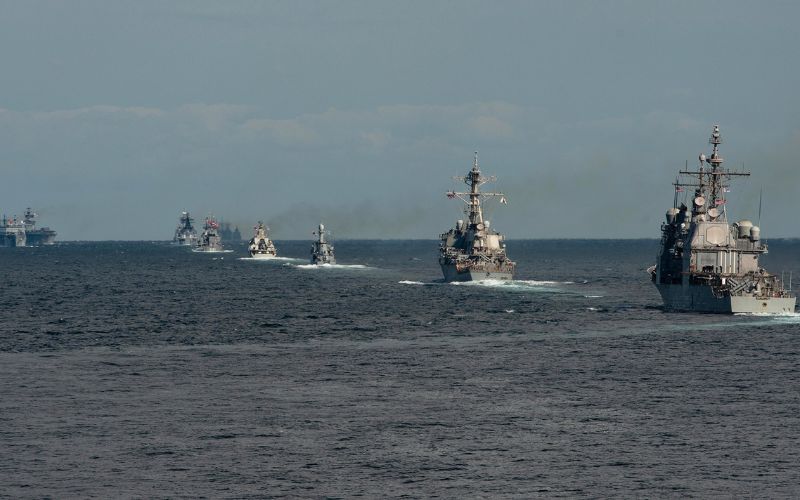
While the North has an ally in China, South Korea has the U.S and a few regional allies.
It has 21 submarines, making up 14% of its total strength, 13 destroyers, which make up 9%, 17 frigates giving it 12%, 14 mine warfare ships and 69 offshore patrol ships. It also has 10 amphibious assault vessels.
6. Japan Maritime Self-Defense Force
The Japanese Navy is the second largest navy in Asia in terms of fleet tonnage. It has 105 ships in service.
Its warships are endowed with cutting-edge technology, with a focus on anti-submarine warfare capabilities, a robust shipbuilding infrastructure and a trained crew.

It lacks dedicated aircraft carriers, however, its strength lies with destroyers and submarines with advanced weapons and sensors.
The navy has 24 submarines, 42 destroyers, 6 frigates, 22 mine warfare ships, 6 offshore patrol vessels and 3 amphibious assault vessels.
7. Indian Navy
India’s geographic position allows its Navy to monitor important sea lanes while maintaining its regional influence.
The Indian Navy has a fleet of 150 ships and submarines and 300 aircraft. It is served by 67,252 active personnel and 75,000 reserve personnel.

It has modern warships, aircraft carriers, submarines and a well-organised naval aviation arm, its expanding shipbuilding capacity enabling it to project power across the Indian Ocean.
The navy’s INS Vikramaditya and the INS Vikrant provide a platform for deploying fighter aircraft, enhancing India’s naval projection capabilities.
It has 2 aircraft carriers, 19 submarines, 13 destroyers, 14 frigates, 18 corvettes, 29 offshore patrol vessels and 5 amphibious assault ships.
8. French Navy
The naval force of France is one of the strongest navies in the world, with its strength coming from its nuclear aircraft carrier, the Charles de Gaulle and a considerable fleet of surface vessels and submarines.
Its undersea fleet is made up of 10 boats, and it also has 8 submarines, 21 destroyers, 17 mine warfare ships, 20 offshore patrol vessels and 3 amphibious assault vessels.

The French navy is built around nuclear deterrence. Coming to naval technology, the French Navy is going ahead with its maritime uncrewed systems (MUS) programmes.
It is also developing new systems and vessels, including uncrewed surface vessels (USVs).
9. British Navy
Also known as the Royal Navy, it has a long history of naval dominance and boasts advanced technologies in its ships and submarines, with a special focus on research and development.
The navy can operate in multiple theatres simultaneously, a legacy which stems from Britain’s role in the Industrial Revolution, enabling the nation to build super shipbuilding capabilities and maintain a large fleet.

A quarter of the force is made of frigates, followed by mine warfare ships and submarines.
Its Queen Elizabeth-class aircraft carriers are some of the largest warships, laden with weapons and modern communication systems and sporting the fixed-wing F-35 Lighting II strike fighter as its main offensive system. These ships can carry up to 72 aircraft.
The British Navy has 50 ships in service, including 2 aircraft carriers, 9 submarines, 6 destroyers, 8 frigates, 7 mine warfare ships and 18 offshore patrol vessels.
10. Turkish Navy
Turkiye has made significant investments to modernise its naval fleet with domestically built warships such as the Ada-class corvettes and the upcoming MUGEM aircraft carrier.
It is also developing its naval defense systems and technologies since the country has made self-sufficiency a priority to reduce dependence on outside powers.

Turkiye has 90 ships in its current active inventory, including a helicopter carrier, 13 submarines, 17 frigates, 9 corvettes, 11 mine warfare ships, 34 offshore patrol vessels and 5 amphibious assault vessels.
TCG Anadolu is the largest ship of the Turkish Navy. It is a landing helicopter dock-type amphibious assault ship, allowing Turkiye to extend its influence in the Black Sea and the Eastern Mediterranean.
You might also like to read-
- Top 15 Biggest Aircraft Carriers in the World
- Frigates vs Corvettes: What are the Differences?
- Which is the World’s Strongest Navy And Why?
- Top 10 Books On Submarines
Disclaimer :
The information on this website is for general purposes only. While efforts are made to ensure accuracy, we make no warranties of any kind regarding completeness, reliability, or suitability. Any reliance you place on such information is at your own risk. We are not liable for any loss or damage arising from the use of this website.



About Author
Zahra is an alumna of Miranda House, University of Delhi. She is an avid writer, possessing immaculate research and editing skills. Author of several academic papers, she has also worked as a freelance writer, producing many technical, creative and marketing pieces. A true aesthete at heart, she loves books a little more than anything else.
Disclaimer :
The information on this website is for general purposes only. While efforts are made to ensure accuracy, we make no warranties of any kind regarding completeness, reliability, or suitability. Any reliance you place on such information is at your own risk. We are not liable for any loss or damage arising from the use of this website.
Related Articles

⚓️ Enhance Your Knowledge. Prevent Accidents. Stay Safe at Sea.
1. eBooks for Engine Department
Master machinery operations, troubleshooting, and safety procedures with expertly written guides tailored for marine engineers. Prevent costly breakdowns and onboard accidents through practical knowledge.
👉 Explore Engine Department eBooks
2. eBooks for Deck Department
Sharpen your seamanship, navigation, and cargo-handling skills with real-world case studies and practical insights designed for deck officers and cadets.
👉Discover Deck Department eBooks
3. eBooks on Electrical Fundamentals & Issues
Understand marine electrical systems, identify potential faults, and prevent onboard electrical failures with step-by-step explanations from industry experts.
4. Pocket Guides for Quick Reference
Compact, handy, and loaded with essential checklists—perfect for on-the-go reference during operations and emergencies at sea.
5. Combo Packs to Save Big
Access multiple expert eBooks at discounted prices. Ideal for professionals seeking complete safety and operational knowledge across various ship departments.
6. Digital Maritime Courses – Learn at Your Own Pace
Upgrade your competence with Marine Insight Academy’s online courses. Learn from industry professionals anytime, anywhere, and become a safer, smarter seafarer.
Subscribe To Our Daily Newsletter
By subscribing, you agree to our Privacy Policy and may receive occasional deal communications; you can unsubscribe anytime.

BE THE FIRST TO COMMENT