
Green Financing Options For Shipowners Retrofitting Their Fleets
Much of the fleet that must decarbonise by 2035 is already in service, making retrofits essential rather than optional. Getting to Zero Coalition estimates that efficiency measures alone could reduce emissions across the global fleet by 25% to 30%. At the start of 2023, commercial ships averaged 22.2 years of age, which is more than two years older than what it was a decade earlier.
With vessel life cycles extending to roughly 25 years, many of these ships will remain in service beyond 2035. For owners able to fund retrofits from their balance sheets, payback periods can be as short as one to two years, which is an unusually attractive return on capital.
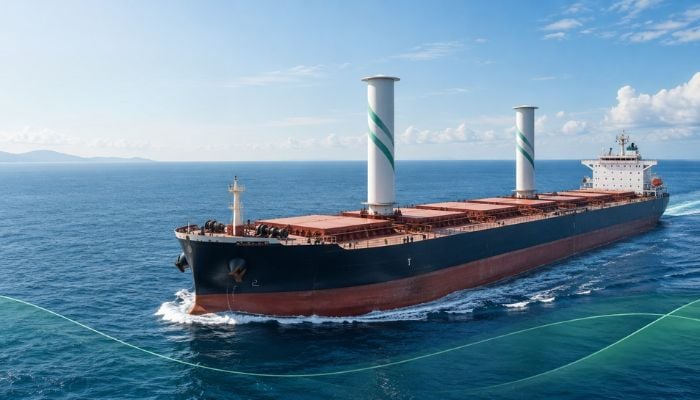
Despite this strong technical and commercial case, retrofit uptake remains slow. The principal barrier is not technology; it is the financing structure, particularly the vessel mortgage.
The Security Problem
Ship finance is asset-based. The bank lends, the vessel secures the loan, and the bank takes a first-ranking mortgage. That works beautifully for a newbuild but badly for a 12-year-old bulker that already carries a mortgage from the acquisition financing.
KfW IPEX-Bank put it plainly in EDF’s June 2024 discussion brief: a bank financing a retrofit usually cannot become a first-ranking mortgage; second-lien financing is complicated and expensive, and first-ranking mortgages are normally reluctant to accept a second-ranked mortgage behind them.
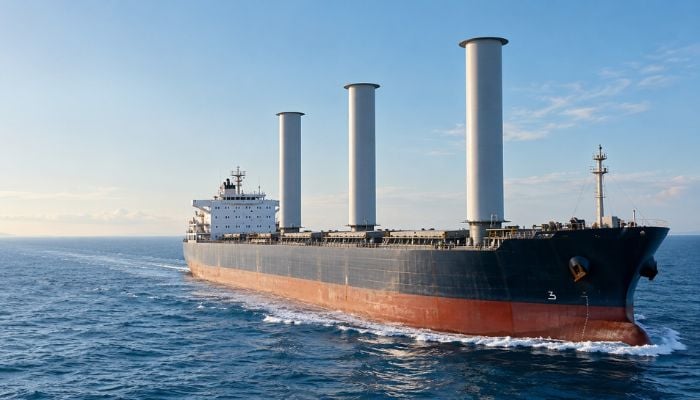
There is a second problem, less discussed and just as damaging. Retrofit tickets are small. A wind rotor package or an air lubrication system might cost USD 2 million to USD 5 million on a ship worth USD 40 million. A USD 3 million loan takes roughly the same credit committee time, legal spend, and monitoring effort as a USD 30 million loan, and returns are a tenth of the
interest. Banks respond rationally, and they focus on the big deal. Owners have historically funded efficiency technology out of equity. Fine if you are a big player; however, out of reach if you run four handy sizes.
Option 1: Top UP the facility you already have
The simplest route, and the one most often skipped. If you are refinancing or amending an existing facility, anyway, fold the retrofit capex into it. The first-ranking mortgage is already there. You are asking for an increase, not a new security package, and the bank gets to book the vessel’s improved CII rating against its own Poseidon Principles disclosure.
Time this to your refinancing calendar rather than your drydock calendar and start the conversation 12 months early.
Option 2: Guarantee-Backed Bank Debt
Where a bank will not take the risk alone, a guarantor can bridge it. The EIB approved its Green Shipping Guarantee programme in June 2016 with a EUR 750 million budget, EUR 500 million from the European Fund for Strategic Investments and EUR 250 million from the Connecting Europe Facility. It covers retrofitting existing vessels as well as fleet renewal for both seagoing
and inland operators, and has run through framework agreements including EUR 300 million with ING and EUR 150 million with ABN AMRO.
Export credit agencies do the same job at national level, offering guarantees or direct lending conditional on sustainability performance. If your retrofit involves equipment manufactured in Korea, Japan, Germany or Norway, ask the supplier which Export credit agencies cover them. Suppliers often know but seldom disclose this information proactively.
Option 3: Specialist Debt funds
Traditional bank lending accounted for roughly 62 percent of global ship finance in 2023, according to Petrofin’s numbers, and European banks have been retreating since 2008. APAC lenders picked up much of the slack, moving from 15 percent of global shipping bank portfolios in 2010 to 45 percent in 2023. Private credit filled another part of the gap.
PROW Capital’s Green Shipping Fund is a EUR 420 million private debt fund lending against emissions-reducing retrofits as well as vessels, writing tickets of EUR 15 million to EUR 45 million for European short sea and deep-sea owners, with an eligibility test that the ship measurably outperforms a reference ship by at least 20 percent. These funds price above bank debt. They also say yes to things banks decline.

Option 4: Unsecured Leasing against Verified Savings
This is the structural innovation worth understanding properly. The Fund for Energy Efficiency Technologies (FEET) breaks the link between retrofit financing and the vessel mortgage by offering unsecured leases. It funds up to 100 percent of equipment, installation, and sensor costs, leases the hardware to the owner, takes repayment linked to verified fuel and regulatory savings, and transfers ownership for a nominal fee at the end of the lease.
The fund is anchored by the Global Centre for Maritime Decarbonisation and managed by AIM Horizon Investments, with the Development Bank of Japan holding preferred equity and DBS and ING on the senior debt, with ING coordinating. It closed at USD 35 million in November 2025, against a target of USD 500 million by 2030, enough for roughly 200 ships.
Thirty-five million dollars is small. The retrofit market is worth more than USD 20 billion. But the template matters more than the first close. Repayment tracks the savings. A bad month for technology is a small month for the lender. That is the risk allocation owners have been asking for since the CII entered into force.
Option 5: Charterer Money
The split incentive is real, and it is expensive. The owner writes the cheque. The time charterer buys the bunkers and banks the savings. On bulk carriers this gets worse, because the charterparty chain often runs through multiple charterers and operators on different time or voyage contracts, each optimizing their own position.
It can be solved in the charterparty. Hammonia Reederei retrofitted three Intermarine-chartered multipurpose vessels in 2016 with an optimised bulbous bow, rudder work, high-performance coating and trim optimisation, at USD 1.2 million per vessel, targeting 25 percent fuel savings. Intermarine agreed to an above-market rate through a retrofit clause, sharing the savings
Hammonia got a five-year time charter attached. The Liberian Registry added a 50 percent tonnage tax discount for the first year after retrofit.
A retrofit clause plus a longer charter converts an efficiency project into a financeable contracted cash flow. Banks understand contracted cash flow. They do not understand fuel curves.
Option 6: Public Money
EU ETS revenues feed the EU Innovation Fund, which shares deployment risk on decarbonisation technology. The European Hydrogen Bank has committed EUR 200 million to renewable hydrogen production for shipping, and the EIB’s Blue Champion initiative provides advisory support on ocean-related investment projects.
Nationally, the offerings are scattered and underused. Norway’s NOx Fund recycles emission fees into abatement grants, Japan’s Green Innovation Fund channels NEDO money into low- emission maritime technology, and ports including Long Beach run green ship incentive schemes.
In India, the numbers got serious in 2026. The Maritime Development Fund (MDF) was set up with an INR 25,000 crore corpus, split between an INR 20,000 crore Maritime Investment Fund and an INR 5,000 crore Interest Incentivisation Fund, with guidelines issued on 20 February 2026 and SBI Ventures appointed as fund manager on 26 May 2026.
The parallel Shipbuilding Financial Assistance Scheme carries an outlay of INR 24,736 crore, with guidelines issued on 26 December 2025. The MDF runs on a blended model, with 49 percent concessional government capital and 51 percent commercial capital from multilateral lenders and sovereign funds.
There is also an INR 115 crore scheme under the National Green Hydrogen Mission covering retrofits of existing vessels to hydrogen and derivatives, with the Shipping Corporation of India committed to converting at least two ships by 2027.
Option 7: Sustainability-Linked Loans
A green loan finances a specific green asset or project. A sustainability-linked loan (SLL) prices off the borrower’s sustainability performance targets regardless of what the proceeds buy. Seaspan’s USD 200 million SLL in 2020, underwritten by Societe Generale and BNP Paribas, used two KPIs: carbon intensity alignment of the collateral vessels with the IMO’s 2050
trajectory, and progress on writing sustainability-linked provisions into future charter contracts. Now the uncomfortable arithmetic.
Ship finance platform Oceanis makes the point that at current base rates, a margin improvement from 2.00 percent to 2.50 percent represents about 7 percent of total interest cost. If a green facility comes with trading restrictions, that 50 basis points may cost you more in lost earnings than it saves.
Treat the margin as a bonus. The real prize is access, because European lenders have made ESG compliance core credit criteria, and ships without a credible decarbonisation story are finding competitive bank debt harder to get at all.
Regulatory Pressure
The EU ETS has applied to ships of 5,000 GT and above since January 2024, covering 100 percent of emissions between two EU ports and 50 percent of voyages into and out of the bloc, and from 2026 it also captures methane and nitrous oxide. FuelEU Maritime is running. Those are the savings a lender will underwrite today, because they are denominated in euros and they
are already law.
IMO Net-Zero Framework was agreed in principle at MEPC 83 in April 2025, with 63 countries voting in favour and 16 against. Adoption then failed in October 2025, when delegates voted 57 to 49 to adjourn the extraordinary session for twelve months, pushing the earliest possible entry into force to early 2028. The session reconvenes in October 2026. Be careful about building a
payback model on a global carbon price.
Build the model on EU compliance value. Treat an IMO carbon price as upside. If the October vote lands, every retrofit financed on that basis improves overnight. The owners getting funded right now are not the ones with the best technology story. They are the ones who can hand a credit committee twelve months of data and a charterer who can give positive cash flow for long-term charter.
Turning a Retrofit into a Financeable Project
Before looking for funding, the owner needs a clear case: what is being installed, what it will cost, what it should save, and how long the payback is.
Azolla can help build that case. We assess the vessel, evaluate retrofit options, estimate the savings and payback, and support the engineering and execution plan. If external funding is needed, we can also help owners and charterers identify suitable lenders, funds, leasing models, or public schemes and take the project into those discussions. A retrofit is easier to finance when it is presented as a defined project, not just a technology idea.
You might also like to read-
- Understanding Onshore Power Supply
- Carbon Intensity Indicator (CII) And Actionable Solutions for Shipping Industry
- Exploring Biofuels As A Potential Maritime Fuel of the Future
Disclaimer :
The information on this website is for general purposes only. While efforts are made to ensure accuracy, we make no warranties of any kind regarding completeness, reliability, or suitability. Any reliance you place on such information is at your own risk. We are not liable for any loss or damage arising from the use of this website.


About Author
Azolla is a leading provider of sustainable solutions that drive decarbonization in the maritime industry. With a firm conviction that maritime professionals are key agents of change, Azolla endeavours to educate and empower individuals to embrace sustainable practices and lead the industry towards a carbon-neutral future.
Disclaimer :
The information on this website is for general purposes only. While efforts are made to ensure accuracy, we make no warranties of any kind regarding completeness, reliability, or suitability. Any reliance you place on such information is at your own risk. We are not liable for any loss or damage arising from the use of this website.
Related Articles
Subscribe To Our Daily Newsletter
By subscribing, you agree to our Privacy Policy you can unsubscribe anytime.


BE THE FIRST TO COMMENT