
8 Differences Between A Ship & A Boat
What’s the Difference Between a Ship and a Boat?
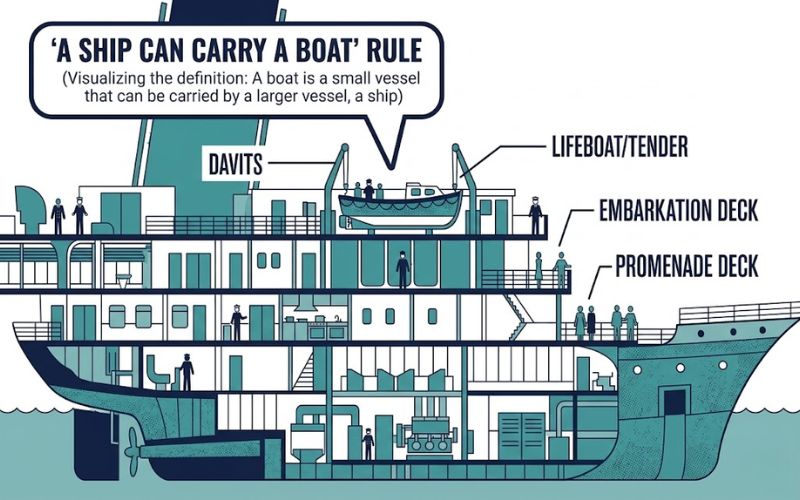
The simplest difference between a ship and a boat is that the former can accommodate the latter but not vice versa.
Though both might look similar, they both are actually on opposite ends of the classification, as a ship is subject to IMO conventions, flag state inspections, and has a STCW-certified crew, while a boat does not need to meet any such requirements.
Even if we set aside the size factor, a ship has to meet certain tonnage and design benchmarks, have an operational range and possess a command structure where the captain is at the helm and whose decisions are final.
For anyone working in or studying the maritime industry, understanding these differences between a ship and a boat is very important.
Ship Vs Boat- A Quick Comparison
| Feature | Ship | Boat |
|---|---|---|
| Size | Typically 200ft (60m) or longer | Generally under 100ft (30m) |
| Gross tonnage | Usually 500 GT or above | Below 500 GT |
| Crew | Large, permanent, STCW-certified | Small, crewed only when in use |
| Navigation range | Ocean-going, deep-water | Coastal, inland, limited range |
| Propulsion | Multi-engine, dedicated engine room | Single outboard or inboard engine |
| Cargo/passenger capacity | Thousands of TEUs or passengers | Limited — recreational or small-scale |
| Regulatory framework | IMO conventions, flag state, and PSC inspections | National maritime authority only |
| Cost | $50 million to over $1 billion | $10,000 to $500,000 |
1. Size and Tonnage
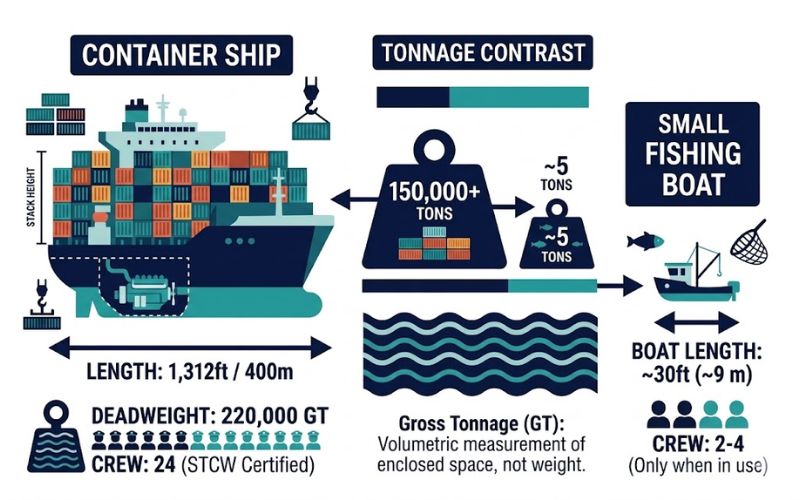
While size, perceived through the eyes, is the most visible and commonly cited difference between a ship and a boat, there is a technical term in maritime called Gross Tonnage, i.e., it is a volumetric measure of a vessel’s enclosed space and not physical weight.
Vessels having a gross tonnage of 500 and above are called ships, per SOLAS and MLC 2006, while those weighing less than that are called boats.
Ships are also subject to strict regulatory requirements, unlike boats. Most ships are massive in size and weigh a lot. Rarely will you find any ship which is less than 60 m long.
The container ship Ever Given, which came into the limelight for blocking the Suez Canal in 2021, was 400 m long and had a displacement of 220,000 GT.
On the other hand, boats are under 100 feet in length and can be of different types, such as a fishing vessel or a recreational cruiser.
While there are no clear demarcation lines, the 500 GT is the standard in regulatory contexts.
2. Operational Range and Navigation
Ships can sail on open seas or oceans for weeks or months without needing to refuel, as their fuel capacity can exceed 5000 metric tonnes of heavy fuel oil. They also carry sufficient provisions, including food, drinking water and life-saving gear.
Boats usually operate in smaller water bodies like lakes, bays, lagoons, or rivers. They are also used for small-distance transport of goods and people in places where all-weather roads cannot be constructed.
Technically, a boat is not built to endure the harsh conditions of the oceans like saltwater, swells or tumultuous waves. They are small in size and hence can carry limited food, fuel and other resources, which means they cannot sail for months without coming to port.
The distinction is important under SOLAS, which lays down stringent requirements for ships regarding the presence of lifesaving gear onboard, fire protection measures and navigation systems to ensure the safety of crew members and the ship.
Boats come under the purview of a country’s maritime authority’s laws and regulations, which are relatively lighter.
3. Crew Requirements and Command Structure
A ship has a permanent crew that is well-qualified and possesses the necessary qualifications and certifications. They have designated duties onboard depending on the department they belong to. There is a deck department and an engine department.
The former has a Master/Captain, Chief Officer, Second Officer, and Third Officer, all of whom hold STCW certificates of competency. The engine department also mirrors this structure and has a chief engineer, a second engineer, etc.
Boats, in this sense, do not have a strict command structure comprising officers of different ranks. They do not have a watch schedule, and neither do they have permanent crew members, as they are crewed only when used.
A recreational sailing boat can be operated by a single person with a national coastal skipper licence. The presence of a permanent crew with a Master indicates that a vessel is a ship, irrespective of size.
4. Hull Design and Construction
Ships are classified by classification societies such as Lloyd’s Register, DNV, Bureau Veritas, and the American Bureau of Shipping, which certify that their hull design, onboard machinery, and other systems meet the international structural and safety requirements laid out by IMO.
Without class certification, a ship cannot get insurance or operate legally.
Certain types of ships have to meet more stringent requirements than others because they carry dangerous cargo, such as oil tankers.
According to MARPOL Annex I, tankers constructed after 2010 must have a double-hull, which comprises 2 steel layers separated by a void space to reduce the risk of an oil spill in the event of an accident, collision, or grounding.
Boats are usually built for customers according to their requirements, as per national standards, but they are not subject to the oversight of International Classification Societies.
The materials and construction methods used for both are also very different.
While a boat can be built in just a few days, in a small space, a ship’s construction occurs in stages in massive shipyards, followed by days or months of sea trials to ensure its seaworthiness.
5. Propulsion and Engine Systems
Ships run on slow-speed, two-stroke diesel engines which use heavy fuel oil (HFO), with output measured in megawatts.
However, many new constructions are also using cleaner alternatives like LNG and methanol to reduce the carbon footprint, and meet IMO’s 2020 sulphur regulations and the 2030 decarbonisation targets.
A ship’s engine room is managed by engineering officers, including a Chief Engineer, Second Engineer, and watchkeeping engineers who hold STCW engineering certificates.
Boats have a simple propulsion system, which includes an outboard motor, or, in the case of sailing vessels, wind-assisted propulsion with a backup engine.
6. Cargo and Passenger Capacity
A ship’s enormous carrying capacity is what makes global trade possible and lucrative. In one journey, they can carry thousands of tonnes of cargo from one part of the world to another.
The biggest container ships, which are currently operational, can accommodate over 24,000 twenty-foot equivalent units (TEUs).
A Panamax bulk carrier carries 65,000 to 80,000 deadweight tonnes of dry cargo, while the world’s biggest cruise ship, the Wonder of the Seas, is no less than a floating city since it welcomes 6,988 passengers and has a 2,300-member crew.
Boats have a smaller carrying capacity. For instance, a ferry crossing a harbour, a fishing trawler landing a catch or a recreational vessel with a family on vacation, represents the limited capacity of boats.
It is important to note that even commercial fishing vessels, even bigger ones, are generally classified as boats in common maritime usage unless they exceed the above-mentioned tonnage threshold.
7. Regulatory and Classification Frameworks
Ships are subject to a complex regulatory framework, and the International Maritime Organisation sets the conventions.
SOLAS governs safety, MARPOL governs pollution prevention, and MLC 2006 governs seafarer welfare.
These conventions are implemented and enforced by Flag States through their respective maritime authorities, and Port State Control Officers inspect ships in port to verify if they are compliant with these mandatory regulations.
If a ship is found to be non-compliant, for instance, if it does not have the minimum number of lifeboats required, or has an expired fire-fighting system or crew with expired certificates, etc., it can be detained in port until the matter is resolved.
Boats for domestic use fall under the purview of national maritime regulations, which means a simpler registration process, no port state control inspections and no stringent safety requirements.
8. Cost
Ships are costly to build and operate, and also require insurance. A Panamax container ship costs approximately $50 million to $80 million to build.
A Very Large Crude Carrier (VLCC) runs $100 million or more. The cruise ship, Wonder of the Seas, cost an estimated $2 billion!
A large container ship burns 150 to 200 metric tonnes of fuel per day.
Ships also have additional expenses comprising crew wages, maintenance costs, port dues, and classification society fees that run into millions of dollars.
Boats range from a $10,000 aluminium fishing vessel to a $500,000 luxury motor yacht. Their operational and regulatory compliance costs are less than those of ships.
The Submarine Exception
Submarines, including nuclear-powered vessels, are called boats, not ships.
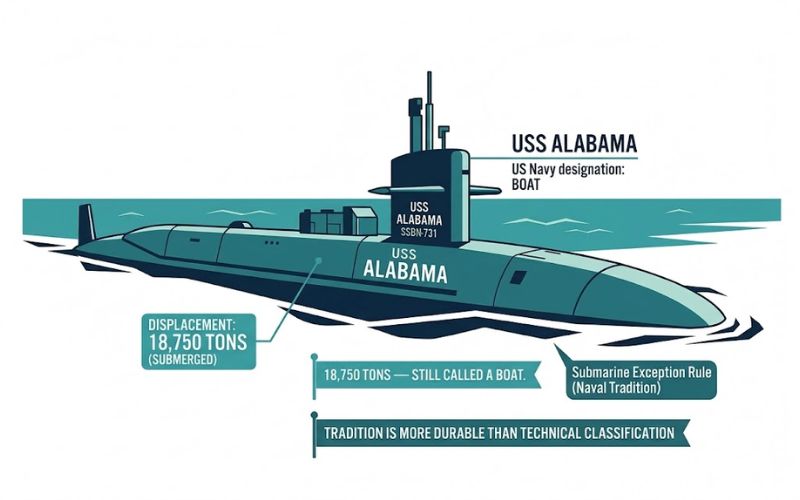
The USS Ohio (SSBN-726), which is a nuclear ballistic missile submarine, displaces 18,750 tonnes when submerged, but the US Navy designates it a boat.
The tradition dates to a time when submarines were small enough to be carried aboard surface ships. The name was carried forward due to naval tradition, even though submarines evolved and came to rival ships in size.
Frequently Asked Questions
1. What is the simplest way to tell a ship from a boat?
A ship can carry a boat, but a boat cannot carry a ship. Additionally, if a vessel has a permanent crew with a Master, operates on open seas and is subject to IMO conventions, it is a ship.
2. At what size does a boat become a ship?
The technical threshold is 500 gross tonnage. Vessels at or above 500 GT are subject to international maritime conventions, including SOLAS and MLC 2006. However, there is no internationally agreed legal definition, and flag states may apply different criteria.
3. Why are submarines called boats and not ships?
The answer is Naval tradition. Early submarines were small enough to be carried aboard surface ships and so were called boats.
The name continued to be used even though submarines grew in size and capabilities.
4. Is a cruise ship a boat or a ship?
Even the smallest cruise vessels exceed 500 GT, have a licensed crew and are subject to SOLAS and MLC 2006. The Wonder of the Seas displaces approximately 236,857 GT and is one of the largest ships ever built.
5. What is the difference between a ship and a yacht?
A yacht is used for recreational or private purposes. Small yachts are boats, but bigger motor yachts over 500 GT, sometimes called superyachts, can be classified as ships and may be subject to commercial ship regulations if used for charter.
6. Can a fishing vessel be considered a ship?
Large commercial fishing vessels exceeding 500 GT are classified as ships, but smaller ones under 500 GT are referred to as boats.
Conclusion
Tonnage, operational range, crew structure, regulatory burden, and cost are some of the factors taken into account when classifying a vessel as a ship or a boat. Understanding this difference is crucial as frameworks governing a 200,000 GT tanker and a 50 GT coastal ferry are different in scope and consequence.
The 500 GT threshold and the presence of a permanent, STCW-certified crew are the most reliable indicators. The submarine, however, remains an exception due to the prevalence of naval tradition over technical classification.
You might also like to read-
- Types of Sailboats: A Comprehensive Classification
- A Guide to Different Types of Boats
- A Guide To Types of Ships
- Types of Fishing Vessels
Disclaimer :
The information on this website is for general purposes only. While efforts are made to ensure accuracy, we make no warranties of any kind regarding completeness, reliability, or suitability. Any reliance you place on such information is at your own risk. We are not liable for any loss or damage arising from the use of this website.


Related Articles

About Author
Zahra is an SEO-Strategist & a Technical Writer with over 5 years of experience crafting top-tier content for the shipping world. From news, articles, ebooks, blogs and marketing pieces to industry white papers, she has written it all and now brings that experience to her role as Senior Editor. She makes complex maritime stories clear, sharp, and engaging.
Disclaimer :
The information on this website is for general purposes only. While efforts are made to ensure accuracy, we make no warranties of any kind regarding completeness, reliability, or suitability. Any reliance you place on such information is at your own risk. We are not liable for any loss or damage arising from the use of this website.
Subscribe To Our Daily Newsletter
By subscribing, you agree to our Privacy Policy and may receive occasional deal communications; you can unsubscribe anytime.


Please i am a National Diploma student of Maritime Academy of Nigeria Oron studying nautical science, i want to know more about the course
Hi.thank its so good and sufficient
As a profesional mariner of over 25 years I would like to “weigh in” on this subject. What I will say is not about the currently accepted distinction between ship and boats, but rather historical.
When ships (powered by sails) began to start losing trade to vessels powered by engines (boats) they as an industry attempted to associate these vessels with unplesant attributes like noise, soot, vibration, and in some cases slower speed. The sailoing industry (both cargo and passanger) would say that you could SAIL on a quiet, clean, calm, fast ship or go one of those dirty loud vibrating slow BOATS with an engine.
The concept a ship being superior and a boat being inferior was sucessfully instituted. The engine powered vessels simply side stepped the ridicule bestowed on the term “boat” and made bigger, faster, clean, quiet vessels and took the market from the sail powered vessels along with the defination of SHIP for themselves.
i wont step into the curret debate of what constitutes a boat or a ship but the origins of the debate stem from new technology (steam engines) fighting over market share.
A large freighter (1000′ x 85′, think of the Edmund Fitzgerald) hauling iron ore on the great lakes is referred to by her crew and company as a boat, never as a ship!
“Boats in contrast, are operable in smaller/ restricted water areas and include ferrying and towing vessels, sail vessels, paddle vessels, kayaks, canoe, patrolling vessels etc. Boats are mainly used for smaller purposes and mainly ply in areas near to the coast.”
“Technologically, boats are simple vessels with less complicated equipment, systems and operational maintenance requirements.”
Correct me if I am wrong but, isn’t a submarine classed as a boat? That kind of contradicts what you have stated above.
comment:the any where abroad/indian officers
you can any time call me on 30 year’s on merchant officers
You can put a boat on a ship but not visa versa eg life boats…
What is the difference between a boat and a ship?
1. The boat leans to the right when turning right
2. The ship leans to the left when turning right.
This is what I have been told by a old (90 Year old boat capt)
Great reply’s. some years ago while on the QE 2 a passenger asked one of the officers when does this boat dock? The young officer replied. “Madam, this is a Ship not a boat, a boat is those you get into when this ship is sinking!
Hello. May I please ask for some assistance from the forum?
I am writing a blog/journal on the differences between ships and yachts. What has prompted this conversation is the plethora of ‘superyachts’ now plying the international oceans and performing well on deep water passages.
Surely some of these can come under the category of ‘ship’, and not yacht, since many are being built on a larger scale than anything we’ve seen in past years. My understanding of the determination of a ‘ship’ is : Length, Tonnage, Draft and Displacement.
I have read your forum discussion regarding use, but I am still unclear as to where the line is drawn for this category. Many of the ‘superyachts’ carry cars, helicopters, pools, and require very advanced equipment, captain and crew. Perhaps we will soon see this as a real conversation in the industry.
Appreciatively,
Rosanne Allen-Hewlett
For ‘The LUXE Report’
( Sailor, racer of only boats and yachts )
I was told that the difference between a ship and a boat is that a ship has a funnel and a boat doesn’t, no matter it’s size….
David Musselwhwite’s comment is the best way to determine a boat of a ship. This holds true for submarines (boats). If it leans into the turn, it is a boat. If it leans out on a turn, it is a ship.
In response to comments about the Edmund Fitzgerald, when you spend your life on one you can call it whatever you want. I am sure they all knew it was a ship, I served 20 years in the Navy and always said I was heading back to the boat even though I knew it was a ship.
While in Boot camp in 1964, US Coast Guard, we were told that a ship is 95 feet or longer and a boat is 94 feet and under. That makes it pretty simple.
With over 30 years in the marine industry including working at sea, ship building and ship repair, I would offer my comments.
Yes all above is true. My understanding is that the bottom line is ” a Ship carries boats ie Lifeboats”.
If it doesn’t have a proper lifeboat, it is not a ship.
The best a boat has is dinghies or liferafts etc. Consequently a submarine does NOT carry life boats.
There are many broader requirements Size and the ability to navigate very heavy seas, such as those whipped up by a tropical Revolving storm (TRS). It must be designed to travel in the open sea in all weather conditions and have lifeboats that can do the same. They carry cargo or passengers and have a substantial crew to operate it including engineers.
As far as the Edmund Fitzgerald is concerned, these vessels are an enigma. They were large and qualify in most areas, but – was it capable of going to sea and did it have sea-going lifeboats?
Ironically it suffered probably as bad a storm as it would have done at sea. The problem is that in fresh water the waters are more treacherous than salt water as they rise up far more quickly.
But then again it sank meaning that it couldn’t handle it. Yes it was a large vessel but was it a Ship – ?
What is difference among?
Marine Boat
Marine Ship
Marine Craft
Ship
Boat
What is difference between Marina and Marine?
Being the son of a WW II submariner. My dad cruised the Atlantic of the east coast of US and in many conversations about the war he always called his boat a boat never a ship.Thats it!!
The simplest and most accurate definition I stay with is that a ship can carry a boat but a boat cannot carry a ship . SIZE MATTERS !
Captain chalga: try to form a coherent sentence.
I asked a friend of mine, “What is the difference between a boat and a ship?” He said, “About 100 feet . . .”
Thank you for the information. My husband won this discussion. God Bless all who are bravely floating on/in one. I am terrified of the ocean or even a small lake. You have my utmost respect for your sacrifice. I love seafood but would never know the pleasure of eating it without you brave souls. Thank you.
As a proud Submariner I have to disagree and will always say that I serve on a boat.
There is the Boat of Millions of years,which is a very advanced spacecraft able to.travel the millions of light years betwen Galaxies.
And you have vessels such as the Motor Vessel Arlene out of Port Arthur.
I was once told that a ship had multiple decks and a boat had only one.
When I queried sailing yachts that had berths under part of the deck, it was modified to the deck on a yacht is as much structural as deck, but if a vessel has 2 or more non structural “floors” it is a ship.
Then I mentioned tug boats and fishing boats and it all got confused.
It’s a bit like the difference between horse and pony. Despite every one saying it’s size, the falabella is a horse and polo ponies are ponies.
A naval architect (constructors) view is that to be a ‘ship’ a vessel must have at least one continuous internal deck running the length of the vessel. Large Submarines may have complete decks forward however, going aft, it is normal to have to descend a ladder onto a lower ‘engine room’ deck-level or platform. Some large freighters have a similar construction with internal split deck levels and that is why they are correctly known as boats, although in some cases the term ‘ship’ feels more appropriate because of their large displacement. The argument regarding leaning into or out of a turn is an interesting idea, however this may have more to do with hull and propulsion characteristics than vessel construction. In reality, as with most nautical expressions, whatever feels best to use is probably best and relying on the opinion of a sailor, with regards to an explanation of nautical expressions, puts you at the mercy of a sharp sense of humour.
It might be worth mentioning that some might refer to a ship as “boat” as a diminutive term of endearment, similar to the personification of a car or a pet by assigning the human pronouns to them.
I was once told a SHIP sails the oceans, a BOAT sails on rivers and lakes.
IT SEEMS WE HAVE VERY KNOWLEDGEABLE SEA MEN IN THE HOUSE . BUT I AGREE TOTALLY WITH JEREMY MEYER
It’s always been my info is that a boat can be up to 197’ whereas a ship is over that length. As with anything, I’m sure there are exceptions.
some of the people got it spot on. Tilt away from direction of turn = ship. Tilt towards the direction of turn = boat.
There are two points on every vessel. Center of buoyancy and center of gravity. A ship’s center of gravity is above its center of buoyancy. A boat’s center of gravity is below its center of gravity.
Anyone can answer me why we only know the bareboat charter for any size of the ship? It never mentions bareship charter?
“some of the people got it spot on. Tilt away from direction of turn = ship. Tilt towards the direction of turn = boat.
There are two points on every vessel. Center of buoyancy and center of gravity. A ship’s center of gravity is above its center of buoyancy. A boat’s center of gravity is below its center of gravity.”
Except a kayak (or canoe) is like a ship – cg is above cb. If you get a ruddered kayak up to speed and hit the rudder hard it will heel outward like a ship. Since the paddler can easily influence heel, if you want to make a hard turn you heel the ‘boat” outward (to lessen the ends in the water) and sweep stroke on the outward side to spin the “boat”. Is a kayak then a “ship”? Hardly. This is exactly the problem with trying to make one pithy statement to define a ship or boat. It is far more complex than that.
I completely agree with you that the difference between a ship and a boat is the size. One of my friends have a boat, she bought it from Boat Lagoon Yachting. Thanks for sharing!
If you can haul it on the back of truck (even trailered), it’s likely a boat…but if the anchor weighs in like a truck it’s definitely a ship. Obviously, some subs are one or the other regardless of whether you can stuff a (non-inflatable) life boat inside. [Army logic from qualified ex-boat commander, combat support boats, bridge section, Corps of Engineers.]
I grew up near the Welland Canal, and it’s true: vessels which plied the Great Lakes were called “lake boats”, or more commonly, “Lakers”. Oceangoing vessels a were always and reflexively called “ships”..
I am wondering if the naval architect”s comment about internal decks makes the difference, as even a non-engineer can see that a deck extending stem to stern would provide more stability to a vessel’s structure.
The lake boats are always longer than the ocean-going ships, so it’s not size.And we occasionally get a visit from “tall ships”, which are oceangoing sailing vessels, but relatively short.
That’s really informative post. I appreciate your skills, Thanks for sharing.
I will take a shot at this. The word marine is redundant before ship and boat. The word “marine” relates to the sea and one of the conditions of being a ship is that it is ocean going. This does leave the possibility of not being a river boat but a marine boat. I would use the expression sea-going boat.
Marine craft is a useful expression when there is a need to make it cleat that you are not referring an aircraft, space craft etc.
On a general note there are no absolute rules or definition. All we can do is give examples of how the words are used. Companies, governments, navies and anyone else are free to make gheir own definitions but nobody else is bound by them.
I served on the U.S.S. CG-19 ‘THE DZLE & U.S.S. CV-63 KITTY HAWK FOR THE US NAVY in the 80’s.
So what about the placement of the helm being center of Bridge on a ship & on starboard side usually on a boat?
With many years of sailing lakes to blue water sailing and large power yachts I can offer this for abot of levity.
Afterall,the SeaView had the ‘Flying Sub” flown or driven undersea,on the surface and flown by Captain,Admirals and sadly Polititians and insane quasi
research criminals.
The Flying Sub also had an inflatable Zodiac,so both could be considered
Life saving vessels.
Plus,it was really cool!
Can be as difficult as we want. My training was as a NCO (enlisted man in the USN. As others have stated, A ship will lean away from its turn. A boat will lean into the turn. This is naturally due to there the center line of gravity is located. Cargo ships mass above that line.
A boat can be loaded onto a ship (lifeboats).
Regarding Submarines, they are affectionately referee to , by the crew, as boats and that goes back to WWI /II, the ELB. Electric Boat Div of General Dynamics, located Groton Connecticut .
This design is wicked! You obviously know how to keep a reader entertained.
Between your wit and your videos, I was almost moved to start my own blog (well, almost…HaHa!)
Fantastic job. I really loved what you had to say, and
more than that, how you presented it. Too cool!
More importantly… are they all “She’s” ?
I’ve been wondering about this since I was younger and saw The Hunt for Red October. The COB (Chief of the Boat) was an interesting character, and I wondered by a Sub Chief was called Chief of the Boat, if a sub was a naval ship. Some very interesting and fascinating answers in here! I like the one about how a ship turns, leaning into it or not. That makes sense to me. As for the tiny kayak/canoe exceptions to this, I’d guess that if a human weighs more than the ‘vessel’ and can manipulate it’s attributes of buoyancy or center of gravity whichever, with their own body, then it doesn’t really count as either a boat or a ship. It really has no deck, nor propulsion other than human muscle, no anchor, etc. I don’t see it as much more than a modern design for what used to be termed a ‘raft.’ But I am just spit-balling here, don’t blast me! lol
That’s really nice post. I appreciate your skills. Thanks for sharing.
All the information that you shared with us is very useful for us. Thank you for sharing with us.