
How to Tackle Low Load Operating Conditions of Marine Engine?
In a ship procedure involving transportation of goods or passengers, economical and timely operation is of utmost importance. Every ship operator wants his/her ship to reach on time while using as much less fuel as possible.
To achieve correct time arrival of the ship means no anchor or no additional drifting along with direct access to jetty or terminal. All these require low speed of the ship which means less fuel consumption.
All these goals lead to an irritating situation for a marine engineer, who most of the time thinks only on how to deal with the degrading performance of his/her main engine due to continuous low load operation.
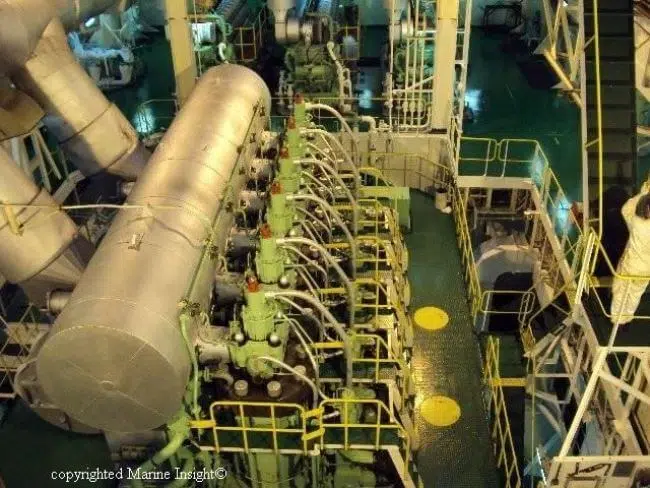
It is considered that marine engine operating above 60 % Maximum Continuous Rating (MCR) will have all its parameters and parts normal as compared to being in low load operation.
Low load operation has an adverse affect on the marine engine resulting in major problems such as carbon deposits and reduction in time between overhaul (BO), which may lead to sudden equipment failure.
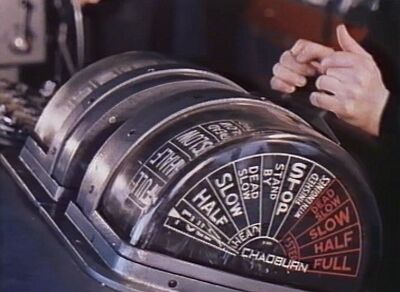
In order to be in sync with the need of the hour, an engineer must make sure of the following points when the ship’s main engine is operating at low load (below 40%) for a long period of time:
- Exhaust gas temperature must be maintained above 250 degree Celsius to avoid fouling of exhaust passage, turbocharger nozzle and cold corrosion of engine parts. Try not to run engine on load giving exhaust less than 250 C.
- Low load operation will result in cut in of Auxiliary blower. A fluctuation in load at this range will lead to an on and off condition for blower. Hence the mode of Auxiliary blowers to be changed to Manual
- Make sure to check Auxiliary blower motor temperature frequently for sign of overheating
- The Viscosity and temperature of fuel oil to be maintained for proper atomization of fuel
- Trace heating fuel line to be operational and all injectors to be in good condition and monitored properly for firing
- Scavenge Air Temperature to be Maintained between 42-50 degree for adequate combustion
- Jacket cooling water to be maintained at upper limit to avoid thermal stress inside the engine
- Cylinder oil feed rate to be monitored at low load operation
- Check under piston area for sign of over cylinder lubrication
- Try to run the engine at 80% MCR for at least one hour a day to burn off the carbon deposits
- Check and clean the economiser tube frequently especially if the tubes are of closed fins type
Do you know any other way to tackle low load operating conditions? Let us know in the comments below.
Disclaimer :
The information on this website is for general purposes only. While efforts are made to ensure accuracy, we make no warranties of any kind regarding completeness, reliability, or suitability. Any reliance you place on such information is at your own risk. We are not liable for any loss or damage arising from the use of this website.
Related Posts


Disclaimer :
The information on this website is for general purposes only. While efforts are made to ensure accuracy, we make no warranties of any kind regarding completeness, reliability, or suitability. Any reliance you place on such information is at your own risk. We are not liable for any loss or damage arising from the use of this website.
Related Articles

About Author
An ardent sailor and a techie, Anish Wankhede has voyaged on a number of ships as a marine engineer officer. He loves multitasking, networking, and troubleshooting. He is the one behind the unique creativity and aesthetics at Marine Insight.
Subscribe To Our Daily Newsletter
By subscribing, you agree to our Privacy Policy you can unsubscribe anytime.


How would you “CHECK UNDER PISTON AREA FOR SIGN(S) OF OVER CYLINDER LUBRICATION” while the engine is running? Excess cylinder lubrication would most likely be burned up, and produce a smoky exhaust. That which gets past the piston rings would gravitate to the crankcase. With the engine stopped there is no cylinder lubrication. So please explain
precisely, how you would acomplish this observation. Louis J. Lemos
@ Louis J Lemos:
For electronically controlled lubrication system (e.g.-Alpha lubrication and Pulse lubrication) correctly feed the data manually for fuel quality.
I agree with you that it is not possible to check the lubrication while engine is running. You can check the signs of over and under lubrication when inspecting the piston ring from scavenge ports and when overhauling the unit by checking the liner surface.
Hi,
There ara few methods to check/evaluate over/under lubrication by sampling methods while ME is running. By sampling scav. drain oil and testing for iron contents. Frequency 1000 hrs reccomended.
Sorry if english is not “shakespeare spoken” but presume than real engineer could understand “meanings”
forza fiume
I have experienced on MAN B&W 6S40ME-B Main Engine. We encountered some broken piston rings after 1500hrs since last piston rings has been changed. BN70 cylinder oil is used and @ high sulphur & low sulphur content of HFO. Fuel oil temperature is around 133 to 135 °C . According to MAN, the main cause is using BN70 @ high sulphur and Cooling water temperature must be @ 85 °C. Do you have same situation like this?
Currently an engineer aboard a vessel with a 6S50ME-B MAN engine burning HFO, our jacket water temperature is maintained at 90-91 Deg C.
We have also has some ring problems. With proper alpha lubricator adjustments and JW temperatures we have had extended period of time since the last rings issue. Hopefully it remains that way.
Do keep us updated on the issue! You can share your experiences at https://forums.marineinsight.com