
The Hong Kong Convention (2009)
The International Maritime Organisation’s (IMO) definition of The Hong Kong Convention is as follows: ‘The Hong Kong Convention for the Safe and Environmentally Sound Recycling of Ships, 2009, is aimed at ensuring that ships, when being recycled after reaching the end of their operational lives, do not pose any unnecessary risks to human health, safety and to the environment’. This Convention came into force in June 2025.

At the end of their operational lives, ships are stripped, and materials and equipment that can be reused are extracted. Besides being energy efficient and saving costs, it is environmentally safe, instead of letting hazardous materials float around in our ecosystem.
Regulations outlined under the Hong Kong Convention state safe working practices and environment for the workforce involved in ship recycling.
It covers the design, construction, and method of operation of ships so that later on, at the time of recycling, it does not compromise the safety of the workforce, nor does it contaminate the environment.
The Convention set in place a method for the safe recycling of ships that are supported by certifications and reporting requirements.
The Hong Kong diplomatic conference convened by the IMO was first held in Hong Kong in May 2009 to discuss the safe as well as economical disposal or recycling of sailing ships and to set global standards.
After ensuring that the required statutory requirements were met, it came into force in June 2025. Since then, the IMO’s technical body, the Marine Environment Protection Committee [MEPC], has adopted various guidelines to assist member states in implementing and enforcing the Hong Kong Conference’s technical standards.
The IMO’s role was first raised at the MEPC session held in March 2000. Later on, as per the request of the IMO, the MEPC developed an instrument that provided regulations for the design, construction, and operations of ships so that, at the time of ship recycling, it would not cause any concerns to human or environmental health.
It also included the safe location of ship recycling facilities, reporting requirements, and certification.
The Marine Environment Protection Committee (MEPC)
The MEPC has the responsibility for adopting and amending, as necessary, regulations concerning the prevention and control of pollution caused by sailing vessels. These guidelines include:
- 2011 Guidelines for the Development of the Ship Recycling Plan, adopted by resolution.
- 2012 Guidelines for Safe and Environmentally Sound Ship Recycling, adopted by resolution.
- 2012 Guidelines for the Authorisation of Ship Recycling Facilities, adopted by resolution.
- 2012 Guidelines for the survey and certification of ships under the Hong Kong Convention, adopted by resolution.
- 2012 Guidelines for the inspection of ships under the Hong Kong Convention, adopted by resolution.
- 2023 Guidelines for the development of the Inventory of the Hazardous Materials, adopted by resolution.
To be compliant with the Convention, ships must have on board an updated list of hazardous materials that are carried on board that particular ship, in line with IMO guidelines.
It is mandatory to have ongoing surveys and a final survey just before the vessel goes for the ship recycling process. Ships owned by a party to the Convention can only be recycled at authorised ship recycling yards that follow all standards set forth under the Hong Kong Convention.
Likewise, for a ship recycling yard to be compliant with the Hong Kong Convention, it must follow these pertinent rules set forth by the Convention.
- It must be authorised by the relevant body to be set up and operate within the jurisdiction of the particular body.
- Such ship recycling yards must have a plan for their facility following IMO guidelines, which covers the safety of the workers, protection of human and environmental health, workers’ training, their roles and responsibilities, measures to meet emergencies, and a comprehensive system of record-keeping and reporting.
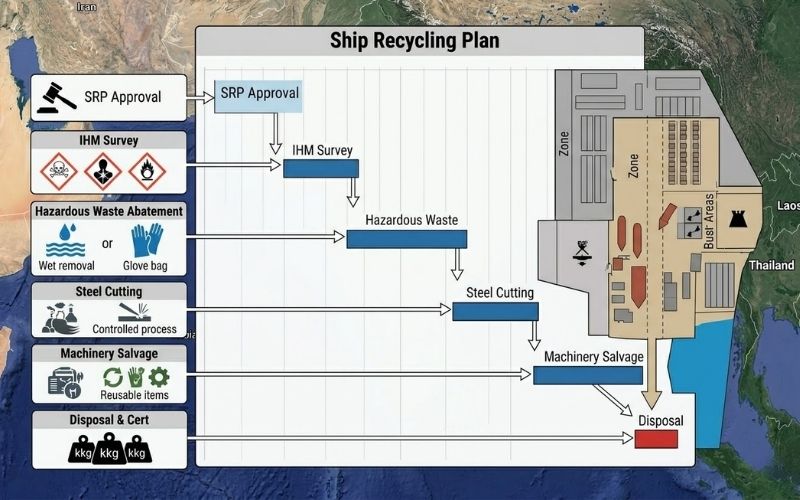
- Each vessel that has to be put through the ship recycling process must first be covered by a Ship Recycling Plan [SRP] showing how it will be recycled based on the particular type of the ship and the inventory of its materials. This has to be approved by the relevant body prior to any ship recycling process.
Hazardous materials and residues found in ships include asbestos, glass wool and foam insulations, Polychlorinated Biphenyls [PCB], heavy metals, oil and fuel residues, bilge and ballast water, Chlorofluorocarbons [CFC] and Hydrochlorofluorocarbons [HCFC], radioactive materials, volatile organic compounds [VOC], etc.
While all these materials and residues are hazardous to human health and the ecosystem, the most dangerous can be the asbestos components found in ships ready for recycling.
Asbestos Components in Ships – from Preparation to Disposal
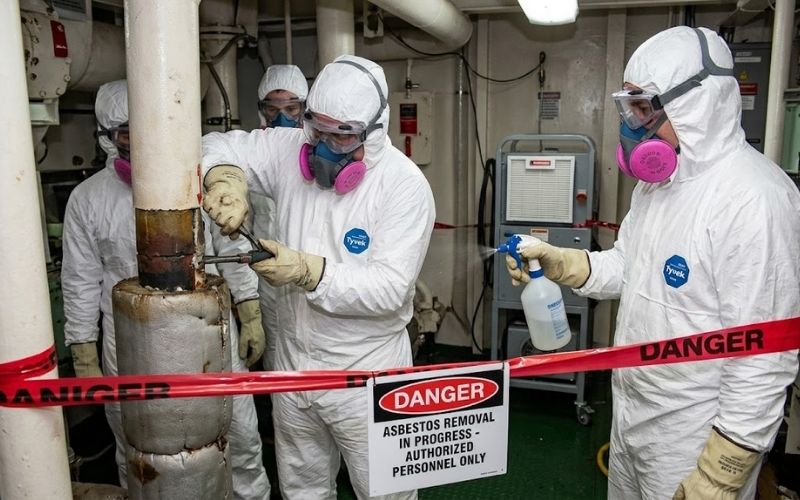
Ships that are ready for the ship recycling process are surveyed to identify all Asbestos Containing Materials [ACM]. Areas with ACM are barricaded, warning signage is posted, and access is restricted. Such areas are often sequestered with plastic sheeting to ensure that the asbestos dust does not escape.
While the major asbestos-containing parts are removed when the ship is beached, the rest are removed during dismantling.
Methods of Asbestos Removal
Wet Method
During the ship recycling process, asbestos is removed using the ‘Wet Method’. Under this method, asbestos-containing materials are continuously sprayed with water and surfactants before and during the removal.
Instead of power tools, hand tools are used by workers to remove the parts to minimise the asbestos fibres from becoming airborne. The asbestos-containing parts are not broken into smaller pieces as far as possible to minimise asbestos dust.
Glove Bag Method
Another method for the removal of smaller components containing asbestos is called the ‘Glove Bag Method’. In this, a large, durable, and transparent bag usually made of polyethene, with built-in gloves for handling, covers the part that is being cut or removed to contain and prevent the fine asbestos dust from escaping outside.
Personal Protective Equipment [PPE]
Workers involved in handling asbestos components during the ship recycling process must wear disposable, impermeable coveralls such as Tyvek suits, gloves, goggles, and boots. They must also use NIOSH-approved respirators to prevent inhalation of the asbestos fibres. All such clothing is finally disposed of as hazardous waste.
Cleaning
High Efficiency Particulate Air [HEPA] vacuum cleaners are used to remove all the remaining dust once the removal of asbestos parts and components is completed. Any other method of dusting or sweeping is strictly prohibited in the area to prevent the dust from rising in the air and getting inhaled.
Disposal
The removed asbestos parts and components are packed in double-layered, leak-proof plastic bags of a minimum 200 microns thickness, sealed and labelled clearly to indicate the contents.
These bags are stored in designated, secure areas inside the ship recycling yard before being transported to a pre-arranged, authorised hazardous waste landfill site. Sometimes they are solidified and stabilised using cement.
Major Ship Recycling Yards
The Alang-Sosiya Ship Breaking Yard, India
The largest ship recycling yard in the world – the Alang Ship Breaking Yard is located at Bhavnagar in Gujarat, India. Founded in 1983, the yard has grown extensively to stretch from Alang to the nearby area of Sosiya. Hence, now, it is often referred to as the Alang-Sosiya Ship Breaking Yard.
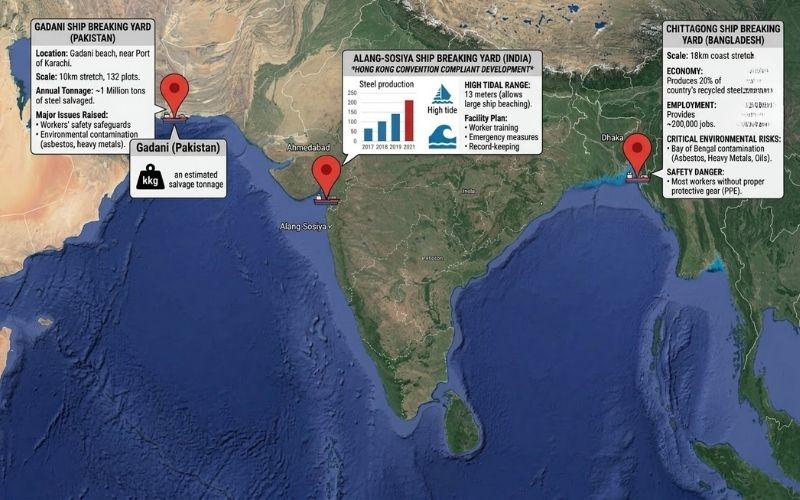
Made up of about 183 yards, it stretches about 14 kilometres along the coast on the Gulf of Khambhat on the Arabian Sea. The high tidal range along this site is about 13 meters, which allows very large ships to be brought in during high tide and beached easily on the mud flats.
As the waters recede during low tides, workers move in to dismantle ships, segregating recyclable parts and scrap. Large super tankers, container ships, car ferries, and ocean liners are broken here. The Alang-Sosiya Yard produces about 4.5 million tons of re-rolling or re-melting steel annually.
Some of the notable ships that have been broken here include the Regal Voyager [formerly known as Scandinavian Star on which a deadly fire broke out in 1990], the Mont [formerly the Seawise Giant, the longest sailing vessel of that time, hit by an airstrike during the Iran-Iraq war in 1988], and the Oriental Nicety [formerly the Exxon Valdez that was involved in a disastrous oil spill at Prince William Sound off the Gulf of Alaska].
Recently, the Indian government has been working with its Japanese counterparts to upgrade and develop Alang-Sosiya Yard into a Hong Kong Convention-compliant ship recycling yard.
Chittagong Ship Breaking Yard, Bangladesh
This ship-breaking yard is located in Faujdarhat, Sitakunda, Bangladesh. It stretches over a coast of 18 kilometres. Large decommissioned ships are brought here and put through the ship recycling process.
The importance of this ship recycling yard to the economy of the country can be understood from the fact that the Chittagong Ship Breaking Yard produces about 20% of its need for recycled steel, besides providing employment to about 200,000 people.
However, various international bodies have issued grave concerns over the negative impact on the environment as a result of contamination caused by asbestos, heavy metals, oils, etc., that are released into the Bay of Bengal and surrounding land areas during the ship recycling process.
The shipyard workers face great danger as most of them work without safety gear or protective equipment.
Gadani Ship Breaking Yard, Pakistan
The Gadani Ship Breaking Yard is located across a 10-kilometre stretch of beach at Gadani, Pakistan. About 40 kilometres from the Port of Karachi, it was the largest ship recycling yard in the world until the 1980s, when facilities such as those at Alang-Sosiya and Chittagong took over.
At the Gadani Ship Breaking Yard, an estimated one million tons of steel is salvaged annually. It has about 132 ship-breaking plots. Here again, workers’ safety and environmental safeguards have been called into question on several occasions.
While India, Bangladesh, and Pakistan dominate the ship breaking industry, it is also found in Turkey, South Korea, Russia, Norway, Japan, the United Arab Emirates, etc.
Documents Required for Breaking a Ship
The ship recycling process is a highly regulated one. The ship owners, as well as the selected ship-breaking yard, have to ensure compliance with regard to environmental safety and legal matters.
Besides following local regulations, the parties to a ship recycling process are most often guided by the Hong Kong Convention.
The local regulations and laws for the ship recycling process might vary from country to country; however, in general, the required documents are as follows:
Documents of Ownership and Other Related Documents
- Bill of Sale: This document confirms the legal transfer of ownership to the designated ship-breaking yard.
- Certificate of Registry and Deletion: To show the proof of registration and subsequent deletion from the Registry List [also referred to as Deregistration] of the flag state, before ship breaking.
- Memorandum of Agreement: This is a legal document that shows the terms of sale.
- No Objection Certificates or NOC: Obtained from the relevant authorities.
- Notice of Readiness: This is a formal certificate notifying the arrival of the ship at the ship breaking yard.
- Customs Clearance Certificate: This document shows that the vessel has been imported legally and meets all customs requirements for breaking at the designated ship breaking yard.
- Crew Clearance Certificate: Confirming that all the crew have disembarked safely from the vessel after it has arrived at the ship breaking yard.
Technical and Safety Documents
- Inventory of Hazardous Materials [IHM]: A mandatory and key document in the ship recycling process that lists out hazardous and dangerous materials contained in the ship and ship structure. Such materials include asbestos, heavy metals, radioactive metals, etc.
- Ship Recycling Plan: A plan on how the specific vessel will be dismantled and parts recycled safely.
- Gas Free for Hot Work Certificate: Certificate issued by authorised agencies [e.g., Petroleum and Explosives Safety Organisation (PESO) in India] that certifies that the ship’s tanks are safe for cutting.
- International Tonnage Certificate: Certification of the vessel size.
- Crew List and Master Information: This list contains details of the crew sailing the ship to the ship-breaking yard.
- Certificate of Port Worthiness: Issued by an authorised surveyor confirming that the vessel is fit to sail safely to the ship breaking yard.
- Protection and Indemnity Certificate: This certificate covers liabilities against third-party risks. It could be crew injury, pollution, collision, etc.
Customs and Environmental Compliance Documents
- Bill of Entry: The Bill for importing a ship to the country where the designated ship-breaking yard is located.
- Original Survey Report: This is an independent report certified by a qualified marine surveyor that confirms the structural integrity of the vessel, machinery and safety equipment, and all the other materials that remain on board that ship.
- Environmental Statement: This statement declares compliance with environmental standards, both local and international.
- Pollution Control Board Certification: A certification from the local Pollution Control Board approving the handling of hazardous waste materials.
- Recycling Readiness Certificate: A certificate that confirms that the said vessel is ready for final dismantling, complying with all required rules and regulations.
The Ship Recycling Industry – Looking Ahead
Over the years, the ship recycling industry has grown into a major source of revenue for many countries. While at the same time, it poses grave problems to human health as well as the environment, as a result of the indiscriminate discharge of hazardous and deadly wastes into the surroundings of ship-breaking yards.
The working conditions of labourers are also poor in most of the cases. The Hong Kong Convention is a major step towards ensuring that the industry moves away from hazardous and unregulated practices. The steps taken by major ship-breaking yards, such as the Alang – Sosiya Yard in India, are welcome and indicate a move towards sustainable practices.
You might also like to read-
- What is Green Ship Recycling?
- Understanding The Ship Recycling Process
- The Role Of A Cash Buyer in Ship Recycling
- Marine Pollution by Ships -Tips for Reducing & Recycling Waste at Sea
Disclaimer :
The information on this website is for general purposes only. While efforts are made to ensure accuracy, we make no warranties of any kind regarding completeness, reliability, or suitability. Any reliance you place on such information is at your own risk. We are not liable for any loss or damage arising from the use of this website.


About Author
Hari Menon is a Freelance writer with close to 20 years of professional experience in Logistics, Warehousing, Supply chain, and Contracts administration. An avid fitness freak, and bibliophile, he loves travelling too.
Disclaimer :
The information on this website is for general purposes only. While efforts are made to ensure accuracy, we make no warranties of any kind regarding completeness, reliability, or suitability. Any reliance you place on such information is at your own risk. We are not liable for any loss or damage arising from the use of this website.
Related Articles

Subscribe To Our Daily Newsletter
By subscribing, you agree to our Privacy Policy and may receive occasional deal communications; you can unsubscribe anytime.


BE THE FIRST TO COMMENT