
Describing Different Parts of SCBA
Self-contained Breathing Apparatus, also known as SCBA, is a necessary protective gear that is worn by paramedics, firemen, and people working on ships and oil rigs.
As the name suggests, the breathing apparatus has all the necessary equipment which allows rescue professionals to carry out their work with utmost safety.
Two major types of SCBA in use today include the Open Circuit SCBA and the Closed Circuit SCBA. The main difference between the two is that the former is used for longer rescue operations.
In this type of SCBA, the air is continuously reprocessed or recycled so the wearer gets a continuous supply of air. In the second variety, the oxygen is compressed to fit into air cylinders. These varieties of SCBA are used for shorter rescue operations.
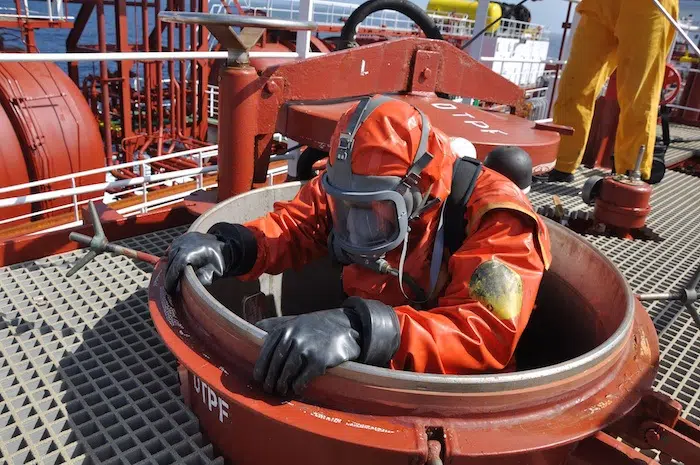
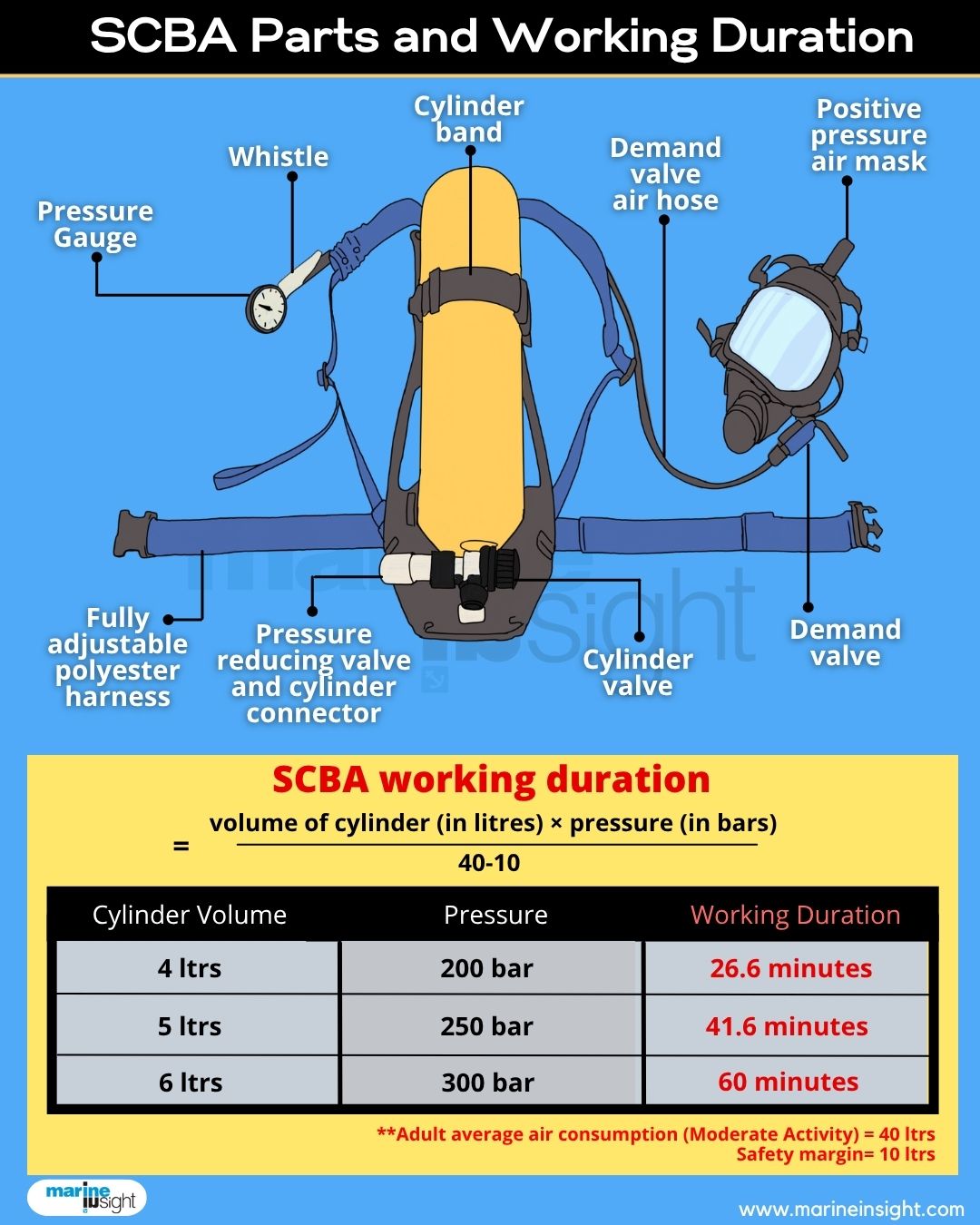
The SCBA or self-contained breathing apparatus used on board ships is of the open-circuit type. In this, the exhaled air is discharged into the atmosphere while air from the cylinder is made available for inhalation. The equipment consists of:
- One or two cylinders containing air under pressure.
- A harness to mount the cylinders on the back of the person.
- A respiratory system which has a means to reduce the pressure of air from the cylinder and to supply the wearer with air on demand.
- A facemask attached to a demand valve that maintains a positive pressure inside the mask at all times.
Air Cylinders
In the open-circuit SCBA, the air cylinder is known as the re-breather, which recycles the air (as mentioned above).
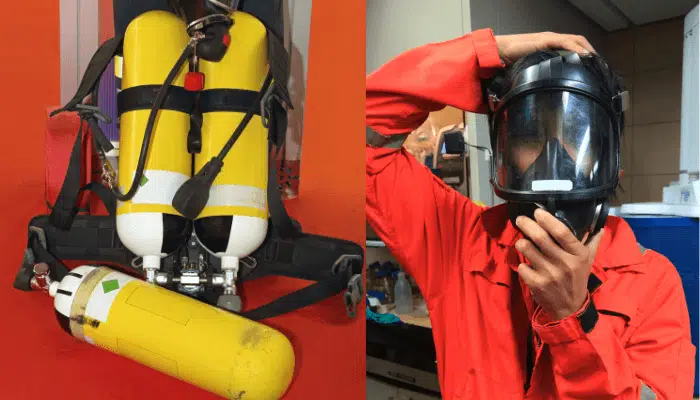
Air cylinders, on the other hand, are filled with oxygen in a compressed form that enables a rescue professional to go into areas that are filled with smoke and fire and free the trapped people successfully.
The air cylinders in the breathing apparatus need to be continuously checked after the rescue operation is carried out, so that they do not end up being empty the next time a rescue operation needs to be carried out. There are also extra air cylinders that are provided for the people who have been trapped and rescued.
Protective Hood
The second-most important presence is that of a Protective Hood. Such hoods are designed to cover all parts of the face, featuring an eye-covering (visor) that allows the person to see while also allowing oxygen to pass continuously.
Portable Transporting Bag
The Portable Transporting Bag is also an essential piece of equipment for the breathing apparatus. It can be filled with air cylinders, hoods and any other protective equipment necessary for rescue operations. The bag is made of a material that is resistant to damage-causing factors and can be effectively used in any emergency.
Portable Hauling Bag
The final breathing apparatus equipment is the Portable Hauling Bag. The main difference between this type of carrying bag and the one mentioned previously is that in this bag, the extra weight of the necessary items can be carried.
It is used for the purpose of getting the SCBA equipment from the headquarters of the rescue professionals to the place where the incident has actually occurred. It is only at the accident site that the equipment is transferred from this bigger bag to the Portable Transporting Bag.
Firefighter Breathing Apparatus has changed the entire rescue operation process, making it simpler and safer. More and more lives can be saved because of the portability factor of SCBA. It, therefore, becomes important and relevant to acknowledge and appreciate the worth of the SCBA in today’s times.

The arrangement of the breathing apparatus is as follows:
- The cylinders contain about 1240 litres of compressed air at 200-atmosphere pressure. This gives the wearer around 31 minutes of air supply for full usage or about 21 minutes for working conditions (person breathes heavily during work, hence there is more consumption of air, and that is why the time is lesser)
- The reducing valve reduces the pressure by about 4 bars, which is further reduced by the demand valve, which is attached to the mask
- The demand valve is the one that supplies the air to the wearer when inhaling
- The exhalation valve releases the air from the facemask
- When the air left inside the apparatus lasts about 10 minutes (40-45 bar pressure), a warning whistle is sounded continuously till the cylinder is emptied. The start of this whistle is an indication for the wearer to move out of the space they’re in to fight fire or whatever purpose it is used for
- The face mask is of soft moulded nature rubber, and five adjustable head straps and a nylon lanyard or neck strap. It has a foam-filled or air cushion seal and a full vision visor. For correct positioning of the mask, the straps should be tightened in the sequence where the first two upper straps, then the middle pair and finally the lower pair. Care should be taken not to over-tighten them, causing discomfort to the wearer. The mask is made of rubber and plastic with a shatterproof visor. It has an exhalation port with a speech diaphragm and a nose guard
- The wearer should have a good, clear field of vision through the visor
- A gauge is provided, clipped or attached to the harness that carries the cylinder, and it monitors the pressure within the cylinder. It is positioned to be visible to the wearer
- Spare cylinders must be provided for each set of breathing apparatus, and a small air compressor must be provided onboard to refill the cylinders with compressed air
- In case the facemask is dislodged in a toxic atmosphere, the wearer should hold their breath and position the mask correctly. Any inlet of such toxic air can be highly dangerous
Approximate consumption by a person is as follows:
| Degrees of work | Air consumption
(litres/minute) |
Duration of the cylinder in minutes (1200 litres capacity in minutes) | Duration of the cylinder in minutes (1800 litres capacity in minutes) |
| Resting | 8-12 | 150-100 | 225-150 |
| Light Work | 12-20 | 100-60 | 150-90 |
| Moderate Work | 20-40 | 60-30 | 90-45 |
| Heavy Work | 40-60 | 30-20 | 45-30 |
Nominal Working Duration = (Fully Charge Cylinder Capacity) – 10
40
We subtract 10 as 10 minutes is when the alarm starts ringing, and it is a safe period that must be taken into account. So a 1200 litre cylinder will last for 1200/40 = 30 minutes, minus the 10 = 20 minutes
Nervousness and excitement can cause an increased demand for oxygen and a proportionate increase in respiration rate.
Assembly Instructions
Open the cylinder cradle by squeezing the two sides of the cradle lever and opening the cylinder strap. Line up the cylinder valve with the reducer valve hand wheel, and turn the hand wheel counterclockwise until hand-tight. Hook the cylinder strap over the cylinder and pull down the operating lever onto the tension spring to be clipped in place.
To attach the demand valve assembly to the facemask- line up the assembly with the red bypass valve knob upwards with the centreline of the facemask and turn the assembly clockwise through 90 degrees until it clicks into place
Donning Instructions
- Hang the facemask from the neck by the neck strap
- Lift the cylinder with the cylinder valve on top and the backplate facing the wearer, and raise it over the head and straighten your hands to slide the shoulder straps on your shoulders. Fasten the waist belt and tighten the shoulder straps
- Slide arms through shoulder straps and place the back plate on the back with the cylinder valve down, then tighten the shoulder straps and fasten the waist belt
- Open the cylinder valve by turning the handwheel slowly counterclockwise
- Check the pressure on the gauge
- Open all facemask straps fully. Hold breath and place the chin into the facemask, and pull the head harness and straps over the head
- Ensure the mask is correctly placed on the face with the nose guard on the nose, and then tighten the upper straps first and then the lower ones. Both side straps must be tightened together
- Start to breathe deeply, which will actuate positive pressure, and then breathe slowly
Pre Use Checks
- Close the cylinder valve
- Breathe normally to vent system
- During venting, observe the gauge- whistle alarm should sound at a preset pressure of 55 bar +/- 5 bar
- When the gauge indicates zero, hold breath. The facepiece should hold onto the face, indicating a positive seal
- Open the cylinder valve slowly, but fully to pressurise the system
- Inhale and hold breath. There should be no audible leak
- Continue breathing. Expired air should easily flow out of the exhalation valve
- Press the centre of the rubber cover on-demand valve, checking the supplementary supply
During Use
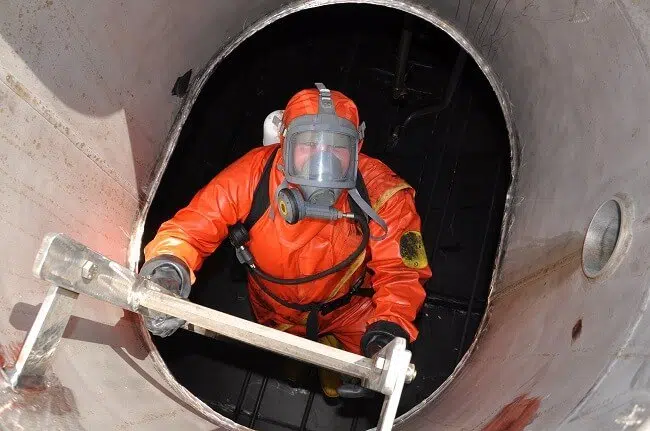
- Cylinder pressure to not be less than 80% full
- Keep checking the gauge reading
- If and when the whistle sounds, go to a safe area with plenty of air
- Do not remove the apparatus till in a safe area
After Use
- Press the reset lever and switch OFF
- Press and hold down the button, and remove the demand valve
- Insert finger behind the neck strap and press buckles forward. Pull the mask forward and then up and back over the head
- Close the cylinder valve and remove the facepiece
- Unbuckle the waist belt. Remove equipment when the shoulder straps loosen
Routine check and maintenance
The SCBA sets must be checked routinely and maintained to keep them in working order at all times. Check the backplate and the shoulder/waist straps for any damage, and keep these straps and belts fully stretched.
Check the facemask straps and other rubber parts for any deterioration. Wipe the mask with a mild disinfectant and rinse under running water. Wipe dry, always. Perform pre-use checks after every maintenance.
Alarm Testing
- Open cylinder valve
- The line will be pressurised with 200 bar pressure
- The pressure gauge will indicate that the pressure is 200 bar
- Close the cylinder valve
- Check that the pressure does not drop by 10 bars within a minute
- Open the demand valve, and the pressure will start to reduce from the high-pressure line
- When the pressure is 50-60 bar, the alarm will sound, which indicates that there are only about 10 minutes for escape
The SCBA is a vital piece of equipment that must be given very high importance in terms of maintenance. Whether it be firefighting or entry into enclosed spaces, the SCBA is what comes in handy in such situations.
Visual inspection must be carried out thoroughly every month on these sets. Every year, all the valves, sealing and speech membranes must be checked.
The exhalation disc must be replaced every two years, and every five years, the complete apparatus should be submitted for a full-service check for overhauling.
You might also like to read:
- 16 Fire Fighting Appliances and Preventive Measures Onboard Ships
- 10 Main Personal Protective Equipment (PPE) Used Onboard Ship
- Immersion Suit: Different Types, Anti Exposure Suits, And Thermal Protective Aids
- Introduction to Global Maritime Distress Safety System (GMDSS): What You Must Know
- What is Fire Safety System (FSS) Code on Ships?
Disclaimer :
The information on this website is for general purposes only. While efforts are made to ensure accuracy, we make no warranties of any kind regarding completeness, reliability, or suitability. Any reliance you place on such information is at your own risk. We are not liable for any loss or damage arising from the use of this website.


About Author
Shilavadra Bhattacharjee is a shipbroker with a background in commercial operations after having sailed onboard as a Third Officer. His interests primarily lie in the energy sector, books and travelling.
Related Articles
Disclaimer :
The information on this website is for general purposes only. While efforts are made to ensure accuracy, we make no warranties of any kind regarding completeness, reliability, or suitability. Any reliance you place on such information is at your own risk. We are not liable for any loss or damage arising from the use of this website.
Subscribe To Our Daily Newsletter
By subscribing, you agree to our Privacy Policy you can unsubscribe anytime.


Good day,
My name is Maral I represent (ship supply/construction) company Ural Caspian Service LLP based in Aktau, Kazakhstan
Dear All,
Could you please consider the below and provide your offers asap?
Description Qty Required Comments
Self Contained Breathing Apparatus – 22 min Duration (SCBA – 22 min) complete including vest, hoses, mask, regulator, etc.. 416 Solas-MED Approved
Self Contained Breathing Apparatus – 45 min Duration (SCBA – 45min) complete including vest, hoses, mask, regulator, etc.. 65 Solas-MED Approved
Breathing air compressor for Filling SCBAs 1 With all accessories required for Filling offered SCBAs
Air compressor:
– Mobile. See Mariner 320-E as an example.
– Electric Motor, 400V, 50 Hz
– Charging rate 320 Lt/min or similar rate
Note: The offer must show specs, approval / origin and availability separately.
We are interested for only Buying option at the moment.
Thank you in advance!