
Infographics: Single Stage Deepwell Cargo Pump
Deepwell cargo pumps are electrically driven cargo discharge pumps which are now used in place of Cargo Operated Pump Turbine (COPT) on tanker ships.
These pumps have several advantages including low installation cost, less space requirement, and minimum operating and maintenance costs.
Deepwell cargo pump construction infographics:
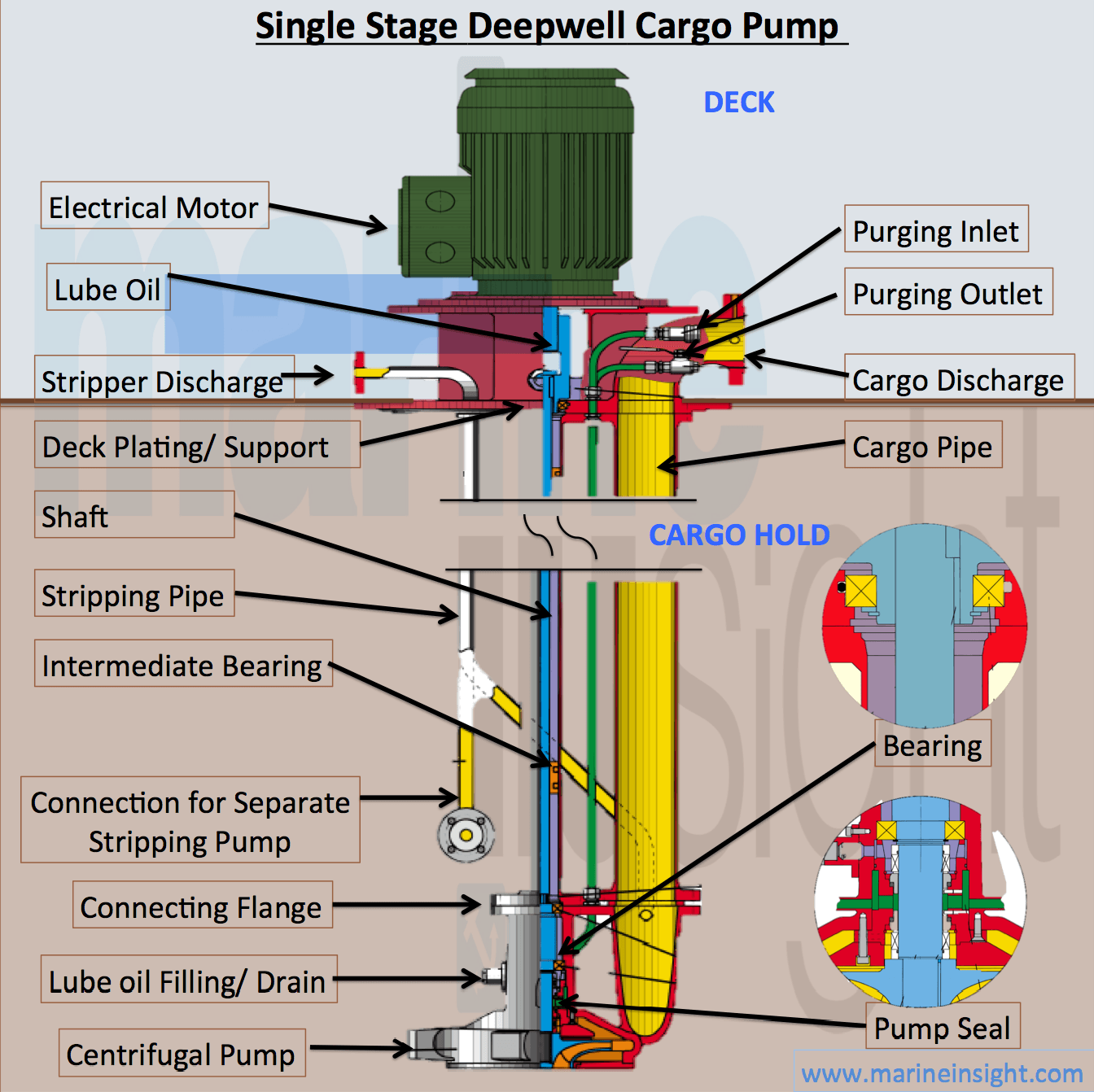
Deepwell pump assembly is installed in two parts- The motor is On deck and the pump is inside the cargo hold. Different parts of this pump are:
1. Electrical motor: The electrical motor is an intrinsically safe, explosion-proof installation in deck provided with speed regulation and frequency controller.
2. Installation: The electrical motor is mounted on lube oil sump installed with purging connections, stripping and cargo discharge connections.
3. Piping column: A piping column is used to carry several pipes (stripping pipe, main cargo pipe, purging pipe, lube oil and shaft etc.) from deck to the cargo tank bottom. If the depth of the hold is more, the piping column is intermediately supported by angles attached to bulkheads.
4. Shaft and Bearings: The electrical motor is attached to pumps via stainless steel shaft. Since the shaft is long, intermediate bearings are placed along with bottom and top bearings inside the pump casing.
5. The Pump: The centrifugal pump is provided with double shaft seal with one shaft seal in contact with cargo/ oil and other with lubrication oil. The two seals are separated by a cofferdam with a purging connection.
6. Purging Connection: Purging connection is to check the condition of shaft seal for leakage of cargo/ oil or lubricating oil. Purging is done by nitrogen or air. Interval of purging depends on cargo or leakage quantity of oil/cargo.
7. Lube oil Trunk: The lube oil is supplied from the sump to the intermediate bearing through a shaft tunnel right to the bottom and top bearings of the deepwell cargo pump.
Want to know about the working of cargo pumps on tankers? Have a look at our premium ebooks:
1. The Ultimate Guide to Cargo Operation Equipment for Tankers
2. The Ultimate Guide to Cargo Operations on Tankers
Note : This is an update to an infographapics we had published earlier. Thanks to our reader Walter Velluci (Marine Superintendent) for letting us know about the error.
Disclaimer :
The information on this website is for general purposes only. While efforts are made to ensure accuracy, we make no warranties of any kind regarding completeness, reliability, or suitability. Any reliance you place on such information is at your own risk. We are not liable for any loss or damage arising from the use of this website.
Related Posts


Disclaimer :
The information on this website is for general purposes only. While efforts are made to ensure accuracy, we make no warranties of any kind regarding completeness, reliability, or suitability. Any reliance you place on such information is at your own risk. We are not liable for any loss or damage arising from the use of this website.
Related Articles

About Author
An ardent sailor and a techie, Anish Wankhede has voyaged on a number of ships as a marine engineer officer. He loves multitasking, networking, and troubleshooting. He is the one behind the unique creativity and aesthetics at Marine Insight.
Subscribe To Our Daily Newsletter
By subscribing, you agree to our Privacy Policy you can unsubscribe anytime.


