
Duties Of Chief Engineer In Merchant Navy

The Chief Engineer in the Merchant Navy heads the engine department of a vessel, and is responsible for all the machinery from the main engine to boilers, pumps, generators and electrical systems. As the most senior officer of the department, the chief engineer is also the leader and mentor of junior officers and engine ratings, offering guidance and advice when needed. This is one of the highest ranks requiring years of sailing experience, management and communication skills. It also comes with big responsibilities and duties, which will be discussed in this article.
How To Become a Chief Engineer?
- Firstly, you must clear Class 12th with atleast 60% in Physics, Chemistry, and Mathematics.
- Then you must go for either B. Tech Marine Engineering, Diploma in Mechanical Engineering or a Graduate in Marine Engineering (GME).
- Secure sponsorship from a reputable shipping company before joining college or during training, to ensure you get placed on board a vessel for training after your studies.
- Complete your course and work on a ship as an engine cadet, learning and getting experience on machinery maintenance, repair, handling fuel, troubleshooting, etc.
- After completion of training, clear the Class 4 CoC, after which you become a 4th Engineer or 3rd Engineer.
- Sailing as a 4th Engineer and then 3rd Engineer, you must pass the MEO Class II exam to receive the MEO Class II CoC. With this and approval from your company, you will be promoted to the rank of 2nd Engineer.
- This rank comes with many responsibilities and prepares you to become a Chief Engineer.
- After 12 months of sea time as a 2nd Engineer, you can go for the MEOClass 1 Preparatory Course and DECGS Course.
- Lastly, clear the Chief Engineer Certificate of Competency (CoC) exam, which includes both a written and an oral test.
- After you clear it, you become a Chief Engineer in the Merchant Navy.
Other Important Requirements
- Sea service on vessels of 750 kW or more is 36 months after class 4 CoC. This must include 12 months as a 2nd Engineer after obtaining MEO Class II.
- The period reduces to 30 months if 12 months are served as Second Engineer on ships of 3000 kW or more.
- Completing Advanced STCW Courses like the DECGS Course, MEO Class 1 Preparatory Course and Refresher Courses (If expired).
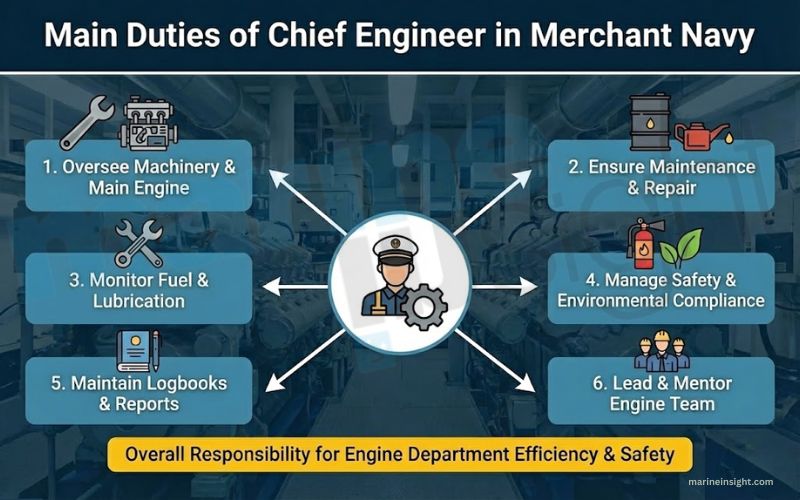

Duties of Chief Engineer in Merchant Navy
The Chief Engineer is an authoritative figure who can decide or even change the work schedule of the junior engineers to suit the requirements and ensure proper rest for all. After consulting with the Captain, he or she can define the duties of additional staff in the engine room. The Chief Engineer must keep the Captain informed of all matters which affect cargo operations, navigation, vessel safety, seaworthiness and the marine environment.
The main duties of the chief engineer include-
- Operating and overseeing the main engine, pumps, generators and other machinery.
- Ensuring the machinery is working properly, is well-maintained, and repaired on time.
- Checking and recording the ship’s fuel consumption levels and lubrication of vital systems.
- Making sure that fire-fighting systems and life-saving equipment are available and in working condition.
- Ensuring compliance with international rules regarding preventing pollution, proper management of onboard waste and controlling harmful emissions.
- Maintaining daily logbooks, records, manuals, inventories, defect lists and reports for reference and transparency.
- Perform monthly checks of engine department logs and records using the ship-specific checklist.
- Leading, guiding and advising the engine team, including the 2nd, 3rd and 4th Engineers.
- Prepare standing orders according to company guidelines and discuss the same with all watchkeeping officers.
- Make appraisal reports for the engine room staff.
- Plan and oversee bunkering operations.
- Advise the captain on bunker consumption, inform about the remaining quantity and the volume of fresh water generated daily.
Now, let us look at some of the responsibilities of the chief engineer in more detail.
Environmental Duties of Chief Engineer
As the designated Environmental Control Officer (ECO) on board, the Chief Engineer is responsible for-
- Implementation of national and international rules regarding environmental protection and the company’s Environmental Management System policies.
- Ensuring the crew is aware of the spill contingency plan.
- Work as an oil spill coordinator, except on oil tankers.
- Maintain the oil record book (Part I – Machinery Space Operations).
- Maintain records in accordance with the company’s requirements for compliance with MARPOL Annex VI.
- Report any issues with pollution prevention equipment to the Office through the Master.


Safety Duties of Chief Engineer
- Ensure the ship has enough fuel before departure from a port.
- Check if there is sufficient inventory of lubricating oil and spare parts for engine room machinery.
- Make sure that the machinery operations are safe, especially when the vessel is arriving at or leaving a port or crossing congested waterways.
- Be present in the engine room during the above mentioned situations, unless needed elsewhere due to any emergencies.
- Ensure statutory and class surveys are done timely.
Duties Regarding Maintenance of Vital Onboard Machinery
- Identify important machinery and ensure its operational readiness.
- Supervise the maintenance of machinery, oily water separator, emergency equipment, ballast water treatment system, refrigeration plants, air conditioning systems and incinerator.
- Ensure compliance with the machinery planned maintenance program and keep updated records.
- Advise the Captain and the Company regarding repairs which might need assistance from the shore.
- Do Class-approved Continuous Machine Surveys (CSM) as per the vessel’s PMS and keep records including pictures, videos and test documents of the same, confirming that it represents the actual condition onboard the ship.
- Immediately inform about any technical issues that lead to non-compliance with any laws.
- Regularly monitor how machinery is functioning to ensure optimum vessel performance.
- Offer technical support to the Chief Officer during cargo operations.
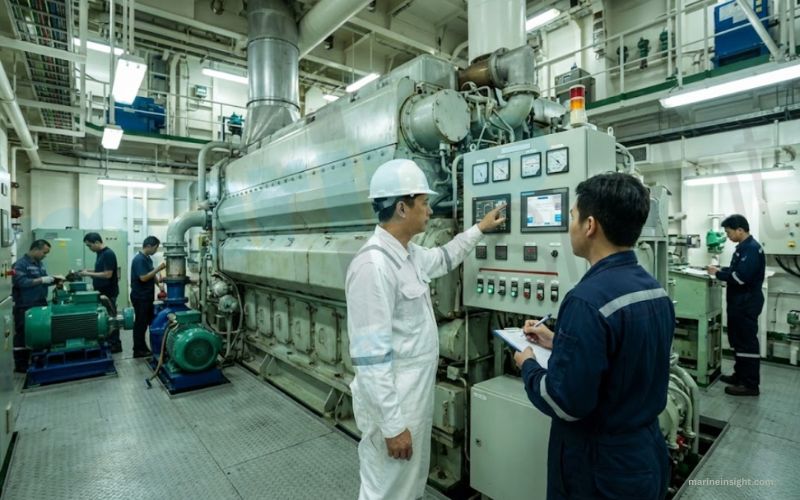

Additional Duties
- Ensure there is no overdue statutory or class survey or overdue maintenance or testing of machinery/equipment.
- There should be no unplanned stoppages, no breakdowns of vital machinery or cargo handling equipment.
- There should be no detention in Port State Control Inspection, no observation in flag state inspection, and no failures in vetting/charterer’s inspection.
- There should be no NC in ISM/ISPS/MLC external audit and no unresolved and unreported disputes, be it any matter.
Salary of Chief Engineer in Merchant Navy
A Chief Engineer’s salary ranges between $7500 to $15000 monthly.
The salary depends on the kind of vessel they work on, as LNG, LPG and tankers pay more than dry cargo carriers or container ships.
It also depends on the shipping company, vessel flags and trade routes, as dangerous international routes command higher pay.
Salaries in India, cited in INR, can range between $8,000 to $18,000+ USD, often touching ₹8 Lakhs to ₹18 Lakhs per month (approx. $9,600 – $21,000 USD) for senior roles.
Salaries in USD based on Vessel Type-
- Container Ships: $7,500 – $11,000/month
- Specialised Vessels (LNG/LPG Tankers): $10,000 – $13,000+/month
- Cruise Ships: $8,000 – $12,000/month
Conclusion
A chief engineer in the merchant navy has many important responsibilities, which, if not shouldered properly, could have disastrous consequences for everyone onboard the vessel. Apart from the required sailing experience, certifications and degrees, a chief engineer should have great problem-solving skills, the ability to lead, support and allow space for engine room staff to express their ideas and concerns.
He or she should be approachable and calm. Lastly, it takes years to become a chief engineer, but if you feel you do not want to continue being one, or opt for a different career, you can find shore jobs in fields including technical superintendence, fleet management, ship building, or surveying.
You might also like to read-
- Procedure for Chief Engineers to Take Over Large Vessels
- Top Reasons for which a 4th Engineer Should Call the Chief Engineer to the Engine Room
- A Chief Engineer’s Concern Regarding Slow Steaming of Ships
- What are the Responsibilities of Chief Engineer Under SOLAS?
Disclaimer :
The information on this website is for general purposes only. While efforts are made to ensure accuracy, we make no warranties of any kind regarding completeness, reliability, or suitability. Any reliance you place on such information is at your own risk. We are not liable for any loss or damage arising from the use of this website.

About Author
Zahra is an SEO-Strategist & a Technical Writer with over 5 years of experience crafting top-tier content for the shipping world. From news, articles, ebooks, blogs and marketing pieces to industry white papers, she has written it all and now brings that experience to her role as Senior Editor. She makes complex maritime stories clear, sharp, and engaging.
Disclaimer :
The information on this website is for general purposes only. While efforts are made to ensure accuracy, we make no warranties of any kind regarding completeness, reliability, or suitability. Any reliance you place on such information is at your own risk. We are not liable for any loss or damage arising from the use of this website.
Related Articles


⚓️ Enhance Your Knowledge. Prevent Accidents. Stay Safe at Sea.
1. eBooks for Engine Department
Master machinery operations, troubleshooting, and safety procedures with expertly written guides tailored for marine engineers. Prevent costly breakdowns and onboard accidents through practical knowledge.
👉 Explore Engine Department eBooks
2. eBooks for Deck Department
Sharpen your seamanship, navigation, and cargo-handling skills with real-world case studies and practical insights designed for deck officers and cadets.
👉Discover Deck Department eBooks
3. eBooks on Electrical Fundamentals & Issues
Understand marine electrical systems, identify potential faults, and prevent onboard electrical failures with step-by-step explanations from industry experts.
4. Pocket Guides for Quick Reference
Compact, handy, and loaded with essential checklists—perfect for on-the-go reference during operations and emergencies at sea.
5. Combo Packs to Save Big
Access multiple expert eBooks at discounted prices. Ideal for professionals seeking complete safety and operational knowledge across various ship departments.
6. Digital Maritime Courses – Learn at Your Own Pace
Upgrade your competence with Marine Insight Academy’s online courses. Learn from industry professionals anytime, anywhere, and become a safer, smarter seafarer.
Subscribe To Our Daily Newsletter
By subscribing, you agree to our Privacy Policy and may receive occasional deal communications; you can unsubscribe anytime.


BE THE FIRST TO COMMENT