
USS Abraham Lincoln Carrier Strike Group Wins US Military’s Highest Valour Award After 40 Days Of Combat Against Iran
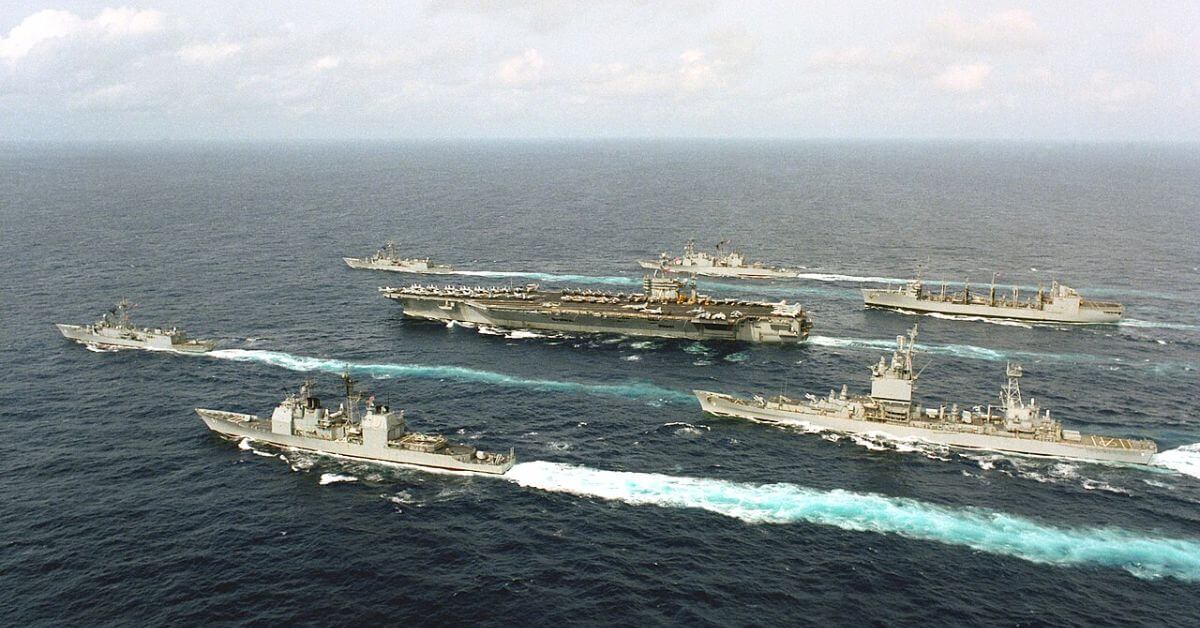
The US Navy carrier strike group led by the USS Abraham Lincoln has received the Presidential Unit Citation, the military’s highest unit-level award for valour, after 40 days of combat operations against Iran.
The aircraft carrier returned to San Diego after spending 321 days away from home.
US Defence Secretary Pete Hegseth announced the award on Wednesday, October 7, after visiting the carrier a day before its planned return. The award recognises the strike group’s role in Operation Epic Fury, the Trump administration’s campaign for the war against Iran.
According to the award citation Hegseth read, the strike group carried out 3,693 combat flights, delivered 1.37 million pounds of ordnance, and launched 450 Tomahawk cruise missiles.
It also shot down 77 one-way attack drones, sank 64 Iranian warships, destroyed 21 anti-ship cruise missiles and defended against four fast attack craft and explosive-carrying vessels.
Hegseth said the strike group began Operation Epic Fury with 60 hours of strike missions without a break. The citation also credited the group with 40 days of combat operations and a maritime blockade against Iran.
The Abraham Lincoln spent 321 days away from home, including 265 consecutive days at sea without a port call. It left Naval Station San Diego in late November, reached the Middle East in January and left the US Central Command area of responsibility in late August.
On its way home, the carrier stopped in Thailand early last month and later made a logistics stop in Guam. The destroyer USS Frank E. Petersen Jr., the first ship from Carrier Strike Group 3 to return, reached Hawaii on September 28 while the Lincoln continued towards California.
The long deployment brought reports of problems with supplies and sailors’ mental health.
In mid-August, Military Times reported that two sailors had attempted to jump overboard while the carrier had been at sea for 265 consecutive days.
On September 22, acting Navy Secretary Hung Cao said eight sailors aboard ships in the Abraham Lincoln carrier strike group had attempted suicide during the deployment. He said none of them had died from the attempts.
The Navy initially played down reports of supply shortages but later acknowledged that combat operations had made it harder to bring supplies to the carrier.
In August, Cao said the ship had enough food, although meal options had temporarily been reduced from two to one. In a letter to a Democratic lawmaker, he said sailors were still receiving four nutritionally balanced meals a day.
Navy officials said combat operations had delayed planned supply shipments. Hygiene products were given priority, and a rotation system was introduced to improve their distribution among squadrons.
Hegseth rejected suggestions that the reports about sailors’ welfare should define the deployment. He said the crew had dealt with the difficulties and completed its mission.
The Abraham Lincoln is the second carrier strike group to receive the Presidential Unit Citation for its deployment during the war with Iran.
The USS Gerald R. Ford strike group received the same award in May after returning from a deployment reported to have lasted 326 to 327 days. That deployment was described as the longest for a US aircraft carrier in the past 50 years and a record in the post-Vietnam War era.
The Presidential Unit Citation is awarded to military units for extraordinary bravery in action against an armed enemy. Past recipients include US Army units involved in the D-Day landings in France during World War Two, Marine units that took part in Pacific island campaigns, special operations forces involved in the 2011 raid that killed Osama bin Laden, and Coast Guard units that responded to Hurricane Katrina.
The USS George Washington, which is normally based in Asia, was sent to replace the Lincoln in the region in August. The USS George H.W. Bush has also been deployed for about six months and recently stopped in Phuket, Thailand.
US officials have said the USS Theodore Roosevelt could join the two carriers in the Middle East as early as the end of October. Thousands of troops aboard the carrier and its accompanying ships could also be part of the deployment.
References: taskandpurpose, indiatoday
Disclaimer :
The information on this website is for general purposes only. While efforts are made to ensure accuracy, we make no warranties of any kind regarding completeness, reliability, or suitability. Any reliance you place on such information is at your own risk. We are not liable for any loss or damage arising from the use of this website.
RELATED POSTS


About Author
Aakriti is a journalist and news writer at Marine Insight, with over three years of experience covering the global shipping and maritime …Read More ->
Disclaimer :
The information on this website is for general purposes only. While efforts are made to ensure accuracy, we make no warranties of any kind regarding completeness, reliability, or suitability. Any reliance you place on such information is at your own risk. We are not liable for any loss or damage arising from the use of this website.
Related Articles
Subscribe To Our Daily Newsletter
By subscribing, you agree to our Privacy Policy you can unsubscribe anytime.


BE THE FIRST TO COMMENT