US Rejects China’s Trespassing Claim As Philippine Military Backs USS Charleston Passage
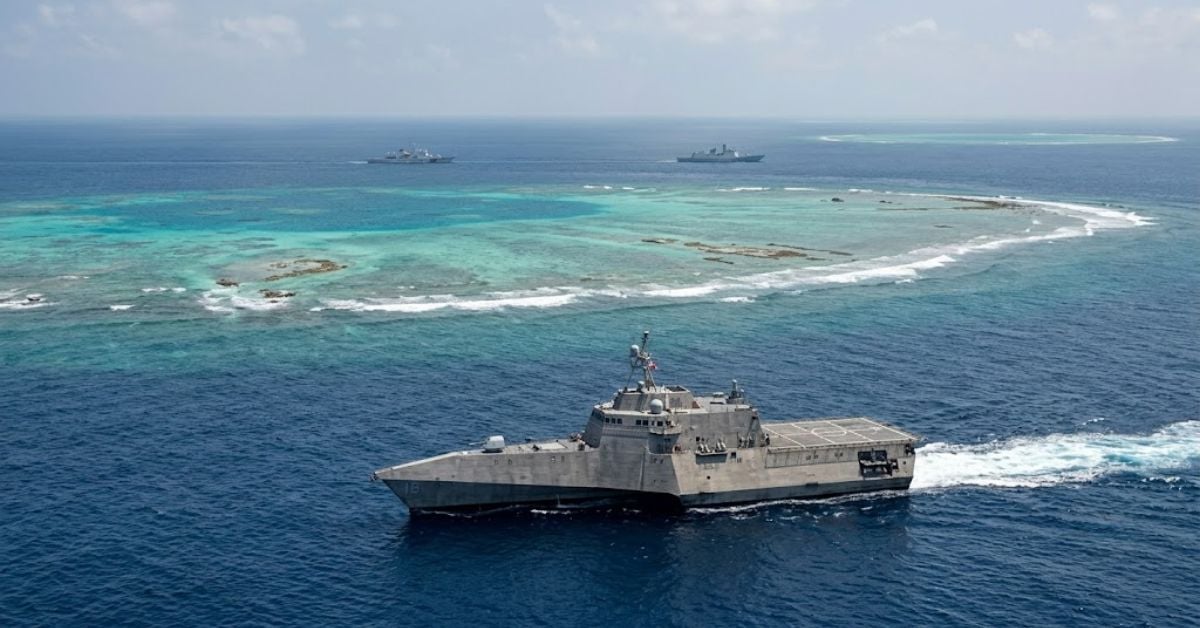
Washington has rejected Beijing’s claim that a U.S. Navy vessel, the USS Charleston, trespassed into its territorial waters and advised the country to stop its illegal activities in the South China Sea. After the U.S. vessel sailed close to the Sabina Shoal, China immediately sent its naval warships to monitor its movements.
The incident was referred to as the U.S. infringement on China’s sovereignty rights and interests by several military officials, to which the U.S. replied that China’s claims were unlawful and not in accordance with international law.
China claims the entire South China Sea as part of its territory, even though its neighbours like the Philippines, Malaysia, Brunei, etc. also assert rights over some islands and shoals close to their respective coasts.
A spokesperson for the U.S. State Department said that the U.S. would fly, sail and operate wherever international law permits, including the South China Sea, as per the right to freedom of navigation, which allows every country to sail its ships in international waters.
United States has urged China to cease its risky and unlawful behaviour in the contested waters and also comply with the treaty obligations and adhere to the 1982 UN Convention on the Law of the Sea.
Additionally, Washington also reminded Beijing about the ruling of the 2016 Arbitral Tribunal ruling in The Hague which said that China’s claims in the South China Sea have no legal basis. The U.S., Philippines and 12 other countries gave a joint statement stating that this decision is final and legally binding on all.
The spokesperson added that China’s maritime claims undermine regional stability and peace, along with the legal rights and freedoms of the U.S. and other neighbouring countries.
However, China follows its own regulations, and in this case its Law on the Territorial Sea and the Contiguous Zone mandates foreign naval ships to get prior permission from the government before entering its territorial waters.
China has argued that the South China Sea does not comprise international waters and that international naval activities within its exclusive economic zone require consent, though this view is rejected by all countries.
Sabina Shoal, which China calls the Xianbin Reef, is a coral formation in the Spratly Islands, about 75 nautical miles west of the island of Palawan, which is under the control of the Philippines. Manila calls it the Escoda Shoal and claims it to be within its 200-nautical-mile Exclusive Economic Zone (EEZ).
RELATED POSTS




Disclaimer :
The information on this website is for general purposes only. While efforts are made to ensure accuracy, we make no warranties of any kind regarding completeness, reliability, or suitability. Any reliance you place on such information is at your own risk. We are not liable for any loss or damage arising from the use of this website.

About Author
Zahra is a maritime writer with 6 years of technical writing experience spanning port operations, offshore wind, oil and gas, and maritime policy. Her analytical edge...Read More ->
Disclaimer :
The information on this website is for general purposes only. While efforts are made to ensure accuracy, we make no warranties of any kind regarding completeness, reliability, or suitability. Any reliance you place on such information is at your own risk. We are not liable for any loss or damage arising from the use of this website.
Subscribe To Our Daily Newsletter
By subscribing, you agree to our Privacy Policy you can unsubscribe anytime.