
US Navy Proposes 15 New Trump- Class Battleships For $275 Billion To Replace DDG(X) Destroyer Program
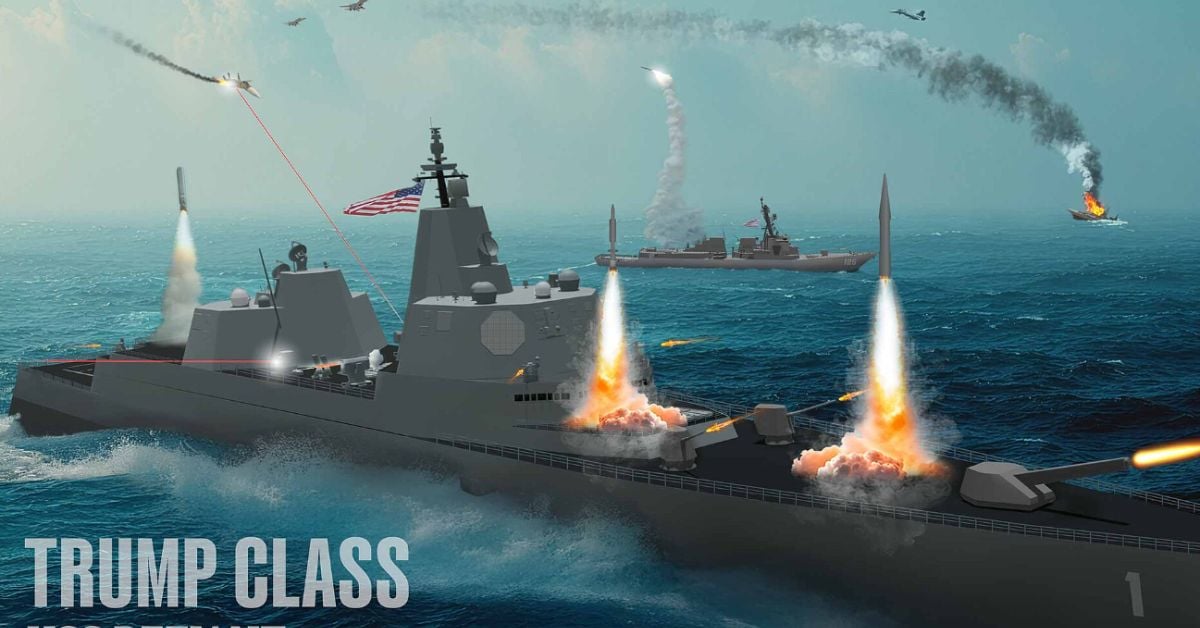
The U.S. Navy is planning to replace the DDG (X) destroyer program and build 15 Trump-class nuclear-powered battleships, each with a displacement of around 35,000 tons, according to a Congressional Budget Office (CBO) review of the Navy’s 2027 shipbuilding plan.
The latest proposal mentions the procurement of larger capital ships fitted with hypersonic missiles, advanced weapons and a nuclear propulsion system.
The first or lead battleship of the Trump-class would be procured in 2028, with an average of roughly one ship every two years through 2056.
The vessel would cost nearly $23.4 billion, with the other 14 expected to be around $18 billion each, bringing the total cost of the 15 ships to an estimated $275 billion, excluding research and development expenditure.
The ships designated BBGN would be one of the largest surface combatants ever built by the U.S. Navy since the Iowa-class.
Given their nuclear endurance, the ships would be perfect for longer missions across the Indo-Pacific waters.
Sources suggest that each ship would be fitted with 128 Mk 41 Vertical Launch System Cells alongside 12 Conventional Prompt Strike Hypersonic Missiles in 4 large launch tubes.
They could also be equipped with high-energy laser weapons in future upgrades, along with a better version of the AN/SPY-6 radar and an electromagnetic railgun.
The Navy is moving towards acquiring fewer but larger and more armed ships. It is also expanding the planned Flight III Arleigh Burke-class destroyer fleet from 23 last year to 57 while also procuring 15 battleships.
The Navy’s 30-year shipbuilding plan envisages growing the fleet from 286 ships to 398 by 2056 by getting 371 new vessels.
However, CBO has said that building these vessels comes with its own challenges. Presently, Newport News Shipbuilding is the only shipyard in America that can build nuclear-powered ships, though there are others as well that can fabricate modules before the final assembly stage.
According to the report, equipping fewer ships with several missiles and weapon systems runs counter to the initial naval effort of distributing weapons across more ships and unmanned platforms.
Another issue is the maturity of technology like railguns and energy-lasers which are being planned for integration on the future battleships.
RELATED POSTS


RELATED POSTS
Disclaimer :
The information on this website is for general purposes only. While efforts are made to ensure accuracy, we make no warranties of any kind regarding completeness, reliability, or suitability. Any reliance you place on such information is at your own risk. We are not liable for any loss or damage arising from the use of this website.

About Author
Zahra is a maritime writer with 6 years of technical writing experience spanning port operations, offshore wind, oil and gas, and maritime policy. Her analytical edge...Read More ->
Disclaimer :
The information on this website is for general purposes only. While efforts are made to ensure accuracy, we make no warranties of any kind regarding completeness, reliability, or suitability. Any reliance you place on such information is at your own risk. We are not liable for any loss or damage arising from the use of this website.
Subscribe To Our Daily Newsletter
By subscribing, you agree to our Privacy Policy you can unsubscribe anytime.


