
U.S Navy Uses Wall-Climbing Robots That Promise To Inspect Ship Hulls Up To 50 Times Faster
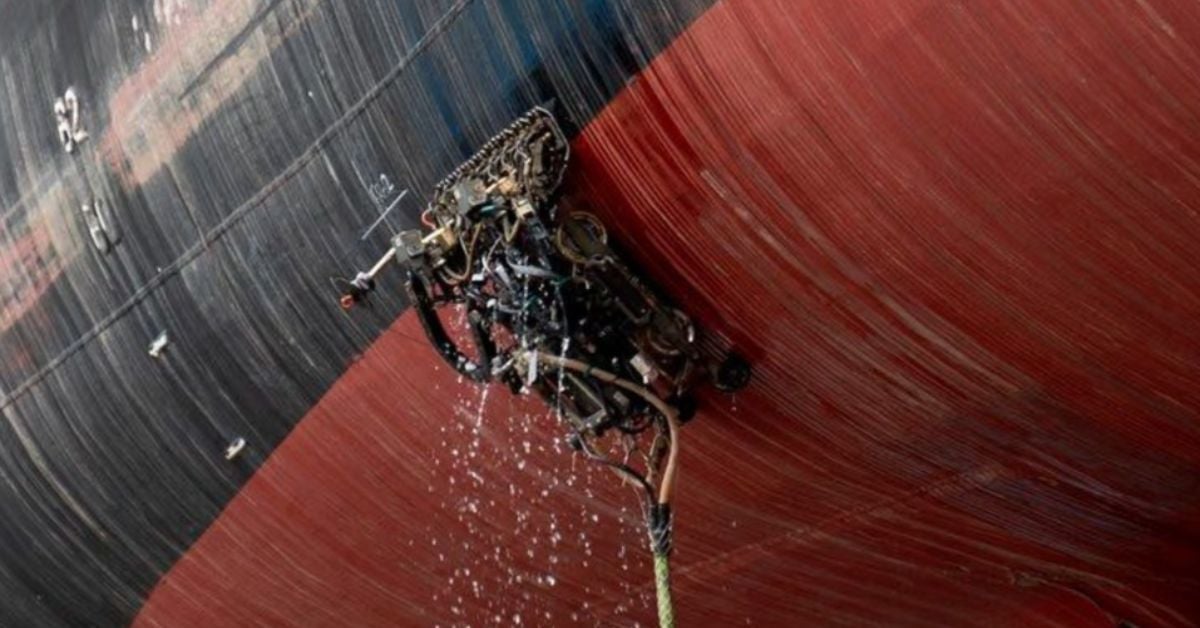
The U.S Navy has signed a $300 million deal with Gecko Robotics to use its AI-powered robots for identifying maintenance and structural issues on its ships.
The company has claimed that the robots can save around $8 million in repair costs per vessel for the navy. This means ships would be able to rejoin service faster than they would if traditional inspection methods were employed.
Gecko Robotics said that the wall-climbing robots can inspect a ship 50 times faster than a human team could.
The robots can identify the most minute cracks and corrosion on the hull while reducing maintenance period from months to just days. They have highly sensitive sensors to collect a vast amount of information.
The company’s Komodo machine system can quickly go through deck coatings through scans without physically digging into them.
This deal is no less than a revolution in naval fleet maintenance as it signals a transformation from slow ship inspections to a system driven by AI which is more accurate than a human ever could be. Not only is it cost effective, it is time-saving as well. Using these robots, the navy plans to achieve its goal of ensuring 80% readiness by 2027.
As of now the Komodo system can be used only when the ship is in a drydock, however the company is also working on a new kind of robot named Axoloti that can operate below the waterline.
This would allow for complete inspections without needing to take the vessel into a dry dock or the Auxiliary Floating Dry Dock Medium (AFDM).
To make the maintenance process faster, the U.S Navy in the past, also used drones and uncrewed surface vessels. However, the Komodo system beat their capabilities.
Usually, workers have to scrape the paint from different parts of the hull to confirm if repairs are required or not, but the Komodo system does not make it necessary to do so.
Without removing the paint, the system can scan the entire surface area, along with the panel, frames and seams to identify the tiniest bit of corrosion or rust.
The system utilises an EMAT or Electromagnetic Acoustic Transducer for this purpose which uses ultrasonic waves. The EMAT can scan through paint, rust and around 150 mm of metal plating, making it far better than the naked eye.
Another advantage is that it can reach places where people or heavy equipment cannot. Every scan is recorded to maintain a log of all the inspection data of a particular ship.
RELATED POSTS


RELATED POSTS
Disclaimer :
The information on this website is for general purposes only. While efforts are made to ensure accuracy, we make no warranties of any kind regarding completeness, reliability, or suitability. Any reliance you place on such information is at your own risk. We are not liable for any loss or damage arising from the use of this website.

About Author
Zahra is a maritime writer with 6 years of technical writing experience spanning port operations, offshore wind, oil and gas, and maritime policy. Her analytical edge...Read More ->
Disclaimer :
The information on this website is for general purposes only. While efforts are made to ensure accuracy, we make no warranties of any kind regarding completeness, reliability, or suitability. Any reliance you place on such information is at your own risk. We are not liable for any loss or damage arising from the use of this website.
Subscribe To Our Daily Newsletter
By subscribing, you agree to our Privacy Policy you can unsubscribe anytime.


