
US Approves License For Texas Deepwater Oil Export Terminal After Six-Year Review

The United States Department of Transportation has approved a licence for Texas GulfLink, LLC to build and operate a deepwater crude oil export terminal off the Texas coast, making it the first such approval under the Trump administration and potentially reviving a licensing process that has remained slow for decades.
The Texas GulfLink terminal will be located about 26.6 nautical miles, or roughly 30 miles, off Brazoria County, Texas.
The offshore facility is designed to export up to one million barrels of crude oil per day and is expected to support around 720 jobs.
Transportation Secretary Sean P. Duffy announced the approval on Tuesday, stating that the project supports the administration’s goal of boosting US oil production and export capacity.
He said faster approvals could help reduce domestic bottlenecks and improve the country’s position in global energy markets.
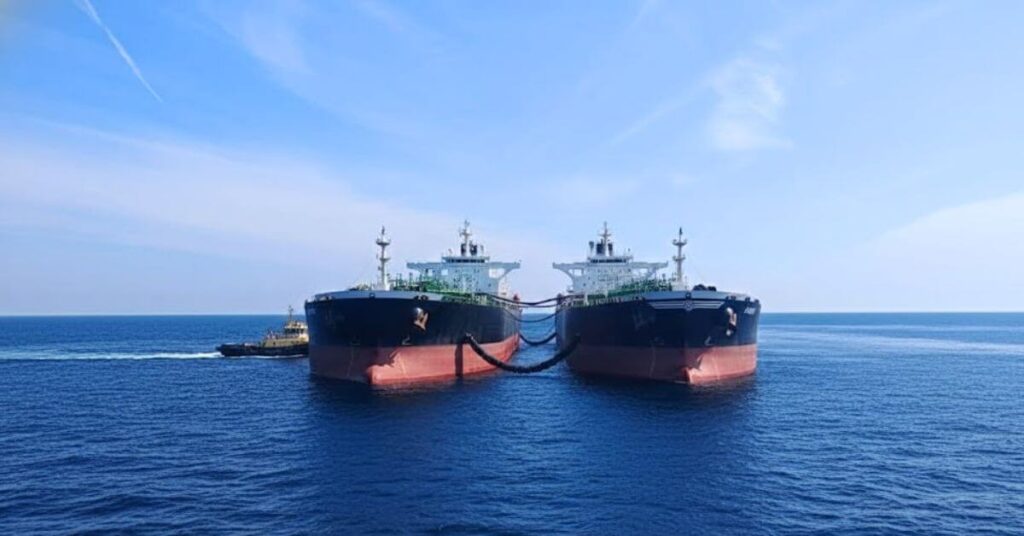
The project is owned and operated by Sentinel Midstream. It includes a fixed offshore platform, around 45 statute miles of pipeline, and infrastructure to berth two very large crude carriers (VLCCs) at single-point mooring buoys, although only one vessel will load at a time.
Sentinel Midstream’s President and Chief Executive Officer, Jeff Ballard, said the approval marked a major milestone for the company after years of work on the project.
The application for Texas GulfLink was first submitted in May 2019 and underwent a six-year review by the US Maritime Administration (MARAD), the US Coast Guard, the State of Texas, and several federal agencies.
In September, the Environmental Protection Agency issued a Clean Air Act permit allowing the use of an offshore support vessel to control volatile organic compound emissions at the proposed terminal.
This is the first deepwater port licence issued since oversight of the programme was shifted earlier this year from the US Coast Guard to MARAD, a change aimed at speeding up approvals that industry participants have long criticised as too slow.
Maritime Administrator Capt. Stephen M. Carmel said the offshore terminal would help ease vessel congestion closer to shore, improve navigational safety, and make crude exports more efficient.
At present, the Louisiana Offshore Oil Port is the only US facility able to fully load supertankers. Other ports face draught restrictions, requiring crude to be transferred offshore using smaller vessels.
The Texas GulfLink project is expected to improve the United States’ ability to load very large crude carriers directly.
Data from the US Energy Department shows exports averaged 4.4 million barrels per day in September, the highest level since February 2024.
However, securing a licence does not guarantee a project will move forward. Enterprise Products Partners recently said its Sea Port Oil Terminal project, which received approval from MARAD in April 2024, has struggled to attract enough commercial interest, partly due to delays caused by the long permitting process.
Texas GulfLink is one of three oil export terminals currently under review by MARAD, alongside several liquefied natural gas projects.
Reference: Reuters
Disclaimer :
The information on this website is for general purposes only. While efforts are made to ensure accuracy, we make no warranties of any kind regarding completeness, reliability, or suitability. Any reliance you place on such information is at your own risk. We are not liable for any loss or damage arising from the use of this website.
Related Posts

Disclaimer :
The information on this website is for general purposes only. While efforts are made to ensure accuracy, we make no warranties of any kind regarding completeness, reliability, or suitability. Any reliance you place on such information is at your own risk. We are not liable for any loss or damage arising from the use of this website.
Related Articles
Latest News


⚓️ Enhance Your Knowledge. Prevent Accidents. Stay Safe at Sea.
1. eBooks for Engine Department
Master machinery operations, troubleshooting, and safety procedures with expertly written guides tailored for marine engineers. Prevent costly breakdowns and onboard accidents through practical knowledge.
👉 Explore Engine Department eBooks
2. eBooks for Deck Department
Sharpen your seamanship, navigation, and cargo-handling skills with real-world case studies and practical insights designed for deck officers and cadets.
👉Discover Deck Department eBooks
3. eBooks on Electrical Fundamentals & Issues
Understand marine electrical systems, identify potential faults, and prevent onboard electrical failures with step-by-step explanations from industry experts.
4. Pocket Guides for Quick Reference
Compact, handy, and loaded with essential checklists—perfect for on-the-go reference during operations and emergencies at sea.
5. Combo Packs to Save Big
Access multiple expert eBooks at discounted prices. Ideal for professionals seeking complete safety and operational knowledge across various ship departments.
6. Digital Maritime Courses – Learn at Your Own Pace
Upgrade your competence with Marine Insight Academy’s online courses. Learn from industry professionals anytime, anywhere, and become a safer, smarter seafarer.
Subscribe To Our Daily Newsletter
By subscribing, you agree to our Privacy Policy and may receive occasional deal communications; you can unsubscribe anytime.


BE THE FIRST TO COMMENT