
Royal Navy’s Largest Aircraft Carrier HMS Queen Elizabeth Conducts Strike Drone Tests In North Atlantic
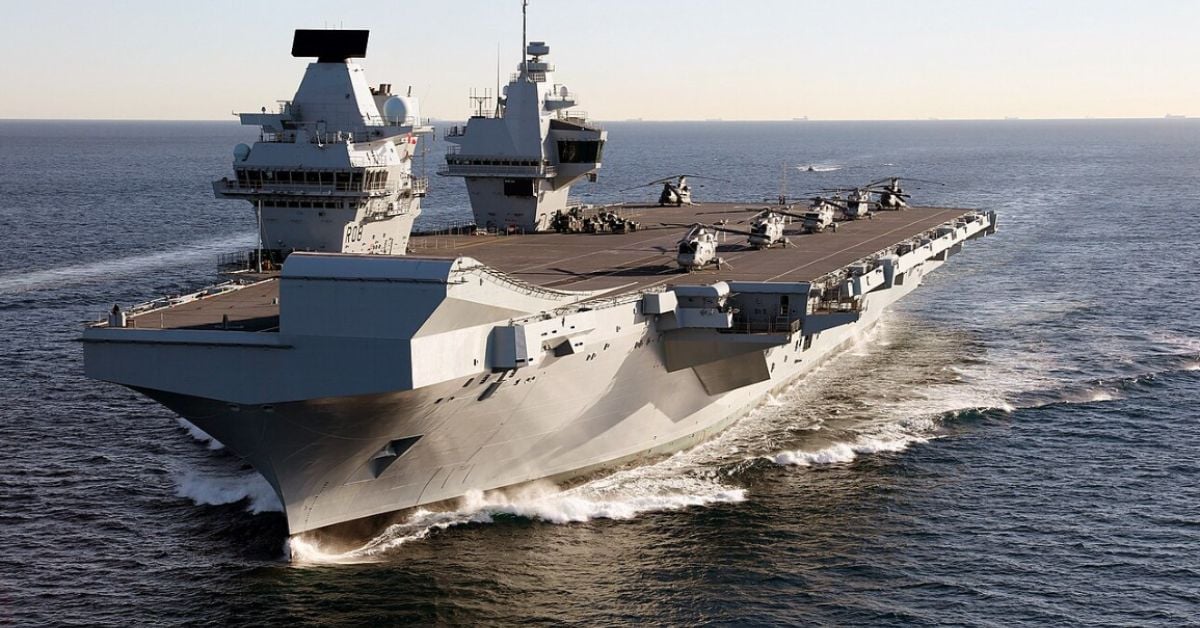
Royal Navy tested Nyan Strike Drone from its Largest Aircraft Carrier, HMS Queen Elizabeth, in the North Atlantic.
The drone was launched from its largest aircraft carrier, giving valuable insight into the integration of unmanned aircraft into maritime operations.
The Nyan One-Way Effector is developed by Callen-Lenz, a subsidiary company of BAE Systems, to deliver precision strikes. The drone completed 4 launches in the North Atlantic Ocean and hit its target in every attempt. The test was vital to test the integration of unmanned systems into the working of carrier strike groups and naval platforms.
It took place during Exercise Neptune Reach B, which was conducted to explore how autonomous unmanned systems could support British naval operations in the high seas.
The task was not easy since it required integration of the drone with the warships’ aviation operations.
The drone has a wingspan of 2.9 m and offers a compact design for maritime operations. It has a one-way configuration, which means it delivers a strike without returning to the launch platform.
Before its test on the HMS Queen Elizabeth, the drone also underwent a trial on the Royal Navy’s experimental ship, the XV Patrick Blackett, earlier this year.
The HMS Queen Elizabeth was also part of the Heavy Lift Challenge 3 Trials, in which a Tekever AR5 fixed-wing drone operated from an aircraft carrier for the first time.
The aircraft is mainly used for logistics purposes, surveillance, reconnaissance, and target acquisition. It has a wingspan of 23 feet and can accommodate payloads weighing up to 17 pounds.
Through these extensive trials, the Royal Navy plans to increase strike assets and reduce dependence on crewed ships.
To coordinate these efforts across the Royal Navy, the Army and the Air Force, Project Vantage has been established. It focuses on the development of such systems for the three wings.
Lieutenant Commander David Burton, the Royal Navy’s capability sponsor, said that the Neptune Reach B offers vital information regarding the operation of future carrier strike groups.
He added that the trials helped determine how to integrate strike drones with maritime task groups and support Britain’s Maritime Aviation Transformation Program.
Matt Foster, CEO of Callen-Lenz, described the capabilities of the Nylan, stating its affordability, and combat mass that would boost military capabilities.
The Navy has not announced any specific date for the deployment of the system. Further evaluations would determine how these aircraft could support carrier strike operations.
BAE Systems also announced that it is developing the drone with a wider range of uncrewed aircraft at the FalconWorks research and technology centre.
RELATED POSTS


Disclaimer :
The information on this website is for general purposes only. While efforts are made to ensure accuracy, we make no warranties of any kind regarding completeness, reliability, or suitability. Any reliance you place on such information is at your own risk. We are not liable for any loss or damage arising from the use of this website.

About Author
Zahra is a maritime writer with 6 years of technical writing experience spanning port operations, offshore wind, oil and gas, and maritime policy. Her analytical edge...Read More ->
Disclaimer :
The information on this website is for general purposes only. While efforts are made to ensure accuracy, we make no warranties of any kind regarding completeness, reliability, or suitability. Any reliance you place on such information is at your own risk. We are not liable for any loss or damage arising from the use of this website.
Subscribe To Our Daily Newsletter
By subscribing, you agree to our Privacy Policy you can unsubscribe anytime.


