
Pakistan’s Hangor Submarine Fires First Anti-Ship Missile In Arabian Sea
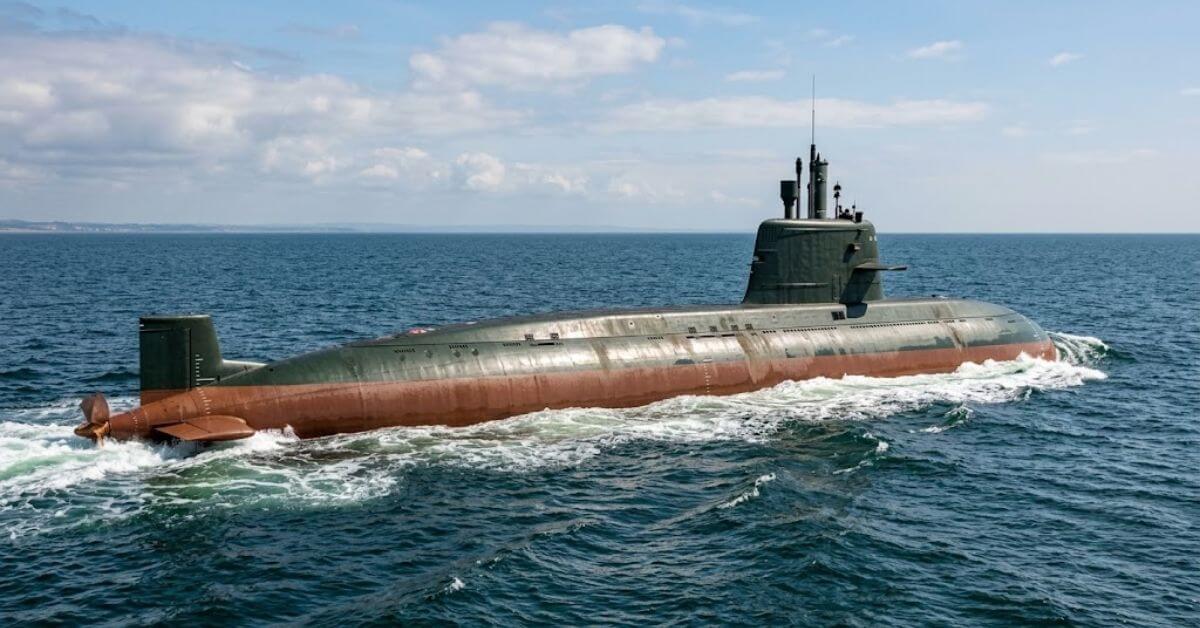
Pakistan’s first Hangor-class submarine has fired an anti-ship cruise missile in the North Arabian Sea, in its first publicly announced live weapon firing since joining the Pakistan Navy earlier this year.
PNS/M Hangor hit a designated long-range target on September 27, Pakistan’s Inter-Services Public Relations (ISPR) said. Chief of the Naval Staff Admiral Naveed Ashraf watched the firing.
Pakistan has not said which missile was used. It has also not given its range, details of the target or the conditions in which the missile was launched. It has not confirmed whether the submarine fired the missile while submerged.
The test is part of Pakistan’s plan to build an eight-boat Hangor-class submarine fleet. The submarines are fitted with modern combat systems and sensors, air-independent propulsion (AIP) and enhanced stealth features.
The firing gives Pakistan a new submarine-based anti-ship capability in the Arabian Sea. The area is important for both Pakistan and India and is part of the shipping network linking the Middle East, South Asia and East Asia.
ISPR said PNS/M Hangor accurately engaged a designated long-range target with an anti-ship cruise missile.
Admiral Ashraf said stronger underwater capabilities were important for Pakistan’s operational readiness and maritime deterrence.
ISPR said the exercise showed the Pakistan Navy’s commitment to maintaining a modern and combat-ready force to protect Pakistan’s maritime frontiers and regional peace.
Prime Minister Shehbaz Sharif also congratulated the navy and its leadership.
Sharif said the successful strike showed the readiness, professional skills and combat capability of the navy’s submarine force. He also said the government remained committed to keeping the armed forces ready to deal with national security challenges.
The firing confirms that Hangor and its crew have completed a live missile engagement against a designated target. It does not, however, show how the submarine would perform against a warship in combat.
An exercise target does not behave like an operational warship. A warship can change course, use countermeasures and operate with other ships, aircraft and helicopters.
The submarine also needs accurate information about a target before launching a missile. It may have to detect the target itself or receive information from another source.
Hangor is the first of eight submarines
The Hangor-class is a Chinese-designed conventional submarine based on the Type 039A/B Yuan family.
Pakistan has ordered eight submarines. Four are being built in China and four are planned to be built in Pakistan at Karachi Shipyard & Engineering Works.
The construction in Pakistan is part of a technology-transfer arrangement.
PNS/M Hangor was commissioned in Sanya, China, on April 30, 2026. It reached Karachi on June 11.
The first submarine was launched in China in April 2024. More boats were launched in 2025.
The submarine is reported to have a displacement of about 2,800 tonnes. It is around 76 metres long and has a beam of about 8.4 metres.
The Hangor-class uses diesel-electric propulsion with air-independent propulsion. The submarines are intended to improve Pakistan’s underwater surveillance, survivability and strike capabilities.
Why AIP is important
AIP allows a conventional submarine to generate power underwater without using atmospheric oxygen for its main power-generation cycle.
A normal diesel-electric submarine uses batteries when underwater. It needs to operate its diesel engines or snorkel to recharge them.
AIP can allow a submarine to stay underwater for longer.
That gives the crew more time to search for targets, move into position and avoid anti-submarine forces.
AIP is one of the main features of the Hangor-class, along with its sensors, combat systems and stealth features.
References: The Print, Business Today
Disclaimer :
The information on this website is for general purposes only. While efforts are made to ensure accuracy, we make no warranties of any kind regarding completeness, reliability, or suitability. Any reliance you place on such information is at your own risk. We are not liable for any loss or damage arising from the use of this website.
RELATED POSTS


About Author
Aakriti is a journalist and news writer at Marine Insight, with over three years of experience covering the global shipping and maritime …Read More ->
Disclaimer :
The information on this website is for general purposes only. While efforts are made to ensure accuracy, we make no warranties of any kind regarding completeness, reliability, or suitability. Any reliance you place on such information is at your own risk. We are not liable for any loss or damage arising from the use of this website.
Related Articles
Subscribe To Our Daily Newsletter
By subscribing, you agree to our Privacy Policy you can unsubscribe anytime.


BE THE FIRST TO COMMENT