North Korea’s Largest Ever Warship Is A 5,000-ton Destroyer With 64 Missile Launchers
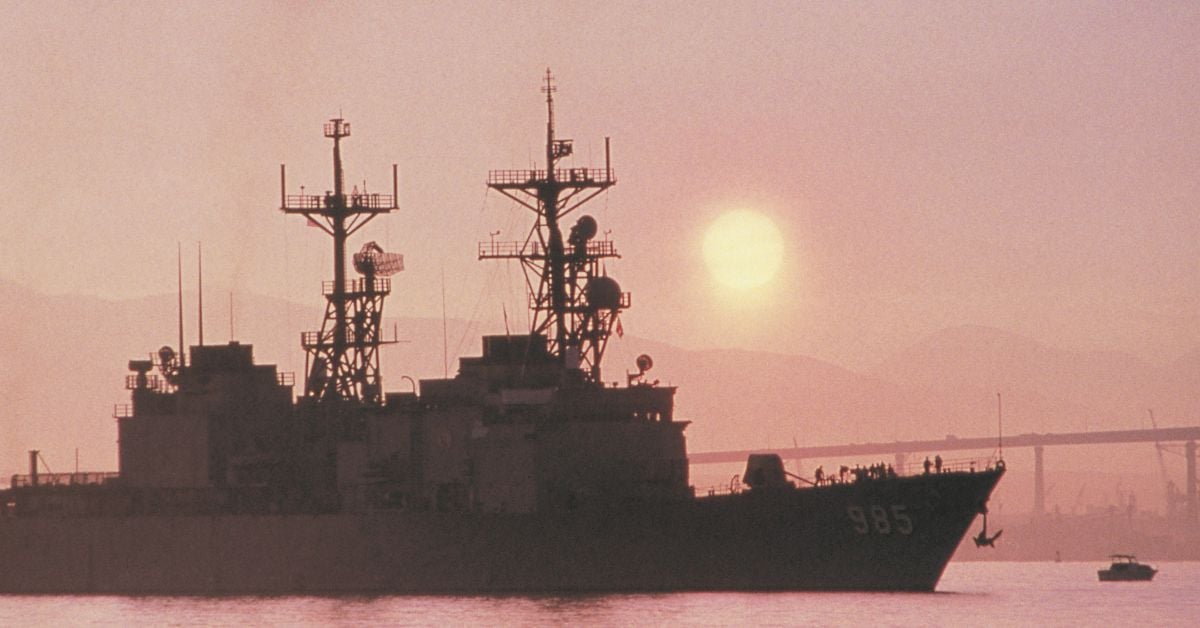
North Korean naval strategy historically focused on defending the immediate coastal waters using torpedo boats, corvettes, and midget submarines.
However, the leader Kim Jong Un has vowed to change this by equipping the country’s navy with bigger and more advanced warships with nuclear weapons to meet the naval capabilities of South Korea and the U.S.
He envisages the new navy to project power beyond its shores and enable stricter maritime control over contested waters where countries like China and Russia have frequently conducted maritime exercises.
To fulfil this ambition, North Korea launched its first large warship, the 5000-ton Choe Hyon, at the port city of Nampho, calling the nuclear arming of the fleet a ‘strategic course’ to keep it combat-ready for ‘multifaceted and efficient operations.’
Choe Hyon is 144 to 145 meters long and has a beam of around 16 meters. While smaller than the U.S. Navy’s Arleigh Burke-class destroyers, which displace 9,000–10,000 tons, or South Korea’s Sejong the Great-class Aegis destroyers at 11,000 tons, it is by far the largest surface combatant ever built by Pyongyang.
North Korea has also said that the Choe Hyon is equipped with some of the most powerful weapons, adding that the naval build-up is necessary as deterrence against Washington and Seoul.
Kim said that the Korean Peninsula is at war and raised concerns about U.S. interference as well, which could drive it to a nuclear war in the near future.
Several defense assessments mention that the vessel has 64 missile launchers; however, the number accounts only for the vertical launch cells in its aft section rather than its total magazine capacity.
Till its final commissioning, the ship’s vertical launch system (VLS) structure was updated from a 74-cell layout, with 44 forward and 30 in the aft section, to a final configuration of 88 VLS cells in small, medium, and large sizes to handle an array of missiles ranging from surface-to-air interceptors to land-attack cruise missiles such as the Hwasal-2 and ballistic missiles capable of carrying nuclear warheads.
Apart from this, the destroyer has a main gun which is a 127 mm or 130 mm stealth-cupola naval cannon. Its anti-surface capabilities are supported by two quadruple canister launchers mounted amidships for anti-ship cruise missiles like the Kumsong-3, alongside 4-cell Bulsae-4 launchers for short-range missiles, loitering munitions and anti-submarine charges.
Layered close-in weapon systems (CIWS) include an integrated Pantsir-ME missile and rotary-gun hybrid system alongside two 30 mm AK-630 multi-barrel cannons.
Sub-surface engagements depend on hull sonar that coordinates with two twin 533 mm DTA-53 torpedo tube installations on the ship’s sides.
The Choe Hyon has an integrated sensor and combat suite with an array radar mounted on the bridge along with three fire-control radars, a main mast Type 362 air or surface search radar, dual navigation sets, IFF antennas and radar electronic support and countermeasure arrays.
The stern has a flight deck for medium helicopters and unmanned aerial vehicles, though it usually operates without an enclosed hangar for aircraft maintenance.
This well-endowed warship is expected to support the enforcement of North Korea’s Two State Doctrine, which defines inter-Korean relations as two different and permanently adversarial nations that cannot reconcile.
At sea, this means disputing the Northern Limit Line (NLL), the de facto maritime border that was established after the 1953 Armistice.
By assigning the vessel to the West Sea or the Yellow Sea fleet, North Korea might use it to deploy gray zone tactics and challenge the NLL without calling for an open conflict with South Korea.
The West Sea does not witness only South Korean Navy ships, but also China’s Coast Guard and regular drills by Beijing and Moscow.
A surface combatant offers Pyongyang diplomatic leverage and deterrence capabilities amidst changing geopolitical conditions, while asserting its maritime claims in the waterbody.
RELATED POSTS


Disclaimer :
The information on this website is for general purposes only. While efforts are made to ensure accuracy, we make no warranties of any kind regarding completeness, reliability, or suitability. Any reliance you place on such information is at your own risk. We are not liable for any loss or damage arising from the use of this website.

About Author
Zahra is a maritime writer with 6 years of technical writing experience spanning port operations, offshore wind, oil and gas, and maritime policy. Her analytical edge...Read More ->
Disclaimer :
The information on this website is for general purposes only. While efforts are made to ensure accuracy, we make no warranties of any kind regarding completeness, reliability, or suitability. Any reliance you place on such information is at your own risk. We are not liable for any loss or damage arising from the use of this website.
Subscribe To Our Daily Newsletter
By subscribing, you agree to our Privacy Policy you can unsubscribe anytime.