
5 Types Of Maritime Insurance
Maritime trade operates in one of the most risk-intensive environments in the world. From unpredictable weather and mechanical failures to cargo damage, pollution incidents, and geopolitical tensions, the financial exposure faced by shipowners and cargo interests is substantial. Maritime insurance exists to manage these risks, providing structured financial protection that enables global shipping to function with confidence.
Outlined below are the principal types of maritime insurance commonly encountered in practice, explained in a structured and accessible manner.

1. Protection and Indemnity (P&I) Insurance
Protection and Indemnity insurance is designed to cover a shipowner’s third-party liabilities arising from the operation of a vessel. Unlike conventional commercial insurance, P&I is typically provided by mutual associations known as P&I Clubs.

This form of insurance addresses liabilities that fall outside physical damage, such as crew injury or death, passenger claims, cargo liability where the carrier is legally responsible, pollution damage, wreck removal, and collision liabilities. Its broad scope reflects the reality that many maritime claims arise from legal responsibility rather than direct physical loss.
2. Hull and Machinery (H&M) Insurance
Hull and Machinery insurance provides cover for physical damage to a vessel itself. This includes damage to the hull, engines, and onboard machinery caused by perils such as collision, grounding, fire, heavy weather, or mechanical failure.
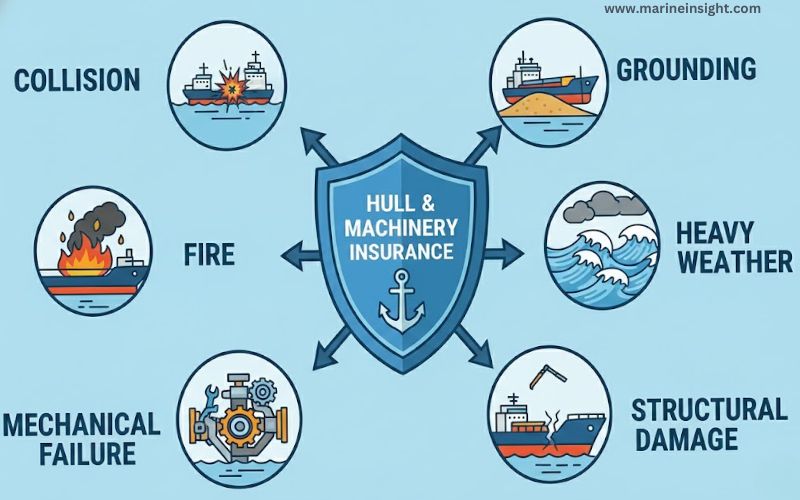
H&M insurance is fundamental for shipowners, financiers, and operators, as it safeguards the asset value of the vessel and ensures repairs can be undertaken without crippling financial impact. However, it does not typically cover liabilities to third parties or pollution, which are addressed under separate policies.
3. War Risk Insurance
Standard marine insurance policies generally exclude losses arising from war-related perils. War Risk insurance fills this gap by covering damage and losses caused by acts of war, terrorism, piracy, civil unrest, and hostile acts.
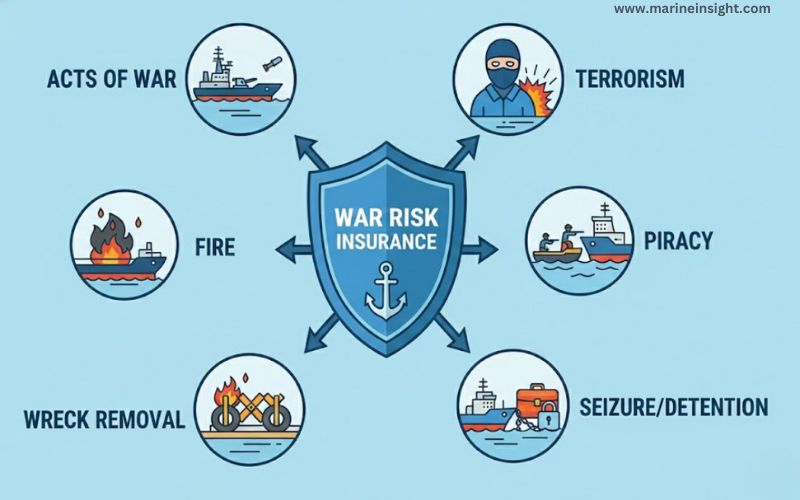
With vessels increasingly operating through high-risk regions, this form of insurance has become particularly relevant. Coverage may extend to physical damage, seizure, detention, and certain ransom-related losses, subject to strict policy conditions and exclusions.
4. Loss of Hire Insurance
Loss of Hire insurance focuses on income rather than physical damage. When a vessel is rendered inoperable due to an insured peril—such as collision, machinery breakdown, or fire—this policy compensates the assured for loss of earnings during the repair period.
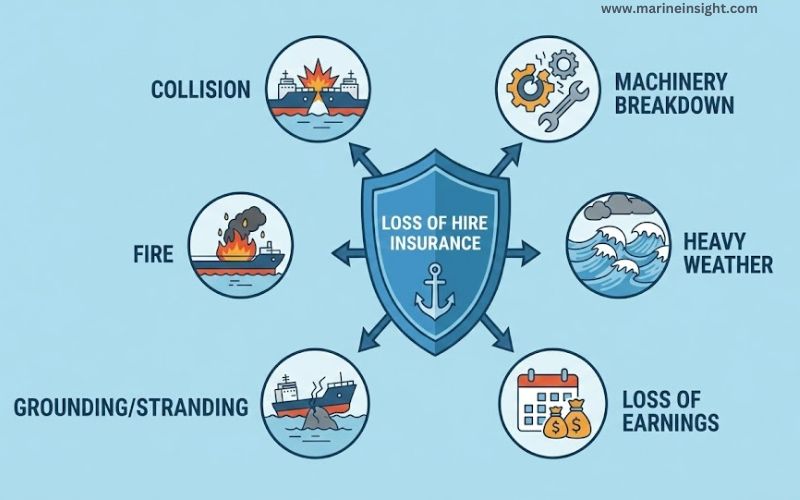
For shipowners operating on time charter or spot markets, loss of hire coverage plays a crucial role in maintaining cash flow when operational disruptions occur.
5. Freight, Demurrage, and Defence (FD&D) Insurance
FD&D insurance covers legal and advisory costs arising from maritime disputes. These may include charter party disagreements, freight and demurrage claims, cargo disputes, or contractual interpretation issues.

Unlike other forms of maritime insurance, FD&D does not indemnify physical loss or liability. Instead, it supports the insured by funding legal representation, arbitration, and settlement negotiations, helping manage the often substantial cost of maritime litigation.
Conclusion
Maritime insurance is not a single, uniform product but a framework of specialised coverages designed to address distinct risks within shipping operations. Understanding how these policies interact is essential for legal professionals, ship operators, and commercial stakeholders involved in maritime trade.
Beyond the insurance types outlined above, there are several other important principles—such as policy exclusions, claims handling, and risk allocation—that shape how maritime insurance operates in practice. These concepts, along with detailed explanations and case-based insights, are explored further in the ebook Maritime Insurance – Beginner’s Guide to Maritime Law Series.
You might also like to read-
- What is Marine Insurance?
- Marine Insurance for Piracy Attacks: Necessities and Benefits
- The Importance of Marine Insurance Brokers
- What is Marine Cargo Insurance and How to Get One?
Disclaimer :
The information on this website is for general purposes only. While efforts are made to ensure accuracy, we make no warranties of any kind regarding completeness, reliability, or suitability. Any reliance you place on such information is at your own risk. We are not liable for any loss or damage arising from the use of this website.
Related Posts


Disclaimer :
The information on this website is for general purposes only. While efforts are made to ensure accuracy, we make no warranties of any kind regarding completeness, reliability, or suitability. Any reliance you place on such information is at your own risk. We are not liable for any loss or damage arising from the use of this website.
Related Articles

About Author
Rishabh Srivastava is a Maritime lawyer dealing in Ship arrests, maritime claims and arbitration in India.
Subscribe To Our Daily Newsletter
By subscribing, you agree to our Privacy Policy you can unsubscribe anytime.


BE THE FIRST TO COMMENT