
World’s First Global Maritime Competition
Immersion Suit – Different Types, Anti Exposure Suits, And Thermal Protective Aids
An immersion suit is a body covering suit worn specifically for flotation and survival during emergencies on high seas. This suit is, therefore, also known as a survival or rescue suit, used during commercial operations. In today’s times, an immersion suit is one of the necessities on ships and oil rigs, considering the protection needed from cold water, rough seas and dangerous situations.
Hence, all sailors, commercial fishermen, and crew members onboard cargo vessels maintain their immersion suits, which offer better visibility and prevent them from drowning. It also provides hypothermia protection and saves from extremities as it is made of waterproof material. Some suits have harnesses and offer ankle adjustments or a better fit.
Immersion suits are generally made of neoprene, a type of rubber that is completely waterproof and can withstand extreme temperatures of water and fire. The immersion suit fits the person’s body without exposing any part to the water. It also has a protective hood to cover the head and comes along with protective gloves. Hence, it provides warmth to the body while its inflatable head pillow and air bladders increase buoyancy.
Maintenance of immersion suits is a must. Regular inspections should be done, and suits must be checked thoroughly for any holes, tears etc. Their inflatable hoses, zipper, straps, mitts and face shield should also be checked. If they had been in salt water, they should have been rinsed with fresh water and left to dry, but not in direct sunlight.
A rescue suit is designed mainly in two colours – red and orange. Both the colours are kept bright (fluorescent) so that the suits can immediately attract the attention of paramedics or rescue aid.
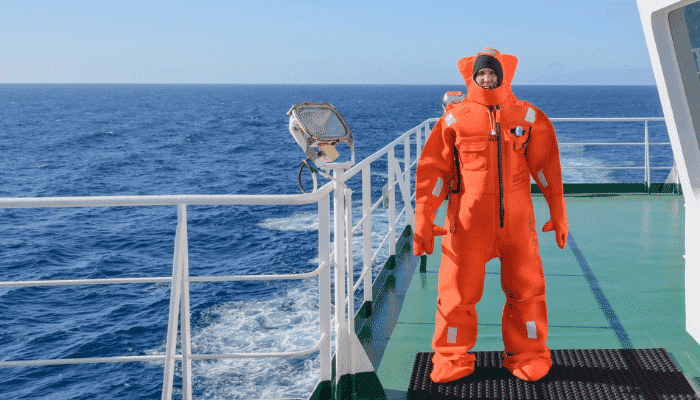
The following are the SOLAS Regulations for Immersion Suits; to know how many immersion suits are present onboard a ship, one should refer to the “fire control and safety plan“:
- Each person on the ship must have an immersion suit. Also, extra immersion suits should be provided for the watchkeepers
- Immersion Suits may be of the kinds that are Insulated, Un-insulated, or wearable with a life jacket (all should have sufficient buoyancy)
- Made of waterproof material
- Internationally RED in colour, which is highly visible. Note that most other LSA equipment is bright ORANGE.
- The immersion suit should be unpacked and donned within 2 minutes without any external help or assistance.
- The individual must jump from a height of at least 4.5 meters into the water without injury to life or damage to the immersion suit.
- The suit should be able to cover the whole body except the face. Hands should be covered unless permanently attached gloves are provided
- Retro-reflective tapes must be fitted.
- It shall not sustain burning or continue to melt after being enveloped in a fire for 2 seconds.
- Everyday work must be able to be carried out upon wearing
- The wearer should be capable of climbing up and down a vertical ladder of at least 5 meters in length
- The wearer must be able to swim a short distance
- The immersion suit is worn in cold weather when the temperature is below freezing.
- The suit does not allow the body temperature to drop by more than 2 degrees when immersed for 6 hours when the water temperature is between 0 and 2 degrees.
- The wearer of the suit, with or without the lifejacket, shall be able to turn from a face-down position to a face-up position in less than 5 seconds.
- If a lifejacket is required along with the immersion suit, it should be worn over it without assistance.
Types of Immersion Suits
There are three types of immersion suits. The main types can be described as follows:
- The first type of survival suit is worn by fishermen who fish in frigid temperatures. These fishermen keep wearing the immersion suit continuously to ensure their bodies do not lose heat and are constantly kept warm and insulated.
- The second type of rescue suit is the one that is kept on all ships, boats and oil rigs. It is a compulsory requirement without which workers cannot be expected to work on the ship or oil rigs.
- The third and final type of immersion suit is known as the Inflatable Immersion Suit. But unlike the two previous immersion suits, this rescue suit does not fully cover the person’s body. The inflated case only covers a person’s hands and legs, thus helping keep the person afloat and safe in emergencies. Because of the compactness of the case, this suit is more accessible to carry and transport than the previous two suits mentioned.
Particular immersion suits are also inbuilt with an emergency torch, a whistle and a tagline that can be attached to the case of the person who is being rescued. This tagline, also known as the buddy line, is provided to ensure that everyone is together and no person gets lost while in the water.
The technology in creating and developing an immersion suit has come a long way. In the days to come, even more advancements will continue to make the application more successful than it is.
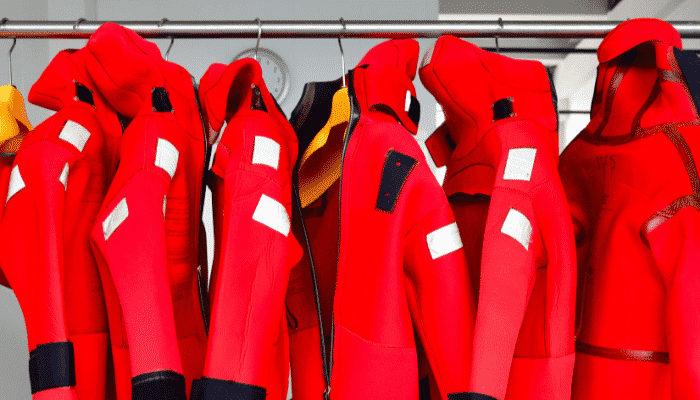
Anti-Exposure Suits
To know the number and location of the anti-exposure suits, refer to the “fire control and safety plan.”
- Made of non-flammable and waterproof material
- International ORANGE in colour, which is highly visible
- The suit should be unpacked and donned within 2 minutes without any external help or assistance
- The suit shall make the wearer capable of jumping from a height of at least 4.5 meters into the water without any injury to life or damage to the suit
- Covers the whole body except the head and hands. Gloves and hood shall be provided for usage with the suit
- Equipped with a pocket to place the handheld VHF transceiver
- It has a lateral field of vision of 120 degrees
- It shall not sustain burning or continue to melt after being enveloped in a fire for 2 seconds.
- Everyday work must be able to be carried out upon wearing
- The wearer should be capable of climbing up and down a vertical ladder of at least 5 meters in length
- The wearer should be able to swim through water for at least 25 meters and board a survival craft
- The suit does not allow the body temperature to drop by more than 1.5 degrees per hour for the first 30 minutes when the water temperature is 5 degrees
- The wearer of the suit, with or without the lifejacket, shall be able to turn from a face-down position to a face-up position in not more than 5 seconds
Thermal Protective Aids
Check the “fire control and safety plan” for the number and location of the TPAs.
- Made of non-flammable and waterproof material
- International ORANGE in a colour that is highly visible
- TPA should have a thermal conductance of not more than 7800 W/m^2.K
- The TPA shall reduce the convective and evaporative heat loss from the wearer’s body
- TPAs should function in air temperatures between -30 to +20 degrees
- The wearer shall be able to remove the TPA in water within 2 minutes if it impairs the wearer’s ability to swim
- It covers everything but the face
- The TPAs should be such that they are unpacked and easily donned without assistance in a survival craft or a rescue boat.
The third mate must ensure regular checks are carried out on this imperative equipment to function as needed under unfortunate circumstances.
Frequently Asked Questions
1. What do immersion suits do?
An immersion suit covers the entire body and is worn by mariners, sailors and commercial fishermen to remain afloat during seas emergencies. Hence, it is also known as a survival suit or rescue suit.
2. How long can you survive in immersion suits?
According to SOLAS/LSA provisions, the immersion suit should meet the given safety and performance requirements, including no more than two minutes of donning time, impact protection of up to 4.5 m and hypothermia protection for 6 hours.
3. What are the types of immersion suits?
Immersion suits are of two kinds, work suits worn by personnel on high seas for longer periods and survival suits worn during times of emergency.
4. How often do immersion suits need to be serviced?
Immersion suits are essential safety equipment and should be maintained well. An immersion suit over ten years of age should be serviced annually at an authorised service station.
5. Do we need a life jacket with an immersion suit?
No, we do not need a life jacket inside an immersion suit. It is designed to be worn without a lifejacket and has a light and whistle, complying with the requirements of life jackets.
You may also like to read:
- How to Buy an Inflatable Life Raft?
- Types of Hulls Used For Vessels
- Types of Life-Saving Equipment Onboard Ships
- Describing Different Parts of SCBA
- Survival at Sea: How to Stay Afloat in Water?
Disclaimer :
The information on this website is for general purposes only. While efforts are made to ensure accuracy, we make no warranties of any kind regarding completeness, reliability, or suitability. Any reliance you place on such information is at your own risk. We are not liable for any loss or damage arising from the use of this website.



Related Articles

About Author
Shilavadra Bhattacharjee is a shipbroker with a background in commercial operations after having sailed onboard as a Third Officer. His interests primarily lie in the energy sector, books and travelling.
Disclaimer :
The information on this website is for general purposes only. While efforts are made to ensure accuracy, we make no warranties of any kind regarding completeness, reliability, or suitability. Any reliance you place on such information is at your own risk. We are not liable for any loss or damage arising from the use of this website.
⚓️ Enhance Your Knowledge. Prevent Accidents. Stay Safe at Sea.
1. eBooks for Engine Department
Master machinery operations, troubleshooting, and safety procedures with expertly written guides tailored for marine engineers. Prevent costly breakdowns and onboard accidents through practical knowledge.
👉 Explore Engine Department eBooks
2. eBooks for Deck Department
Sharpen your seamanship, navigation, and cargo-handling skills with real-world case studies and practical insights designed for deck officers and cadets.
👉Discover Deck Department eBooks
3. eBooks on Electrical Fundamentals & Issues
Understand marine electrical systems, identify potential faults, and prevent onboard electrical failures with step-by-step explanations from industry experts.
4. Pocket Guides for Quick Reference
Compact, handy, and loaded with essential checklists—perfect for on-the-go reference during operations and emergencies at sea.
5. Combo Packs to Save Big
Access multiple expert eBooks at discounted prices. Ideal for professionals seeking complete safety and operational knowledge across various ship departments.
6. Digital Maritime Courses – Learn at Your Own Pace
Upgrade your competence with Marine Insight Academy’s online courses. Learn from industry professionals anytime, anywhere, and become a safer, smarter seafarer.
Subscribe To Our Daily Newsletter
By subscribing, you agree to our Privacy Policy and may receive occasional deal communications; you can unsubscribe anytime.
My business is safety training, would like to add survival and rescue as a of part of my training and this suit is a vital component to that training.