
Indian Navy Seeks Indigenous SATCOM Terminals To Improve Connectivity Between Warships
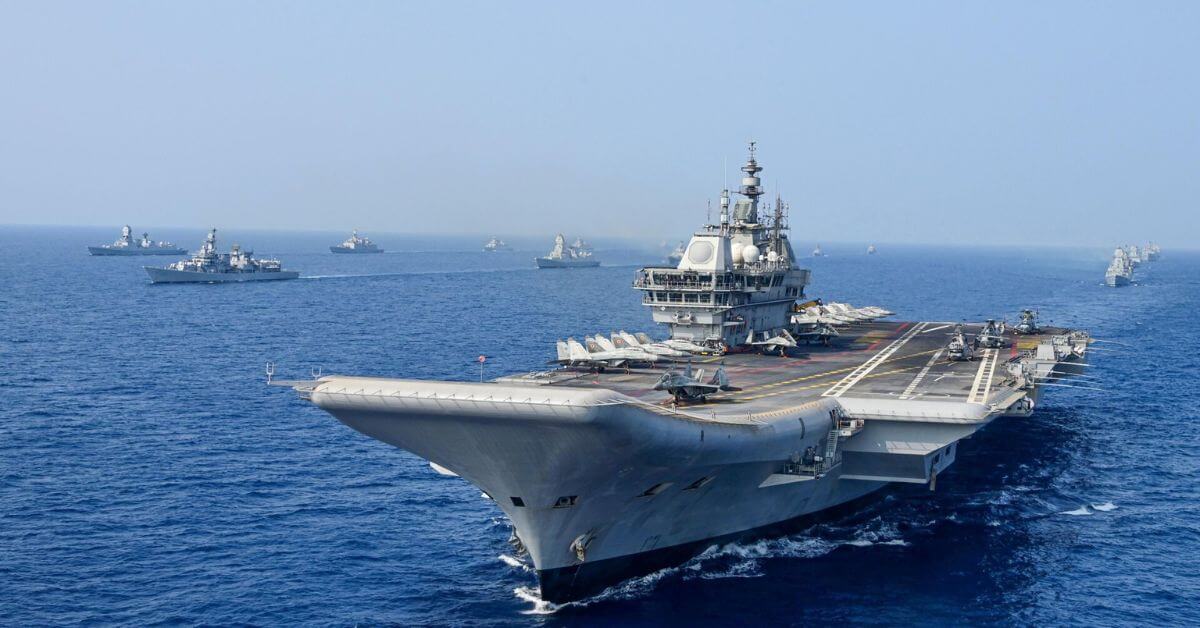
The Indian Navy is looking to develop its own satellite communication terminals for warships as it works to improve secure communications and network-centric warfare.
The Navy has floated an Expression of Interest (EoI) under the Make-II procurement framework for ship-based C-band and Ku-band SATCOM terminals.
The systems will allow warships to maintain secure voice, data and video links while operating thousands of kilometres from shore.
The project will reduce the Navy’s dependence on imported communication equipment. It will start with three prototypes: a large C-band terminal, a large Ku-band terminal and a smaller Ku-band terminal. The Navy could later move to production of around 30 terminals.
The Ministry of Defence’s Department of Defence Production has listed the project as the indigenous development of a Ship Based SATCOM Terminal under the Make-II scheme.
It is also listed under India’s defence-indigenisation framework as a project for ship-based Rukmini SATCOM terminals for the Indian Navy.
Terminals Will Connect Warships to GSAT-7R
The new terminals are being designed to work with GSAT-7R, also known as CMS-03. The satellite was launched on Nov. 2, 2025, aboard ISRO’s LVM3-M5 mission.
GSAT-7R is the Indian Navy’s latest dedicated communications satellite. It is designed to provide secure voice, data and video connectivity across the Indian Ocean Region.
The satellite extends secure communication coverage to roughly 2,000 kilometres across the Indian Ocean Region and supports communications for ships, submarines, aircraft and Maritime Operations Centres.
The new terminals will provide the shipboard connection to this satellite network.
The Navy has used dedicated satellite communications for more than a decade. GSAT-7 Rukmini entered service in 2013 and gave the fleet a secure communications network.
How the Network Works?
Satellite communications allow ships and aircraft operating far apart to share information with each other and with shore-based command centres.
This is important for network-centric warfare. Instead of each platform working on its own, information from one ship or aircraft can be shared across the fleet.
For example, one platform can detect a target and pass the information to another platform that is better placed to engage it. The platform that finds the target does not necessarily have to be the one that attacks it.
The Navy demonstrated this capability during Exercise TROPEX in 2014. About 60 warships and 75 aircraft were connected through the GSAT-7 Rukmini satellite.
The network helped the dispersed fleet share information and showed how one platform could act as the sensor while another acted as the shooter.
The new SATCOM terminals are intended to support this type of network using the newer GSAT-7R satellite.
Navy Wants Three Types of Terminals
The first stage of the programme will involve three terminal designs.
One will be a large C-band terminal. Another will be a large Ku-band terminal, while the third will be a smaller Ku-band system.
C-band and Ku-band systems have different characteristics in areas such as bandwidth, antenna size, atmospheric performance and operation at sea. The different designs will give the Navy options for different platforms and requirements.
If development is successful, the programme could lead to production of around 30 terminals.
Terminals Must Work in Rough Sea Conditions
A satellite terminal on a warship has to keep its connection while the ship is moving.
Ships constantly roll, pitch and yaw at sea. The equipment must also deal with vibration, strong winds, high humidity and salt-laden air.
The Navy therefore wants the new terminals to use fewer mechanical parts wherever possible while still being able to track satellites accurately.
The prototypes will undergo three-axis motion-table trials to recreate the movement of a ship at sea. The tests will check whether the terminals can keep a stable satellite connection during the simulated movement.
The systems will also be evaluated at the Space Applications Centre in Ahmedabad.
Before the terminals can be connected to the Navy’s operational network, they will need mandatory vulnerability assessment clearance.
Indian Companies to Fund Development
The project is being pursued under the Make-II category. Companies taking part will have to bear the full cost of developing the prototypes.
The EoI requires at least 50% indigenous content across the hardware and embedded software.
The project has been reserved for MSMEs for now. Startups and consortiums of up to five members can also participate.
Companies working in satellite communications, radio-frequency electronics, antenna systems, tracking technology, cybersecurity and naval electronics could take part.
Under the Make-II approach, companies fund the prototype development themselves before successful systems move towards procurement.
References: TOI, dharmakshethra
RELATED POSTS


RELATED POSTS
Disclaimer :
The information on this website is for general purposes only. While efforts are made to ensure accuracy, we make no warranties of any kind regarding completeness, reliability, or suitability. Any reliance you place on such information is at your own risk. We are not liable for any loss or damage arising from the use of this website.
Disclaimer :
The information on this website is for general purposes only. While efforts are made to ensure accuracy, we make no warranties of any kind regarding completeness, reliability, or suitability. Any reliance you place on such information is at your own risk. We are not liable for any loss or damage arising from the use of this website.
Related Articles
Subscribe To Our Daily Newsletter
By subscribing, you agree to our Privacy Policy you can unsubscribe anytime.


