
China’s 134.2 Km Long River-To-Sea Pinglu Canal Opens, Offering Trade Shortcut To Southeast Asia
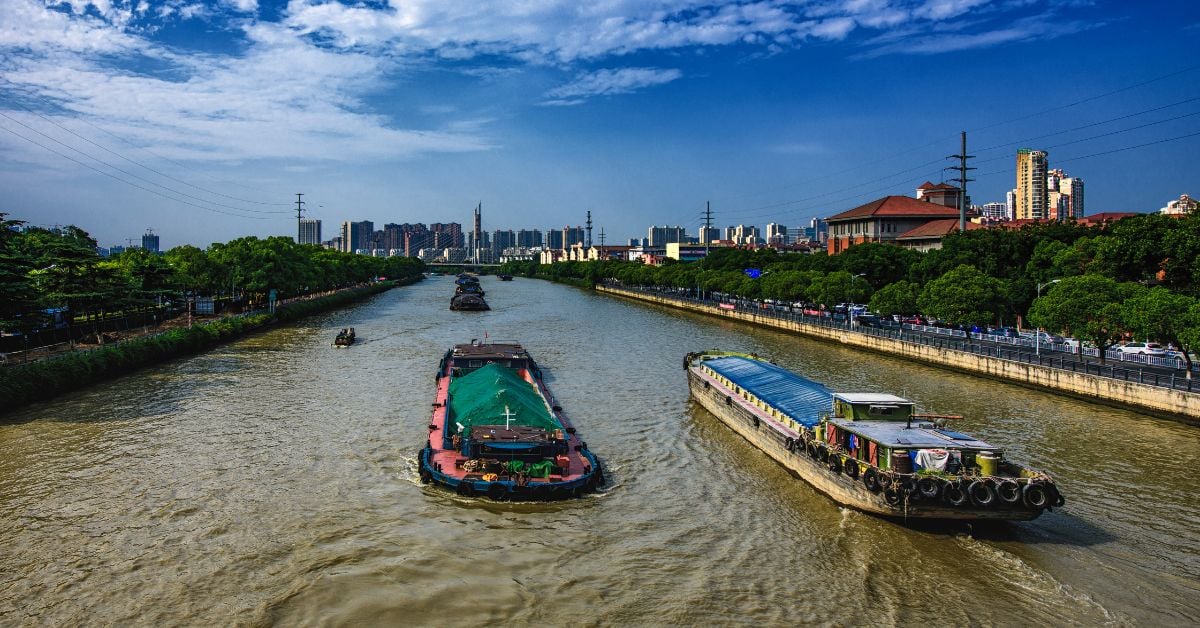
A one-of-a-kind river-to-sea canal, the Pinglu Canal, recently became operational in China, connecting the less prosperous, landlocked regions in the country’s southwest with the international markets through major trade lanes.
It also offers a trade shortcut to the Southeast Asian region as China wants to increase maritime trade with Asian countries, especially the ASEAN nations, which are Beijing’s biggest trade partner as a bloc.
The project began with an investment of 72.7 billion yuan, or 10.8 billion USD. Construction started in 2022 and ended in 4 years. It is the first artificial canal which links a river to the open sea built in China since its founding in 1949.
The 134.2-kilometre-long waterway connects Nanning, which is the capital of Guangxi, to the Gulf of Tonkin or the Beibu Gulf, as it is known in China, enabling cargo from the south and inland regions to reach the sea coast by cutting down an additional 560 kilometres that ships had to sail from Guangzhou.
This would also cut logistics expenses by 18-30%, boost local industries and strengthen inter-regional maritime trade. The canal divides vessel traffic into incoming and outgoing using a tiered navigation system, enabling cargo ships to sail without requiring ship-to-ship transfers.
After the canal became operational on Wednesday, two new trade routes also opened up, one connecting China’s Nanning with Vietnam’s Can Tho while the other is an inland route linking Nanning with Yangpu in China’s Hainan province.
The canal has been designed to handle ships weighing up to five thousand tonnes and would save over 5 billion yuan in total shipping costs annually.
Four new routes for passenger vessels had also been planned, and one of them has opened, according to Chinese news outlets.
On the inaugural day, 30 ships carrying thousands of tonnes of cargo, including construction materials, steel, coal, minerals, fertilisers, etc will sail through the waterway, with Qinzhou and Nanning Ports managing the operations.
The canal became operational after undergoing several tests and inspections. In August, 4 cargo ships weighing up to 5000 tonnes were used to conduct trials along its main channel to check the safety of the locks, service area and the anchorages.
In the same month, a patrol ship also completed its transit test through the Pinglu Canal. A few days later, the canal got its first management ship to handle emergency response and oversee safe navigation practices in the Pinglu Canal.
The ambitious project was also part of a wider effort to develop China’s inland waterways and connect them to other provinces such as Henan, Jiangxi, Hunan and Hubei.
With the canal’s opening, supporting infrastructure has also come up, such as additional berths to handle ships of up to 5000 tonnes at Nanning’s Liujing Operations Area and cross-border railway connections like the China-Laos route.
RELATED POSTS


Disclaimer :
The information on this website is for general purposes only. While efforts are made to ensure accuracy, we make no warranties of any kind regarding completeness, reliability, or suitability. Any reliance you place on such information is at your own risk. We are not liable for any loss or damage arising from the use of this website.
Disclaimer :
The information on this website is for general purposes only. While efforts are made to ensure accuracy, we make no warranties of any kind regarding completeness, reliability, or suitability. Any reliance you place on such information is at your own risk. We are not liable for any loss or damage arising from the use of this website.
Related Articles
Subscribe To Our Daily Newsletter
By subscribing, you agree to our Privacy Policy you can unsubscribe anytime.


