
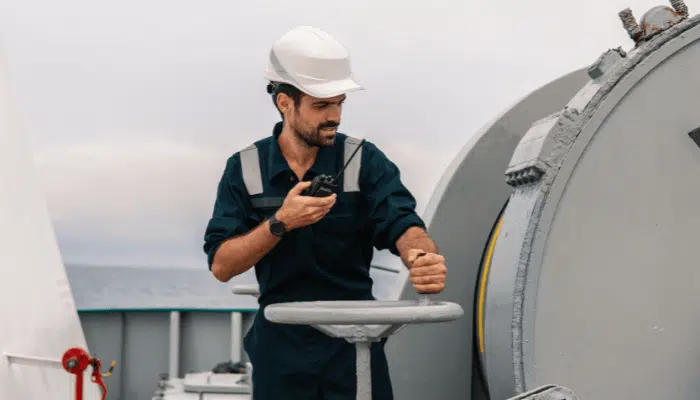
Electro Technical Officer on Ship
Modern Merchant Navy Ships have sophisticated electrical and electronic systems, and the person responsible for ensuring that this equipment works perfectly is the ETO or the Electro Technical Officer. An ETO is engaged in maintenance and repairs of these important onboard systems whenever needed.
The demand for skilled ETOs is on the rise as automation is increasing and the ship systems are becoming more complex, making it a promising career path in the maritime industry. For those interested in machinery and doing something different, this can be an ideal choice, and it offers handsome salary packages as well.
Let us understand everything about ETOs, or Electro Technical Officers, in this article.
Electro Technical Officer/ ETO in Merchant Navy
The ETO or Electro Technical Officer is a part of the merchant vessel’s engine department, according to Section A-III/6 of the STCW (Standards of Training, Certification and Watchkeeping for Seafarers) Code, following the 2010 Manila Amendments.
This replaced the earlier role of Electrical Officer and was done to make electrical engineers competent enough to understand the evolving electrical systems onboard vessels.
An ETO reports to the Chief Engineer and is a part of the senior management team. Unlike marine engineers, ETOs do not carry out the conventional engine room watchkeeping; instead, they work a daily shift and are on call 24 hours a day to handle any electrical or system control failures or malfunctions.

Eligibility for ETO in the Merchant Navy
In order to pursue a career as an ETO, candidates must possess a relevant educational background in engineering, followed by specialised pre-sea training and sea service. Though specific requirements vary by the issuing national maritime authority, like the UK MCA, US Coast Guard, DGS India, etc, the general global prerequisites are mentioned below in this table.
| Criteria | International Requirements (STCW III/6) |
|---|---|
| Academic Qualification | A recognized degree or diploma (typically 3 to 4 years) in a relevant discipline, such as: |
| - Electrical Engineering | |
| - Electronics Engineering | |
| - Electrical and Electronic Engineering (EEE) | |
| - Electronics and Communication/Telecommunication Engineering | |
| Age | Maximum age of 26 to 28 years at the time of course commencement. |
| Pre-Sea Training | Completion of an approved ETO Pre-Sea Training Course. This is a mandatory, full-time residential course typically lasting around 4 months (17 weeks) |
| STCW Basic Training | Completion of all mandatory basic safety courses (Personal Survival Techniques, Fire Fighting, First Aid, PSSR). |
| Sea Service | After the pre-sea course, candidates must complete an approved period of sea service, usually 8 to 12 months, as a Trainee ETO (or Electrical Cadet) documented in an approved Training Record Book. |
| Certification | Passing the national Certificate of Competency (CoC) examination and assessment of competence to be certified as an ETO, enabling service on ships of any propulsion power in any operating area. |
| Medical/Physical | Must pass a stringent medical and eyesight test (including color vision) from a recognized maritime doctor to confirm fitness for sea service. |
Merchant Navy ETO Course Fees
The ETO pre-sea training course is a short and specialised course which lasts for 4 months or 17 weeks. The cost of this residential course depends on the country, the institution, and placement record, sponsorship offerings, etc.
Globally, the course fees, including tuition, mandatory STCW safety courses, accommodation and food, range from $5000 to more than $10,000.
In places having highly competitive private institutions and sponsorships, fees are generally higher, but usually include guaranteed onboard training.
The fees do not include the cost of the initial engineering degree or diploma or the final CoC exam fee.
ETO Job Description
An ETO has to ensure the functional integrity and compliance of all the onboard electrical and electronic systems.
The tasks and responsibilities of an ETO include-
- Operation and maintenance of the main and emergency switchboards, fire detection systems, distribution systems, generators and HV systems.
- Ensuring smooth functioning of all electronic navigation equipment, like the GPS, Radar, ECDIS, radio communication systems (GMDSS), echo sounders, gyro compass, weather Fax, autopilot, Broadcast and internal aerial system, telephone and talk back system and satellite communications.
- Troubleshooting and maintaining control engineering systems, including Programmable Logic Controllers (PLCs), vessel management systems (VMS), and engine room systems.
- Identifying and rectifying electrical and electronic faults which occur on the ship from the propulsion system to the cargo handling gear.
- Developing and carrying out planned maintenance routines for all onboard equipment, motors, batteries and emergency equipment.
- Ensuring all the electrical installations adhere to international maritime regulations and classification society rules.
ETO in Merchant Navy Salary
The salary of an ETO is quite attractive and shows the high level of expertise, skill and knowledge the job demands. The salaries are influenced by the rank, experience and importantly, the vessel type.
| Rank | Experience | Estimated Monthly Salary (USD) |
|---|---|---|
| Trainee ETO / Electrical Cadet | Sea-time Training (8-12 months) | $500 - $1,000 (Stipend) |
| ETO (with CoC) | Entry-Level Officer (Post-CoC) | $4,500 - $6,500 |
| Senior/Chief ETO | Experienced Officer (5+ years) | $7,000 - $9,000+ |
Note: These estimates are based on current trends and can vary significantly. Specialised vessels like LNG carriers or Dynamic Positioning (DP) offshore vessels may offer salaries at the higher end of the range.
Shore Jobs or Future Prospects for ETO
The problem-solving skills and experience gathered by an ETO allow one to transition into high-paying shore-based positions within the engineering, technology and offshore industry.
Major shore career paths for experienced ETOs include:
Technical Superintendent (Electrical): This typically involves managing the electrical and electronic maintenance of a shipping company’s fleet from a shore office, managing dry dock specifications and budgeting.
Maritime Lecturer/Instructor: An ETO’s onboard experience is very valuable and can be beneficial to train future officers at maritime academies or institutions.
Marine Surveyor: ETOs can also work for Port State Control or Classification Societies as electronic systems specialists, performing audits, certifications and inspections.
Automation and Control Engineer/Technician: ETOs can apply shipboard knowledge of PLCs, diagnostics and control loops to industrial automation, power plant operations and smart manufacturing businesses.
Commissioning Engineer: This role requires one to supervise the installation, test, and handover of electrical and electronic systems on new shipbuilding projects at shipyards.
Conclusion
The biggest advantage of this particular option among all maritime jobs is that it is a new field. Since the electrical aspect and IT on vessels have combined recently, not many people have been duly trained to handle them both. With the increasing need for such people, there are immense opportunities for people to make use of their knowledge and skills. Work handled by an electrical officer now needs the expertise of an ETO. Considering that, it seems viable that this option among all marine careers should be seen as a highly lucrative choice by most mariners.
You might also like to read-
- Duties of Electrical Engineer Officer On Board Ship
- What is Electronic Chart Display and Information System (ECDIS)?
- 50 Marine Careers Essential Guide
Disclaimer :
The information on this website is for general purposes only. While efforts are made to ensure accuracy, we make no warranties of any kind regarding completeness, reliability, or suitability. Any reliance you place on such information is at your own risk. We are not liable for any loss or damage arising from the use of this website.

About Author
Karthik, a former navigating officer now turned into a maritime tech innovator focused on advancing the shipping industry through digital transformation. As the co-founder of MarineGPT and a product leader at Marine Insight, he develops AI-driven solutions and tech tools to make knowledge accessible to maritime professionals worldwide.
Disclaimer :
The information on this website is for general purposes only. While efforts are made to ensure accuracy, we make no warranties of any kind regarding completeness, reliability, or suitability. Any reliance you place on such information is at your own risk. We are not liable for any loss or damage arising from the use of this website.
Related Articles


Subscribe To Our Daily Newsletter
By subscribing, you agree to our Privacy Policy you can unsubscribe anytime.


