
Danish Maritime Authority: Less Paperwork On Board Ships
Today, the Danish Maritime Authority publishes a report elucidating which administrative tasks are perceived as burdens by seafarers and Danish shipowners.
The report is part of the Growth Plan for the Blue Denmark and highlights a desire to reduce the amount of paperwork.
The report is based on three surveys focusing on the perception of administrative tasks among Danish and international seafarers as well as Danish shipowners, respectively. The first surveys of the Danish seafarers and shipowners were published in 2012, and they led to a desire to know whether the same experiences were dominant internationally. Consequently, a questionnaire was also carried out among international seafarers.
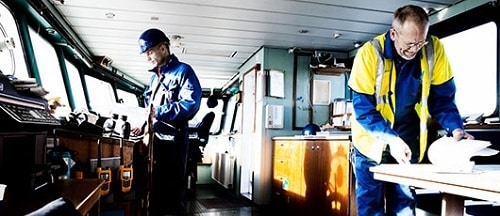
It is the conclusion of the consolidated report that the amount of administrative tasks is decisive rather than the individual task. Danish seafarers have a perception that they spend 20 per cent of their working hours on tasks that do not add value corresponding to the effort made, i.e. administrative burdens. Among Danish shipowners, there is a perception that 9 per cent of the working hours are spent on administrative burdens. 30 per cent of international seafarers feel that they spend too much time on burdens. The survey reveals that Danish and international seafarers do, to a great extent, agree on which tasks are perceived as burdens.
Digitalisation as a solution
The Danish Maritime Authority is already engaged in several initiatives, both nationally and in the International Maritime Organization (IMO), to reduce paperwork.
Director General of the Danish Maritime Authority Andreas Nordseth says:
“Administrative burdens are tiresome and demand considerable resources of both the seafarers and the shipowners. Therefore, we strive to make the administrative tasks easier to carry out. We focus self-service solutions aimed at both the seafarers and the shipowners. It has become easier and faster to acquire certificates of competency and discharge books, and we are still aiming for, inter alia, further digitalisation in order to reduce the administrative burdens.”
Continued focus on reduced administrative burdens internationally
A great part of the administrative burdens originate from international regulation. Therefore, administrative reductions is a Danish key issue in the IMO.
“International regulation is a special challenge. We must not reduce safety, but at the same time we must consider whether we can do things differently. Denmark has contributed to the IMO’s high prioritisation of reduced administrative burdens. We are taking the lead by presenting specific examples showing that it is possible to create improved and more efficient procedures on board the ships and in the companies without impairing safety.”
“In the IMO, Denmark is for example striving for electronic certificates to be recognised on a par with traditional certificates that are signed and stamped,” says Director General Andreas Nordseth.
Reference & Image Credits: dma
RELATED POSTS


RELATED POSTS
Disclaimer :
The information on this website is for general purposes only. While efforts are made to ensure accuracy, we make no warranties of any kind regarding completeness, reliability, or suitability. Any reliance you place on such information is at your own risk. We are not liable for any loss or damage arising from the use of this website.
Disclaimer :
The information on this website is for general purposes only. While efforts are made to ensure accuracy, we make no warranties of any kind regarding completeness, reliability, or suitability. Any reliance you place on such information is at your own risk. We are not liable for any loss or damage arising from the use of this website.
Related Articles
Subscribe To Our Daily Newsletter
By subscribing, you agree to our Privacy Policy you can unsubscribe anytime.


